

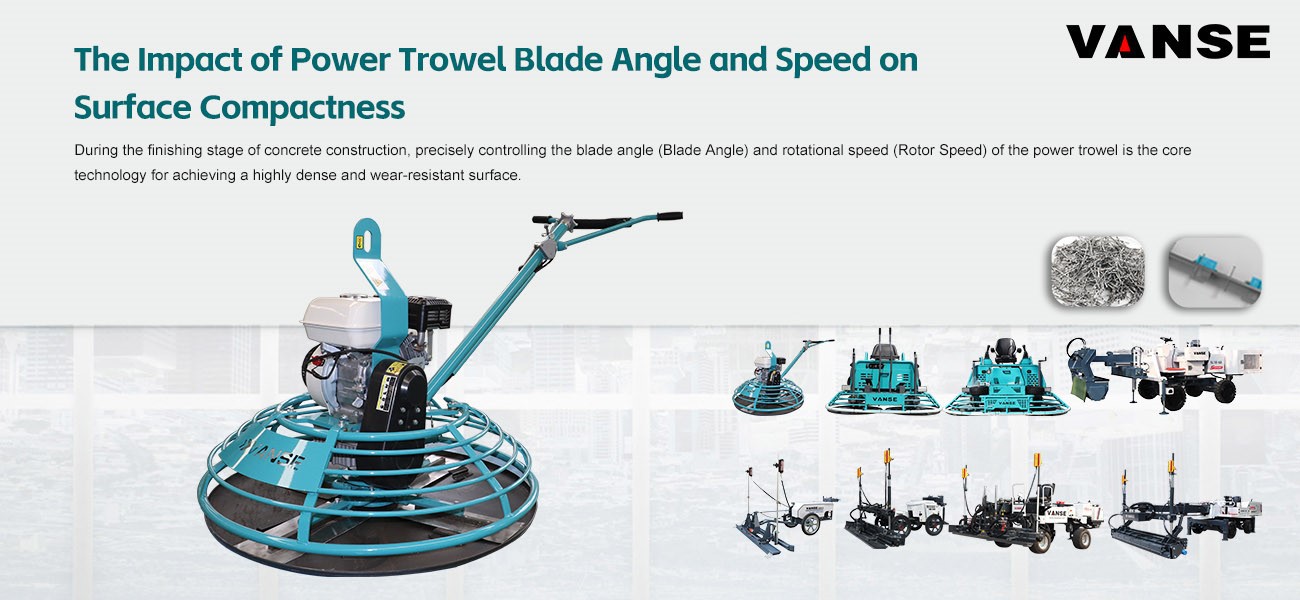
During the finishing stage of concrete construction, precisely controlling the blade angle (Blade Angle) and rotational speed (Rotor Speed) of the power trowel is the core technology for achieving a highly dense and wear-resistant surface.
⚙️ Core mechanism: How do the blade angle and speed affect density
The blade angle (Blade Angle) determines the "pressing force": The physical mechanism is that the smaller the contact area, the greater the pressure. A small angle (such as 0° - 5°) causes the blade to almost lie flat on the ground, used for the initial leveling and slurry removal; as the concrete hardens, the angle needs to be gradually increased (such as 10° - 30°), so that the blade applies high pressure in a "cutting" posture, forcefully closing the capillary pores and squeezing out excess water and air, achieving densification. Studies have shown that correctly setting the blade angle can increase the compressive strength of the concrete surface by up to 15%.
The rotational speed (Rotor Speed) determines the "operation frequency": The logic is the combination of kinetic energy and thermal effect. Low speed (50 - 90 RPM) is used in the initial stage to avoid disturbing the unstable surface; medium-high speed (100 - 150 + RPM) is used in the fine troweling stage, generating micro heat and high-frequency friction, promoting the rapid densification of the surface cement paste, forming a high-gloss "hard shell".
🔧 Vanse Machinery: Equipment and technical support for precise control
Combining with the product knowledge base on Vanse Machinery's official website, the specific practical parameters and equipment support are as follows:
Provide clear practical parameters to put theory into practice:
Coarse scraping stage: Set the blade angle to 10° - 15°, and operate at a low speed (300 - 400 rpm) to remove loose mortar and small protrusions.
Fine scraping stage: Gradually increase the angle to 25° - 30° and increase the speed to a medium-high speed (400 - 600 rpm) to enhance the surface density and gloss. For special requirements such as ultra-smooth floors, the angle can be adjusted to 30° - 45° during the final polishing.
High-speed "polishing" stage: To achieve a "mirror-like" effect, maximize the blade angle (usually 20° - 30°) and speed, generate local heat through high-speed friction, and achieve the physical ultimate densification of the surface.
Precise adjustment strategies for different working conditions:
High-grade/low water-cement ratio concrete (C40 and above): Sets quickly, with a short window period. The initial speed should be introduced earlier, using medium-low speed (approximately 60-80 RPM); during fine troweling, increase to medium-high speed (approximately 90-120 RPM), and gradually increase the blade angle (approximately 5-10°) to implement "cutting-style" polishing.
Concrete containing retarders (summer/ large-scale construction): Sets slowly, requiring patience to build up support force. Initially, use low speed (approximately 50-70 RPM) to steadily scrape the surface; for subsequent polishing, maintain medium-low speed throughout to avoid "waveing" or "skinning" on the surface.
Core adjustment principle: Just as emphasized in the Vanse technical documentation, "Observation is more important than presetting", there are no fixed values for parameters. The only standard is the immediate state of the concrete surface. Construction personnel should follow the principle of "from low speed to high speed, from small angle to large angle", and make dynamic adjustments.
⚠️ Common mistakes and solutions
Too small angle: Leads to insufficient compaction, presence of pores on the surface, and reduced strength.应及时 increase the angle and accelerate the troweling during the fine troweling stage to make up for it.
Too large angle: May scratch the hardened concrete surface or cause the machine to "chatter" and uneven wear. Should immediately reduce the angle and increase the walking speed.
Inconsistent speed: If the initial speed is too fast, it will tear the surface and damage the flatness; if the later speed is too slow, it will result in insufficient compaction and dull luster.
💎 Summary
The blade angle and rotation speed are the core variables for the power trowel machine to achieve a dense concrete surface. By combining the precise staged parameters recommended by the Vanse Machinery website (rough troweling 10°-15°/300-400 RPM, fine troweling 25°-30°/400-600 RPM), and following the dynamic adjustment principle of "observation is more important than presetting", the construction team can effectively improve the construction quality and operational efficiency of the ground project.
For more detailed trowel machine models and operation guidelines, you can directly visit the Vanse Machinery website or contact its technical team via email sales@vanse.cc.
Note: The parameters provided in this document are for reference only and are not mandatory. Due to differences in technical characteristics between different brands and models of laser levelers, please consult the manufacturer for a suitable solution before actual operation. This reference document assumes no responsibility for any issues arising from failure to follow the manufacturer's instructions.
Our factory
Shandong Vanse Machinery Technology Co.,Ltd



Click the below to jump immediately!!!

ARMOUR JOINT

CONCRETE LASER LEVELING MACHINE

POWER TROWEL

SLIPFORM MACHINE

STEEL FIBER

TOPPING SPREADER
Thanks to all the friends who support and trust Shandong Vanse Machinery Technology Co., Ltd.
If you want to know more about Shandong Vanse Machinery Technology Co., Ltd. or have any questions, please feel free to contact us:
• Tel: +86-13639422395
• Email: sales@vanse.cc
• Website: www.vansemac.com