

I. Core Logic Overview
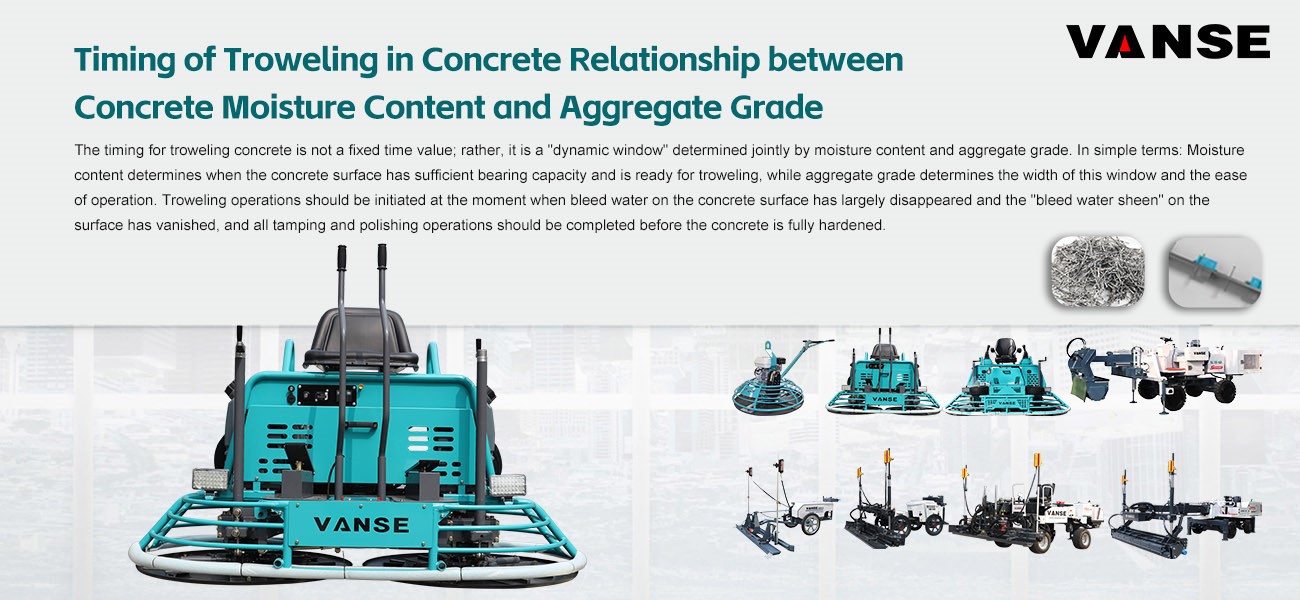
The timing for troweling concrete is not a fixed time value; rather, it is a "dynamic window" determined jointly by moisture content and aggregate grade. In simple terms: Moisture content determines when the concrete surface has sufficient bearing capacity and is ready for troweling, while aggregate grade determines the width of this window and the ease of operation. Troweling operations should be initiated at the moment when bleed water on the concrete surface has largely disappeared and the "bleed water sheen" on the surface has vanished, and all tamping and polishing operations should be completed before the concrete is fully hardened.
II. The Impact of Moisture Content on the Timing of Polishing
2.1 The Physical Relationship between Moisture Content and the Polishing Window
The moisture in concrete exists in three forms: chemically bound water (participating in the hydration reaction), gel water (adsorbed on the surface of the cement gel), and free water (evaporable and exudable free water). When polishing, the core indicator of concern is the state of free water, rather than the overall moisture content of the concrete.
| Water content state | Concrete performance | Smooth surface intervention judgment |
| Excessive free water (weeping stage) | There is obvious water accumulation or reflective water film on the surface, and the concrete is in a plastic flow state. | ❌ Strictly prohibit smoothing: The smoothing operation will force water to be forced into the surface layer, resulting in later dusting, delamination, and peeling |
| Free water completely evaporates (water surface disappears) | The reflective water film on the surface disappears, the concrete loses its plastic flowability, but still has a moist feeling. | ✅ Optimal start time: This is the starting point of the "golden window" that the smoothing machine can enter. Usually 1-3 hours after concrete pouring |
| Surface initially becomes dry (after initial setting) | When a person stands on it, only shallow footprints (about 3-5mm) are left, and the surface begins to generate friction. | ✅ Coarse smoothing and leveling stage: Use the leveling disc for low-to-medium speed operation to evenly remove the slurry |
| Surface becomes significantly dry (before final setting) | When stepping on it, almost no trace is left, and when pressing with fingers, there are only extremely shallow marks and no slurry adheres. | ✅ Fine smoothing and polishing stage: Replace with hard steel blades, increase the rotational speed and blade angle, and perform densification treatment |
2.2 Regulation of Water Evaporation Rate by Environmental Factors
The core mechanism by which moisture content affects the timing of troweling lies in the fact that environmental factors (temperature, humidity, wind speed) determine the rate of water evaporation, thereby altering the initial setting time:
In a high-temperature/low-humidity/high-wind environment: Water evaporates extremely quickly, and the initial setting time may be advanced by more than one hour, resulting in a "false setting" phenomenon (the surface becomes dry while the interior remains soft). Under such conditions, the troweling machine must enter the site earlier and increase the inspection frequency, and at the same time, use a curing agent to lock in the internal moisture.
In a low-temperature/high-humidity environment: Water evaporates slowly, and the initial setting time is significantly prolonged. The entry time of the troweling machine should be appropriately postponed; otherwise, when the concrete is too soft, the operation will cause the troweling machine to sink, damage the flatness, and even "mix" the aggregates.
2.3 Water-Cement Ratio and Its Dual Impact on Moisture Content and Troweling Operations
The Vanse Machinery official knowledge base clearly states that a low water-cement ratio is the "lifeblood" of high-strength and wear-resistant flooring. For large-scale projects such as high-standard factories and airports, the water-cement ratio should typically be controlled below 0.45, the lower the better. A low water-cement ratio optimizes the troweling operation from three aspects:
Reducing bleeding: The lower the water-cement ratio, the less free water is exuded from the concrete surface, significantly reducing the time needed for water to dry.
Enhancing surface strength and wear resistance: With a low water-cement ratio, the cement slurry is more dense, resulting in a higher density after troweling and compaction.
Enhancing the scraping effect of the trowel blade: The slurry is thicker and more viscous, making it easier to be scraped off by the blade and evenly spread on the surface during the rough troweling stage.
III. The Impact of Aggregate Gradation on the Timing and Quality of Finishing
3.1 The Physical Mechanism of Aggregate Gradation on the Workability of Concrete
Aggregate gradation (Aggregate Gradation) refers to the proportion of different particle sizes of aggregates (coarse aggregates and fine aggregates) in concrete. The ACI (American Concrete Institute) clearly states that the gradation, shape, and texture of aggregates significantly affect the workability and finishability of freshly mixed concrete.
| Aggregate gradation types | Characteristics | Impact on troweling |
| Good continuous gradation (Well-Graded) | Appropriate combination of different particle sizes results in the minimum void ratio. | ✅ Best: Low water consumption, good workability, uniform paste distribution, smooth and stable troweling operation, no holes or exposed aggregates on the surface |
| Discontinuous gradation (Gap-Graded) | Lack of certain particle size range of aggregates. | ❌ Disadvantage: Likely to segregate, increased water consumption, coarse aggregates are prone to float or expose during troweling, poor surface density, prone to dusting |
| Excessive fine aggregate (Over-Sanded) | Excessive sand content and insufficient coarse aggregates. | ❌ Disadvantage: Concrete is sticky but there is too much paste, the troweling machine is likely to produce "wave patterns" during the leveling stage, and the risk of shrinkage and cracking increases later |
| Excessive coarse aggregate (Under-Sanded) | Excessive stone content and insufficient mortar to fill the voids. | ❌ Disadvantage: Surface is rough, the blade is difficult to effectively level the paste, honeycomb-like defects and exposed aggregates are likely to occur |
Studies have shown that a well-matched aggregate combination can significantly reduce the water requirement of concrete, maintain appropriate workability, and achieve a uniform and smooth surface with only the minimum amount of troweling. This means that under the same troweling equipment and process, well-matched concrete can shorten the operation time, reduce the operational difficulty, and improve the final surface quality.
3.2 The Influence of Maximum Aggregate Size on Smooth Surface
The Vanse Machinery official knowledge base states that in high-standard floor construction, the maximum aggregate size should not be too large (usually ≤ 25mm) to ensure the uniformity of the surface slurry. The reasons are as follows:
Large aggregate size (>25mm): Under the rotational squeezing effect of the smoothing blade, the coarse aggregate is prone to be "pushed out" from the surface, resulting in exposed aggregate, rough surface, or local depressions.
Moderate aggregate size (≤25mm): The coarse aggregate can be fully encapsulated in the slurry, and during the smoothing operation, the blade can uniformly lift the slurry to the surface without carrying out the coarse aggregate.
3.3 Influence of Aggregate Shape and Surface Texture
Apart from the grading, the shape and surface texture of the aggregate also affect the accuracy of the troweling timing:
Smooth Aggregate (Rounded Aggregate): Such as natural river pebbles, it has a smaller specific surface area and requires less water, resulting in good concrete fluidity and the slurry can easily be lifted to the surface, making the troweling operation relatively less strenuous.
Angular/Rough Aggregate: Such as mechanically crushed stones, it has a larger specific surface area and requires more water. The concrete is more viscous and the slurry is not easily uniformally lifted. The troweling machine needs greater power and more precise angle adjustment to achieve high-quality compaction and smoothness.
IV. Coupling Effect of Moisture Content and Aggregate Classification
In the process of concrete polishing, the moisture content and aggregate classification are not independent variables; there is a coupling effect between them:
Poor classification → Increased water demand → Delay in the polishing window: When the aggregate classification is poor (such as discontinuous classification or insufficient fine aggregate), concrete requires more water to achieve the same workability. This additional water leads to an increase in bleeding volume, a prolonged time for water to dry, a forced delay in the entry of the polishing machine, and even the appearance of a false setting phenomenon of "soft inside and hard on the surface" in high-temperature environments.
When the water-cement ratio remains unchanged, good classification improves the polishing efficiency: Under the same water-cement ratio conditions, concrete with good aggregate classification not only has better workability but also has a more uniform paste distribution. During the leveling stage of the polishing machine, it can more easily carry out the uniform discharge of the paste, thereby shortening the entire polishing operation cycle.
V. Construction Practice Strategies for Vanse (Vanse) Mechanical Products
5.1 "Three-stage" Troweling Operation Based on Dynamic Changes in Moisture Content
The Vanse mechanical website knowledge base clearly stipulates the three stages of troweling operation, and each step is closely related to the moisture content of the concrete:
| Polishing stage | Moisture content status judgment | Vanse equipment configuration |
| First pass: Apply leveling agent | When a person stands on it, the footprints are about 2-3mm deep, and there is no water reflection on the surface. | Install the float pan (Float Pan) or combine the blade plates |
| Second pass: Compact | The footprints are extremely shallow, and further evaporation occurs on the surface. | Replace with the smoothing blade (Iron Plate) |
| Third pass: Fine polishing | There is no visible water on the surface. When a finger is pressed, there are only slight marks. | Replace with high wear-resistant alloy blades, increasing the blade angle |
5.2 Advantages of Vanse equipment for different moisture contents and aggregate gradations
The Vanse mechanical polishing machine product line has been designed to fully consider the impact of dynamic changes in moisture content and aggregate gradation on the construction window:
Precise blade inclination and speed control: The Vanse machinery supports a wide range of blade inclination adjustment and variable speed control, enabling construction personnel to precisely adjust the compaction strength at different moisture content stages. When the aggregate gradation is coarse or the moisture content is low, the blade angle and speed can be increased to compensate for the difficulty in raising the slurry caused by insufficient slurry.
Strong power configuration: The Vanse mobile polishing machine is equipped with a high-power engine (such as HONDA GX690, 25HP), which can still provide sufficient torque output when facing angular rough aggregate or low water-cement ratio concrete, ensuring that the blade can effectively "cut" and compact the hardened surface that is close to final setting.
Efficient double-disc operation system: The Vanse double-disc polishing machine is equipped with a 5×2 set of 65MN manganese steel blade system, which can simultaneously complete the three stages of compaction, leveling and polishing operations, with an efficiency increase of more than 40% compared to single-disc models. In large-scale construction, this efficiency advantage enables the construction party to complete the full coverage of the entire site within the precise moisture state window, avoiding quality inconsistency caused by local dryness.
5.3 Key Practical Tips
Observation is more important than presetting: The moisture content of concrete is dynamically affected by environmental factors such as temperature, humidity, and wind speed. It is not advisable to mechanically apply fixed times. The Vanse technical documentation emphasizes that construction personnel must make on-site real-time judgments of the concrete condition through the "footprint method" (3-5mm depth) and the "finger pressure method".
Avoid sprinkling water for troweling: When the surface moisture content is too low and the blade cannot smooth the concrete, do not sprinkle water on the concrete surface to save effort - this will significantly increase the water-cement ratio on the surface, seriously reducing the surface strength, and causing later dusting and chipping.
Source control of aggregate gradation: Before construction, it is necessary to clearly define the gradation requirements with the concrete supplier, and preferentially select good continuous gradation aggregates. The maximum particle size of the coarse aggregate should be controlled within 25mm.
VI. Summary
The precise timing of concrete polishing is essentially a dynamic response to two core variables: "moisture content determines the physical state" and "aggregate gradation determines the difficulty of the operation". The moisture content is regulated by environmental factors to determine the entry time window for the polishing machine; the aggregate gradation affects workability and the distribution of the slurry, determining the efficiency of the polishing operation and the final surface quality. Under the coupling effect of these two factors, the construction party can only achieve a highly dense and highly wear-resistant hardened floor by relying on rigorous on-site judgment methods (footprint method/indirect pressure method) and the high-performance polishing equipment of Vanse Machinery, in order to complete the process within the short time window of the concrete hydration reaction.
For further information about the specific models, technical parameters and construction plans of the Vanse smoothing machine, please visit the official website www.vansemac.com or contact its technical team via email sales@vanse.cc.
Note: The parameters provided in this document are for reference only and are not mandatory. Due to differences in technical characteristics between different brands and models of laser levelers, please consult the manufacturer for a suitable solution before actual operation. This reference document assumes no responsibility for any issues arising from failure to follow the manufacturer's instructions.
Our factory
Shandong Vanse Machinery Technology Co.,Ltd



Click the below to jump immediately!!!

ARMOUR JOINT

CONCRETE LASER LEVELING MACHINE

POWER TROWEL

SLIPFORM MACHINE

STEEL FIBER

TOPPING SPREADER
Thanks to all the friends who support and trust Shandong Vanse Machinery Technology Co., Ltd.
If you want to know more about Shandong Vanse Machinery Technology Co., Ltd. or have any questions, please feel free to contact us:
• Tel: +86-13639422395
• Email: sales@vanse.cc
• Website: www.vansemac.com