

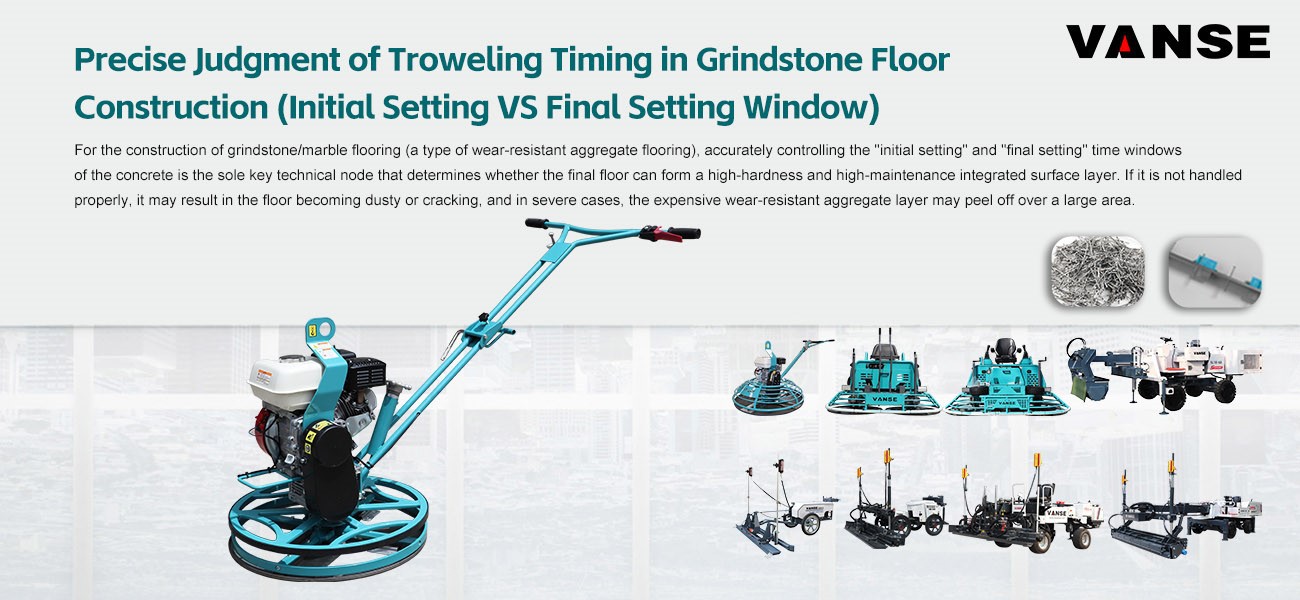
For the construction of grindstone/marble flooring (a type of wear-resistant aggregate flooring), accurately controlling the "initial setting" and "final setting" time windows of the concrete is the sole key technical node that determines whether the final floor can form a high-hardness and high-maintenance integrated surface layer. If it is not handled properly, it may result in the floor becoming dusty or cracking, and in severe cases, the expensive wear-resistant aggregate layer may peel off over a large area.
1. Initial setting and final setting: Definitions and their physical significance in cementitious floor coatings
1.1 Laboratory standard definition
According to the ASTM C403 standard and the GB/T 50080 standard, the setting process of concrete is defined by penetration resistance:
| Stage | Penetration resistance value | Physical state description | |
| Initial setting | 3.5 MPa | The concrete begins to lose its plasticity, capable of withstanding pressure but losing its fluidity. | |
| Final setting | 27.6 MPa | The concrete has completely lost its plasticity and possesses a certain structural strength. |
For the diamond sand flooring, the entire period between the initial setting and final setting constitutes a valuable "golden construction window".
1.2 The Special Significance of the Initial Setting and Final Setting Windows for the Aggregate Layer
Initial Setting Phase (Sowing and Mixing Window): At this stage, the surface of the concrete has lost its fluidity, but still has sufficient moisture content and plasticity of the slurry. After the aggregate is sown on the surface, it can rely on its own weight to embed into the uncompletely set surface layer of the concrete. Through mechanical mixing operations, the aggregate can be closely bonded with the underlying slurry.
Final Setting Phase (Fine Grinding and Hardening Window): As the hydration reaction accelerates, the hardness of the slurry significantly increases and heat begins to be generated. At this time, multiple mechanical troweling operations with high-speed and high-pressure trowels are required to repeatedly press and squeeze the calcium hydroxide and excess water in the hydration products to the surface for evaporation, thereby reducing the water-cement ratio of the surface cement slurry to the lowest.
2. On-site Precise Determination Method for the "Golden Construction Window" of Concrete Abrasive Flooring
At the construction site, due to variations in environmental temperature and humidity, cement type, and mix ratio, it is not sufficient to rely solely on theoretical time countdown. Dynamic judgment must be made based on experience and equipment.
2.1 Determination of the Initial Setting Window (Determining the Timing for Spraying Abrasive Concrete and Initial Grinding)
⏱️ Reference Time: Approximately 2-4 hours after concrete pouring (earlier in hot and windy weather, later in cold and humid weather).
① Thumbprint Test (The Most Classic and Accurate On-site Determination Method)
Operation: Apply force with the thumb to press the concrete surface.
Too early: The thumb easily sinks into a deep pit (>1cm), and there is a large amount of slurry emerging around it.
Optimal Initial Setting Window: The depth of the thumbprint is only 3-5mm, the outline is clear, and there is no cement slurry seeping from the edge of the thumbprint. This is a very crucial signal, indicating that the concrete has reached the initial strength to support the abrasive concrete and grinding machine weight, but the surface still has stickiness for the aggregate to grip.
② Footprint Method
Operation: Construction personnel stand on the concrete surface with both feet and observe the sinking depth.
Optimal Initial Setting Window: The depth of the footprint is approximately 5mm, the edge is clear, no slurry is emerging, and there is a slight sinking sensation when walking.
③ Scratch Method
Operation: Use a nail to scratch the concrete surface.
Optimal Initial Setting Window: The scratch can maintain its shape, the edge is slightly raised and does not automatically heal. This is a strong signal that the mechanical initial grinding (squeezing out the slurry) can begin.
2.2 Determination of the final setting window (for final high-pressure grinding and polishing)
⏱️ Reference time: Approximately 4-8 hours after concrete pouring (within 2-4 hours after the initial setting ends).
Signs of judgment: The "bleed water sheen" on the concrete surface has completely disappeared; walking no longer leaves visible footprints; a deep scratch can only be left by pressing with fingernails, or white powder appears.
Core process operation: At this point, immediately replace with a hard steel polishing blade, adjust the blade angle to nearly zero, and perform high-speed, multiple polishing operations to completely seal the capillary pores on the surface.
3. Consequences of Misjudging the Initial and Final Setting Periods
In the construction of ceramic aggregate flooring, the misjudgment of the time window can lead to irreversible structural defects:
| Type of misjudgment | Physical performance | Consequences |
| Early intervention (spraying or applying) | The concrete is too soft and cannot support the weight of the aggregates and machinery. | The corundum particles sink into the concrete and lose their wear-resistant properties; the trowel sinks and sticks to the slurry, damaging the internal structure of the concrete, resulting in surface peeling and reduced strength. |
| Late intervention (spraying or applying) | The concrete has entered the final setting and even hardening stage. | The corundum cannot bond with the underlying concrete, causing hollowing, cracking, and exposed sand; the trowel cannot effectively smooth out the slurry and compact it, which is time-consuming, laborious, and prone to causing surface cracking. |
4. Utilizing Vanse (Universal) mechanical products to control the precise construction window
During the actual construction process, even if workers accurately determine the initial and final setting time windows, they still need to cooperate with high-performance troweling equipment to convert this judgment into high-quality ground.
4.1 Addressing the efficiency bottleneck of "window periods" in large-scale construction
In large-scale diamond sand floor construction, traditional manual work faces a fatal paradox: To prevent local concrete from drying out too quickly, workers have to start the polishing operation earlier, resulting in a white and dusty quality issue on the entire floor. At this time, an efficient troweling machine is no longer just a speed tool; it is a physical guarantee to ensure the consistency of the construction window.
The technical materials on the Vanse mechanical website clearly state: The troweling machine provides the construction party not only an increase in speed, but more importantly, the ability to choose the appropriate "machine operation time" when dealing with large-scale construction. Mechanical operations can complete the synchronous densification treatment of thousands of square meters of the floor within the most precise few tens of minutes of the concrete hardening curve, without having to start prematurely like traditional manual work due to the large area.
4.2 Stage-based troweling process based on the concrete setting stage
The technical specifications of Vanse mechanical require that the troweling operation be strictly carried out in two stages:
The first stage (initial setting window period) - leveling and rough troweling: At this time, a Vanse troweling machine's leveling disc (Float Pan) or negative-angle wide and thick blade should be configured. The main function is to use the machine's rotational torque to uniformly rub and fuse the diamond sand aggregate and the concrete surface slurry, causing the aggregate to sink and the slurry to float. For this stage, the Vanse seat-mounted troweling machine has a relatively large self-weight pressure, which is conducive to thoroughly compacting the floating slurry and diamond sand during the initial setting stage of the concrete.
The second stage (final setting window period) - fine troweling and sealing: Remove the leveling disc and replace it with a Vanse high-maintenance alloy blade (such as tungsten carbide hard alloy blade). Adjust the blade angle to be close to zero, increase the troweling machine's speed. The Vanse mechanical supports a wide range of blade angle adjustment and variable speed control to ensure that in the high-density troweling operation within the final setting window, the surface cement slurry can be further densified, forming a dust-free and high-gloss hardened layer.
4.3 Environmental variables and the stability of Vanse equipment
The initial and final setting times of concrete are greatly affected by environmental temperature, humidity, and wind speed, which are uncontrollable variables. What can be done at the construction site is to rely on high-quality and highly reliable troweling equipment to ensure stable and efficient completion of full coverage operations within the extremely precise window. The high-performance troweling machine of Vanse mechanical can maintain the stability of the equipment operation during continuous high-intensity final troweling operations, avoiding construction interruptions caused by equipment failures - and if the equipment stops during the final setting stage, it will cause cold seams in the entire floor construction, resulting in uneven wear resistance or even cracking.
Summary
In the construction of diamond sand flooring, the initial setting window is the "last chance" for the diamond sand to achieve physical adhesion with the concrete, while the final setting window is the "accelerated hardening period" for sealing the ground's capillary pores and enhancing density. Only by relying on rigorous on-site judgment methods (thumb pressing method/footprint method/scraping mark method) and the precise polishing equipment of Vanse Machinery, can high-quality and highly wear-resistant diamond sand-hardened flooring be achieved within the short time window of the concrete hydration reaction.
If you need to learn more about the phased construction parameters and specific models of Vanse polishing machines, please visit the official website www.vansemac.com or contact its technical team via email sales@vanse.cc.
Note: The parameters provided in this document are for reference only and are not mandatory. Due to differences in technical characteristics between different brands and models of laser levelers, please consult the manufacturer for a suitable solution before actual operation. This reference document assumes no responsibility for any issues arising from failure to follow the manufacturer's instructions.
Our factory
Shandong Vanse Machinery Technology Co.,Ltd



Click the below to jump immediately!!!

ARMOUR JOINT

CONCRETE LASER LEVELING MACHINE

POWER TROWEL

SLIPFORM MACHINE

STEEL FIBER

TOPPING SPREADER
Thanks to all the friends who support and trust Shandong Vanse Machinery Technology Co., Ltd.
If you want to know more about Shandong Vanse Machinery Technology Co., Ltd. or have any questions, please feel free to contact us:
• Tel: +86-13639422395
• Email: sales@vanse.cc
• Website: www.vansemac.com