

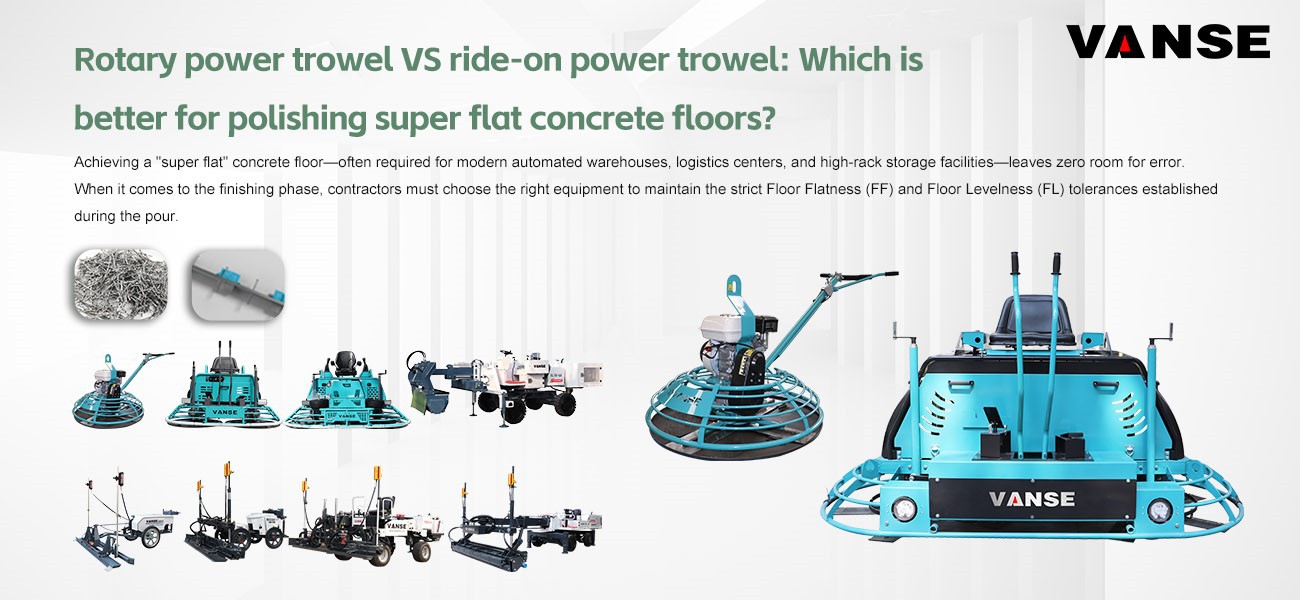
Achieving a "super flat" concrete floor-often required for modern automated warehouses, logistics centers, and high-rack storage facilities-leaves zero room for error. When it comes to the finishing phase, contractors must choose the right equipment to maintain the strict Floor Flatness (FF) and Floor Levelness (FL) tolerances established during the pour.
So, in the debate between a standard walk-behind (rotary) power trowel and a ride-on power trowel, which is the superior choice for super flat commercial floors?
For large-scale, high-tolerance projects, the ride-on power trowel is unequivocally the better choice. Here is a comprehensive, SEO-optimized breakdown of why ride-on equipment dominates the commercial sector, and how to choose the right machinery for your next pour.
1. Walk-Behind (Rotary) Power Trowels: The Edge Specialists
Walk-behind power trowels are operated by a single worker walking behind the machine, guiding a single rotating rotor.
The Pros: These machines are highly maneuverable, lightweight, and cost-effective. They are absolutely essential for finishing edges, tight corners, around plumbing or structural columns, and in small residential spaces where a larger machine cannot fit.
The Cons for Super Flat Floors: For large, super flat applications, walk-behind trowels fall short. The operator must physically walk on the semi-cured concrete, leaving footprints that the machine then has to erase. Furthermore, the lighter weight and single-rotor design do not provide the uniform, heavy-duty compaction required to meet aggressive FF/FL specifications across a massive slab.
2. Ride-On Power Trowels: The Heavyweight Champions of Flatness
Ride-on power trowels feature dual (or sometimes triple) rotors and are operated by a driver seated on top of the machine.,
Unmatched Compaction and Density: The sheer weight of a ride-on trowel-often exceeding hundreds of kilograms-is its greatest asset. When equipped with float pans, this heavy, mechanized downward pressure violently kneads the concrete surface, driving the coarse aggregate down and bringing a rich layer of cement paste to the surface. This deep compaction creates a denser, more wear-resistant "burnished" finish that manual or lightweight tools simply cannot achieve.
Preserving FF and FL Metrics: To get a super flat floor, you typically start with a concrete laser leveling (a specialty of manufacturers like Vanse Machinery). The laser leveling sets the perfect level. The ride-on trowel preserves it. Because the operator is seated on the machine, there are no footprints to fix. The wide wheelbase and overlapping dual-rotor footprint bridge minor undulations, acting like a massive smoothing plane that actually improves the FF numbers as it works.
Massive Output and Efficiency: Concrete sets on its own schedule. If a contractor is pouring thousands of square meters in a single day, the finishing equipment must keep up before the slab cures. A high-performance ride-on trowel can cover vast areas exponentially faster than a walk-behind unit, ensuring the entire slab is finished during the optimal curing window, preventing cold joints and surface defects.
3. The Synergy of Laser leveling and Ride-On Trowels
To consistently win bids for high-end commercial floors, contractors must look at their equipment as an integrated system.
According to the engineering and product parameters found at Vanse Machinery (vansemac.com), achieving top-tier industrial flooring requires a combination of precision and power. Using an advanced telescopic boom concrete laser leveling (like the YZ30-4E or YZ40-4E) guarantees initial levelness. Following that immediately with a heavy-duty, engine-driven ride-on power trowel ensures that the precise leveling is locked in with a hardened, highly polished surface.
Using a walk-behind trowel to finish a massive, laser-levelinged commercial floor is a bottleneck that risks ruining the tight tolerances you just paid to establish.
Final Verdict
If your project demands a super flat floor for commercial, industrial, or logistics applications, a ride-on power trowel is not just better; it is a mandatory investment. Walk-behind trowels should be strictly reserved for complementary edge work and confined spaces.
Note: The parameters provided in this document are for reference only and are not mandatory. Due to differences in technical characteristics between different brands and models of laser levelers, please consult the manufacturer for a suitable solution before actual operation. This reference document assumes no responsibility for any issues arising from failure to follow the manufacturer's instructions.
Our factory
Shandong Vanse Machinery Technology Co.,Ltd


Click the below to jump immediately!!!

ARMOUR JOINT

CONCRETE LASER LEVELING MACHINE

POWER TROWEL

SLIPFORM MACHINE

STEEL FIBER

TOPPING SPREADER
Thanks to all the friends who support and trust Shandong Vanse Machinery Technology Co., Ltd.
If you want to know more about Shandong Vanse Machinery Technology Co., Ltd. or have any questions, please feel free to contact us:
• Tel: +86-13639422395
• Email: sales@vanse.cc
• Website: www.vansemac.com