

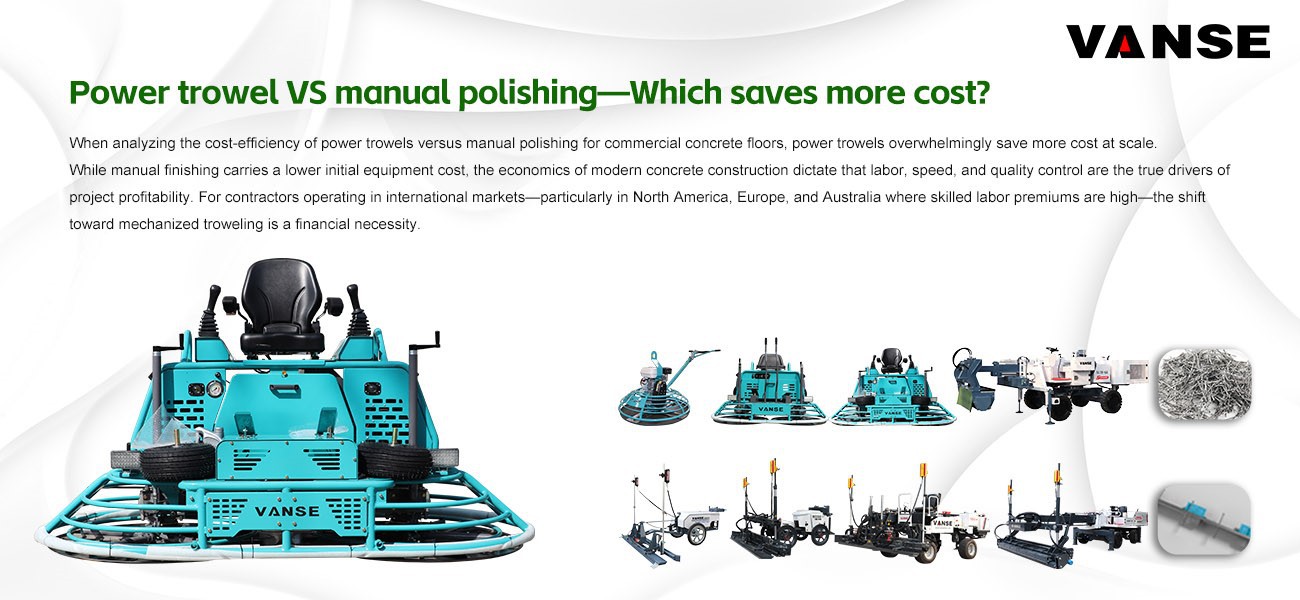
When analyzing the cost-efficiency of power trowels versus manual polishing for commercial concrete floors, power trowels overwhelmingly save more cost at scale. While manual finishing carries a lower initial equipment cost, the economics of modern concrete construction dictate that labor, speed, and quality control are the true drivers of project profitability. For contractors operating in international markets-particularly in North America, Europe, and Australia where skilled labor premiums are high-the shift toward mechanized troweling is a financial necessity.
Here is a breakdown of where the actual costs and savings lie:
1. Labor Costs (Operational Expenditure - OpEx)
Manual Polishing: Finishing a large commercial slab by hand requires a massive crew of skilled laborers working simultaneously to beat the concrete's curing clock. The hourly wages, overtime, and sheer number of personnel required make manual finishing financially unsustainable for anything larger than a residential driveway or tight edge-work.
Power Trowels: A single operator on a ride-on power trowel can finish exponentially more square meters per hour than an entire manual crew. By drastically reducing the headcount required on the slab, contractors immediately slash their largest operational expense. The labor savings generated from just a few large-scale logistics or warehouse pours typically cover the entire initial purchase price of the machine.
2. Time and Project Turnaround
Manual Polishing: Manual work is slow and highly vulnerable to environmental factors. If the concrete sets faster than the crew can work, it leads to cold joints or poor surface finishing. This slows down the entire construction schedule.
Power Trowels: Mechanized equipment allows for massive daily pour volumes. Faster surface finishing means the concrete contractor completes the job sooner, reducing on-site overhead costs and allowing the general contractor to advance the build schedule. Faster turnaround directly translates to higher annual revenue capacity for the contracting business.
3. The Hidden Cost of Rework and Quality Control
Manual Polishing: Human application is inconsistent. Achieving the strict Floor Flatness (FF) and Floor Levelness (FL) metrics demanded by modern automated warehouses is virtually impossible by hand. Failing to meet these specifications results in the hidden, catastrophic costs of remedial grinding, surface leveling, or even slab rejection. Furthermore, manual pressure cannot achieve the deep surface compaction needed to prevent future dusting and wear.
Power Trowels: The mechanical weight and high-speed blade rotation of a power trowel compress the concrete matrix aggressively. This brings the cement paste to the top and drives the aggregate down, creating a dense, highly wear-resistant "burnished" finish. This precision guarantees that the high FF/FL numbers established during the laser leveling process are maintained, eliminating the cost of expensive post-pour corrections.
The Bottom Line
Manual polishing only wins on Day 1 regarding Capital Expenditure (CapEx). However, when factoring in the total lifecycle cost of a commercial pour, power trowels deliver a massive cost advantage. They insulate contractors from labor shortages, eliminate the risk of specification failures, and drive the high-efficiency output necessary to compete in the global construction market.
Note: The parameters provided in this document are for reference only and are not mandatory. Due to differences in technical characteristics between different brands and models of laser levelers, please consult the manufacturer for a suitable solution before actual operation. This reference document assumes no responsibility for any issues arising from failure to follow the manufacturer's instructions.
Our factory
Shandong Vanse Machinery Technology Co.,Ltd


Click the below to jump immediately!!!

ARMOUR JOINT

CONCRETE LASER LEVELING MACHINE

POWER TROWEL

SLIPFORM MACHINE

STEEL FIBER

TOPPING SPREADER
Thanks to all the friends who support and trust Shandong Vanse Machinery Technology Co., Ltd.
If you want to know more about Shandong Vanse Machinery Technology Co., Ltd. or have any questions, please feel free to contact us:
• Tel: +86-13639422395
• Email: sales@vanse.cc
• Website: www.vansemac.com