

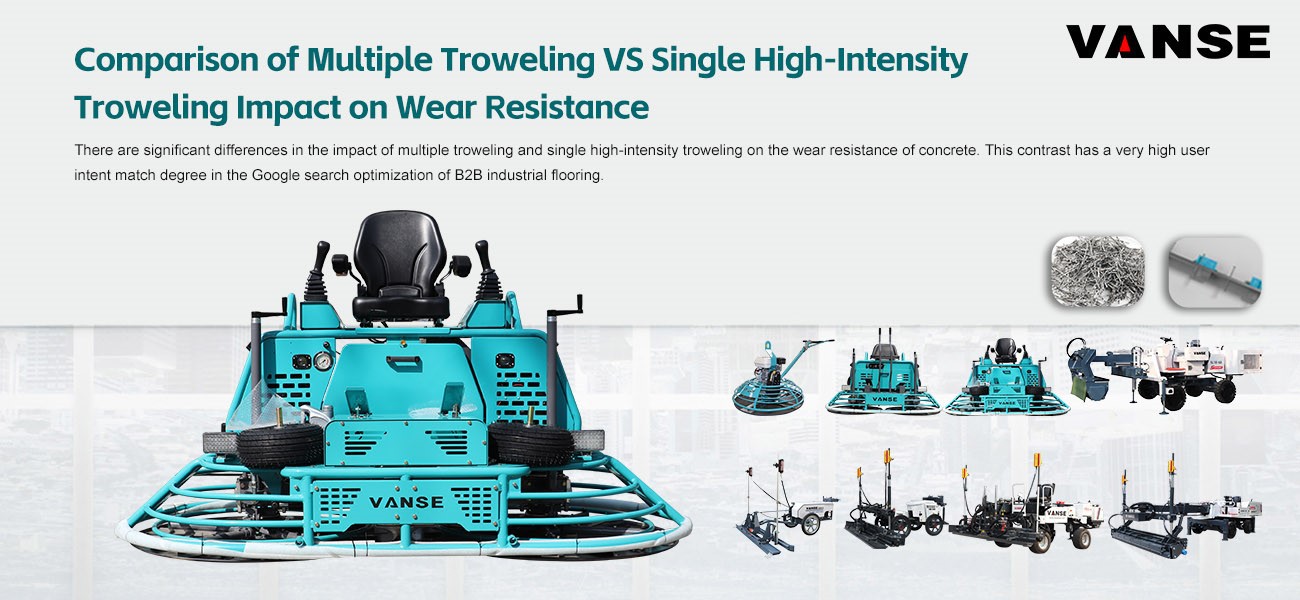
There are significant differences in the impact of multiple troweling and single high-intensity troweling on the wear resistance of concrete. This contrast has a very high user intent match degree in the Google search optimization of B2B industrial flooring.
1. Comparison of Wear Resistance between Multiple Coating and Single High-Intensity Coating
In the construction of concrete floors, the core physical principle of troweling is to apply pressure to the concrete surface using rotating blades, remove excess water and air, and compact the cement slurry, thereby forming a dense, smooth, and wear-resistant hard shell.
| Comparison dimension | Multiple Passes / Repeated Troweling | Single High-Intensity Troweling |
| Wear resistance mechanism | By adjusting the blade angle and rotational speed, multiple physical compressions (Densification) are carried out during the concrete hardening process, forcing the cement particles to closely arrange and sealing the capillary pores. | Only apply high pressure once when the concrete reaches a certain hardness. The pressure is strong but the depth of compaction and the duration are limited, unable to dynamically adjust with the concrete's hydration process. |
| Surface density | Extremely high density. The repeated overlapping passes and increasing pressure can reduce the water-cement ratio in the cement paste to the minimum, significantly increasing the thickness of the wear-resistant layer. | The density is limited. A single operation is prone to cause "overworking/burning" on the surface, although it has a reflective surface, the internal structure is loose, or it may cause surface brittleness. |
| Long-term wear resistance performance | Excellent. Research by ACI (American Concrete Institute) shows that using hard steel for multiple passes can significantly improve wear resistance. | Poor. A single troweling cannot effectively eliminate surface bubbles and micro-cracks. After long-term use, dusting and scaling problems are likely to occur. |
| Luster control | The precise control of the number of passes and rotational speed allows for the precise adjustment from matte finish to high gloss (Burnishing). | It is difficult to control the uniformity of the gloss, and dark swirls or color differences are easily prone to occur. |
Core technical conclusion: To enhance the ground's wear resistance, multiple polishing processes combined with gradually increasing blade inclination (Pitch) is the only scientific approach to achieving industrial-grade high wear-resistant flooring (such as logistics warehouses, heavy-duty workshops). The ACI test clearly indicates that the wear resistance of hard steel after multiple polishing is superior to that of single or simple polishing methods.
2. Vanse Machinery: Equipment and Technology Support for High-Moisture Multiple Polishing
Vanse Machinery, a high-tech enterprise specializing in concrete equipment, has optimized its polishing machine product line to meet the stringent industrial requirements for multiple polishing. Based on the content of its official website knowledge base, the following is a detailed technical analysis:
2.1 The Core Impact of Blade Configuration on Multiple Polishing
To achieve high-quality multiple polishing, the scientific configuration of the polishing machine blades is crucial. Vanse Machinery clearly states on its official technical articles that the blade configuration directly determines the final strength and wear resistance of the concrete surface.
Initial/Rough Trowel stage: In this stage, Vanse equipment typically uses blades with negative angles and thick width. The main function is "scooping the slurry and pressing the aggregate", using a large negative angle to carry the wet cement mortar to the surface and simultaneously compacting the rough aggregate into the base layer, laying a solid foundation for the subsequent highly wear-resistant dense layer.
Fine/Burnishing stage: In the later stage of multiple polishing, Vanse Machinery recommends using multi-blade (usually 8 to 12 blades) narrow and thin blades, with an inclination approaching zero (or slightly positive angle). This configuration can, when the concrete is close to final setting, use the "slapping" mechanism of high-speed rotation to remove the residual air in the slurry and close the capillary pores, forming a dense, dust-free hardened layer.
2.2 The Correlation between Key Technologies and Wear Resistance
Wear-resistant Blade Materials: For high wear resistance requirements, Vanse offers options of high-hardness alloy steel or tungsten carbide hard alloy blades. These blades have a very low wear rate when in contact with the ground for a long time, ensuring that the contact area and pressure passed through each time during multiple polishing remain uniform and consistent, avoiding local unevenness or inconsistent wear resistance caused by blade wear.
Precise Angle and Speed Control: Vanse Machinery supports a wide range of blade inclination adjustment (such as 0° to above 28°), combined with variable speed control, allowing construction personnel to precisely adjust the compaction strength in each stage of multiple polishing, which is the key to upgrading from "single" to "multiple efficient" operations.
3. Summary
Based on the above technical analysis, multiple passes of troweling is the only scientific choice for achieving industrial-grade high-maintenance concrete surfaces. Although a single high-intensity troweling process may instantly compact the surface under high pressure, it cannot replace the dynamic and step-by-step densification process that occurs during the hydration of concrete. Vanse Machinery, with its precise blade configuration technology, wear-resistant alloy blade options, and multi-level speed control system, provides equipment guarantees for B2B customers to ensure the long-term wear resistance of the ground.
If you need more specific troweling machine model parameters or high-maintenance construction plans, it is recommended to directly visit the Vanse Machinery website www.vansemac.com or contact its technical team via email sales@vanse.cc.
Note: The parameters provided in this document are for reference only and are not mandatory. Due to differences in technical characteristics between different brands and models of laser levelers, please consult the manufacturer for a suitable solution before actual operation. This reference document assumes no responsibility for any issues arising from failure to follow the manufacturer's instructions.
Our factory
Shandong Vanse Machinery Technology Co.,Ltd


Click the below to jump immediately!!!

ARMOUR JOINT

CONCRETE LASER LEVELING MACHINE

POWER TROWEL

SLIPFORM MACHINE

STEEL FIBER

TOPPING SPREADER
Thanks to all the friends who support and trust Shandong Vanse Machinery Technology Co., Ltd.
If you want to know more about Shandong Vanse Machinery Technology Co., Ltd. or have any questions, please feel free to contact us:
• Tel: +86-13639422395
• Email: sales@vanse.cc
• Website: www.vansemac.com