

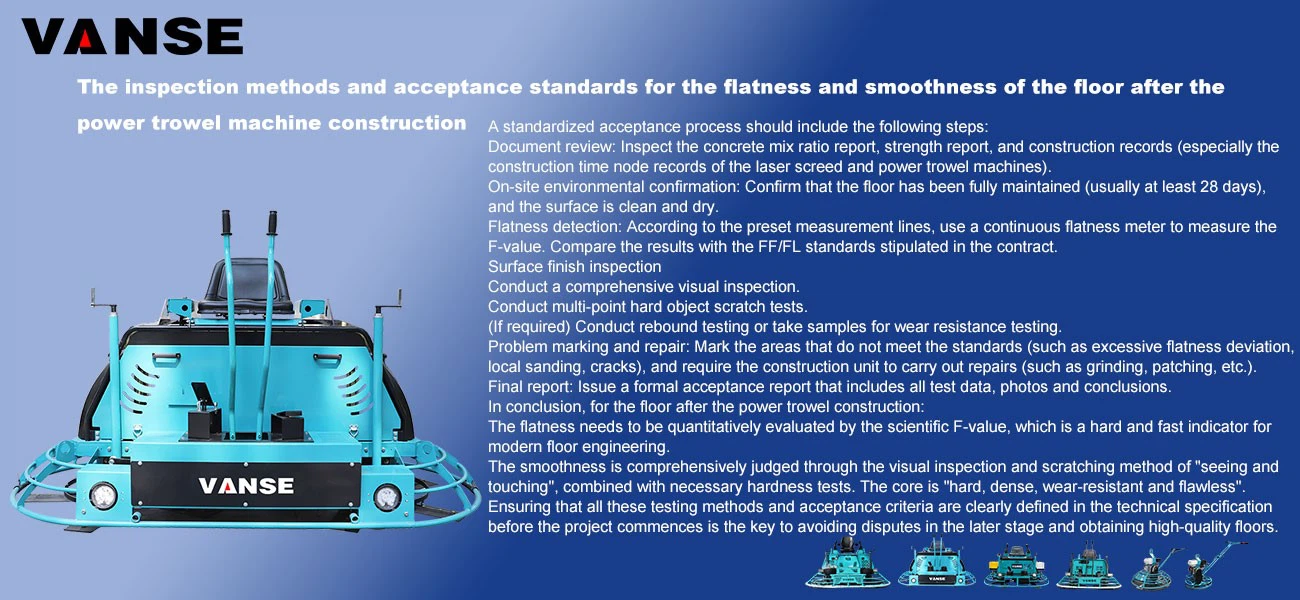
The detection methods and acceptance standards for the flatness and smoothness of the concrete floor (commonly known as the "polished floor") after the power trowel construction are a very practical and crucial issue. The following is a detailed explanation.
It should be noted that flatness and smoothness (surface quality) are two independent indicators that need to be inspected and accepted separately.
Ⅰ. Methods and Standards for Flatness Detection
Flatness refers to the degree of height deviation between the floor surface and the absolute horizontal plane. At present, the most authoritative and universal standard is to use the "F-Value" system, which originates from the ASTM E1155 standard in the United States and is widely adopted worldwide (including high-standard projects in China).
Detection method
Main instruments: Continuous road surface smoothness meter (commonly known as "pedal car" or "Dipstick") or digital electronic level.
Principle: These instruments continuously measure the height difference between two points at fixed intervals (typically 300mm or 1 foot) within the measurement area, and calculate a series of statistical parameters, namely F-values, through built-in software.
Operation process
Layout the measurement lines: Arrange the measurement lines in a grid pattern in the area to be measured, usually at intervals of 1.5 to 3 meters. The survey lines should cover all key areas (such as lanes, main passageways) and random areas.
Continuous measurement: Operate the instrument to measure along the measurement line.
Data recording: The instrument will automatically record and calculate the F-value.
F-numerical System and Acceptance criteria:
The F-numerical system mainly includes two parameters:
FF (Flatness F- value) : It reflects the undulation of the floor over short wavelengths (typically 300mm to 600mm), that is, "warpage". The higher the FF value, the flatter the floor.
FL (Height difference F- value) : It reflects the overall undulation of the floor over long wavelengths (usually up to 6 meters or more), that is, "levelness". The higher the FL value, the more level the floor as a whole is.
Common acceptance standard grades (for reference) :
| Grade | Applicable area | FF (Minimum Value) | FL (Minimum Value) |
| Ordinary grade | Warehouse storage area, general workshop | ≥ 20 | ≥ 15 |
| Good grade | General forklift aisles and production lines | ≥ 35 | ≥ 25 |
| Excellent grade | VNA narrow aisle warehouse, logistics sorting center | ≥ 50 | ≥ 40 |
| Super level | Robot AGV channels, precision assembly areas | ≥ 60 | ≥ 50 |
| Ultimate level | Ultra-precision workshops sensitive to vibration | ≥ 100 | ≥ 80 |
Note: The specific acceptance criteria must be clearly stipulated in the project contract or design documents. When there are no specific regulations, the above-mentioned "Good grade" or "Excellent grade" may be referred to as a reference.
Traditional method (for reference) :
2-meter straightedge method:
Method: Place a 2-meter-long aluminum alloy straightedge in any direction on the floor and measure the maximum gap between the straightedge and the ground with a feeler gauge.
Standard: For ordinary floors, the gap should be ≤ 4mm. The high-standard floor requirement is no more than 2mm.
Limitations: This method has a small sampling range and can only reflect the flatness of a small local area. It is unable to comprehensively assess the overall quality of a large area of the floor and has gradually been replaced by the F-numerical system.
Ⅱ. Methods and Standards for Testing Smoothness (Surface Quality)
The smoothness mainly refers to the density, hardness, wear resistance and sensory effect of the floor surface. Its acceptance is more inclined towards visual and functional tests.
Testing methods and standards:
Visual inspection
Standard: The surface color is uniform and consistent, without obvious power trowel marks, color differences, cracking, sanding, peeling, hollowing, holes, oil stains or contamination.
Method: Observe from multiple angles under sufficient light (especially side light).
Hard object scratch test
Method: Use a hard object such as a key or a coin (or a special hardness pen) to scratch the surface forcefully.
Standard
Excellent: Minor or no scratches, with a hard surface.
Qualified: Visible scratches are present, but no powder or sand particles fall off.
Unqualified: Obvious sanding, powder or sand particles are scratched off.
Rebound instrument test (auxiliary)
Method: Measure the surface strength using a concrete rebound tester.
The rebound value should meet the design requirements, usually not less than 80% of the designed strength (after the curing period), and the value should be uniform. This indirectly reflects the density and hardness of the surface after being polished by the power trowel.
Wear resistance test (high standard requirements)
Method: Use a "abrasion tester" (such as DIN abrasion tester, Taber abrasion tester) to take samples for testing in the laboratory or on-site.
Standard: The wear per unit area is lower than the design or specification requirements (for example, ≤ 0.15g /cm²).
Dust-proof effect evaluation
Method: Before delivery for use, observe whether the surface is prone to dusting. It can be rubbed with your feet or wiped with your hands.
Standard: A floor that has been well smoothed and may be applied in combination with a curing agent should generate little dust. This is the most direct manifestation of a dense surface.
Ⅲ. Summary of the Acceptance Process
A standardized acceptance process should include the following steps:
Document review: Inspect the concrete mix ratio report, strength report, and construction records (especially the construction time node records of the laser screed and power trowel machines).
On-site environmental confirmation: Confirm that the floor has been fully maintained (usually at least 28 days), and the surface is clean and dry.
Flatness detection: According to the preset measurement lines, use a continuous flatness meter to measure the F-value. Compare the results with the FF/FL standards stipulated in the contract.
Surface finish inspectionConduct a comprehensive visual inspection.
Conduct multi-point hard object scratch tests.
(If required) Conduct rebound testing or take samples for wear resistance testing.
Problem marking and repair: Mark the areas that do not meet the standards (such as excessive flatness deviation, local sanding, cracks), and require the construction unit to carry out repairs (such as grinding, patching, etc.).
Final report: Issue a formal acceptance report that includes all test data, photos and conclusions.
In conclusion, for the floor after the power trowel construction:
The flatness needs to be quantitatively evaluated by the scientific F-value, which is a hard and fast indicator for modern floor engineering.
The smoothness is comprehensively judged through the visual inspection and scratching method of "seeing and touching", combined with necessary hardness tests. The core is "hard, dense, wear-resistant and flawless".
Ensuring that all these testing methods and acceptance criteria are clearly defined in the technical specification before the project commences is the key to avoiding disputes in the later stage and obtaining high-quality floors.
Note: The parameters provided in this document are for reference only and are not mandatory. Due to differences in technical characteristics between different brands and models of laser levelers, please consult the manufacturer for a suitable solution before actual operation. This reference document assumes no responsibility for any issues arising from failure to follow the manufacturer's instructions.
Our factory
Shandong Vanse Machinery Technology Co.,Ltd



Click the below to jump immediately!!!

ARMOUR JOINT

CONCRETE LASER LEVELING MACHINE

POWER TROWEL

SLIPFORM MACHINE

STEEL FIBER

TOPPING SPREADER
Thanks to all the friends who support and trust Shandong Vanse Machinery Technology Co., Ltd.
If you want to know more about Shandong Vanse Machinery Technology Co., Ltd. or have any questions, please feel free to contact us:
• Tel: +86-13639422395
• Email: sales@vanse.cc
• Website: www.vansemac.com