

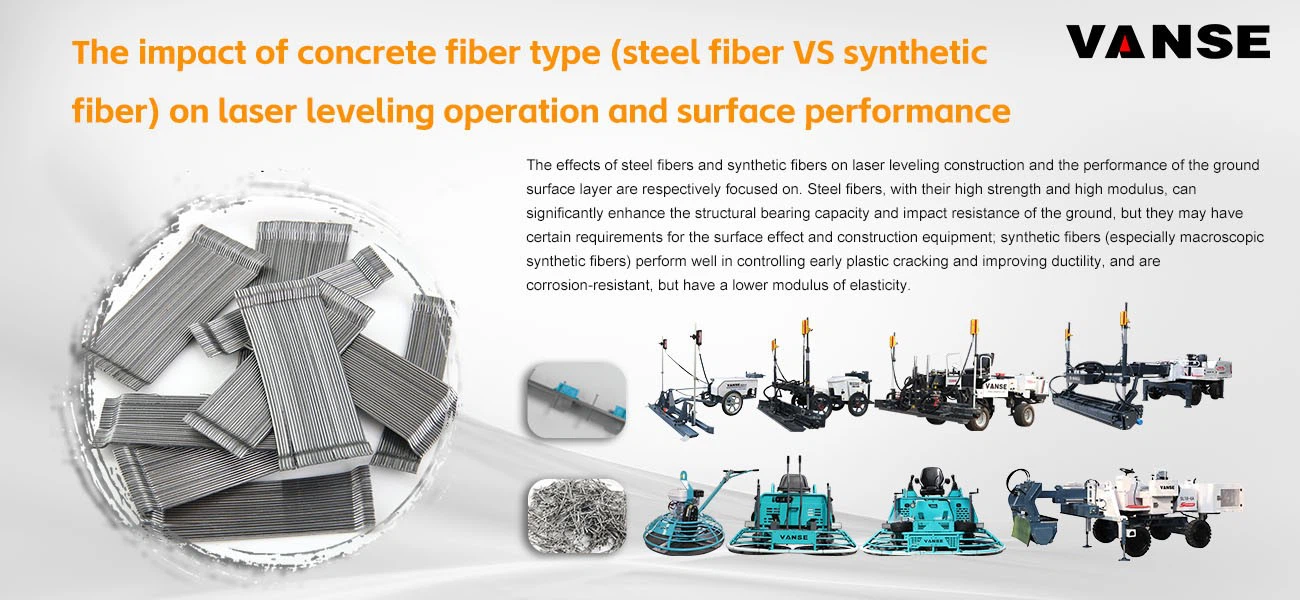
The effects of steel fibers and synthetic fibers on laser leveling construction and the performance of the ground surface layer are respectively focused on. Steel fibers, with their high strength and high modulus, can significantly enhance the structural bearing capacity and impact resistance of the ground, but they may have certain requirements for the surface effect and construction equipment; synthetic fibers (especially macroscopic synthetic fibers) perform well in controlling early plastic cracking and improving ductility, and are corrosion-resistant, but have a lower modulus of elasticity.
In order to more clearly contrast the core differences between the two, I have compiled the following table:
| Comparison dimension | Steel fiber | Synthetic fibers |
| The influence on the laser leveling construction operation | It has a significant impact on the mixture and workability: The concrete appears drier and requires adjustments to the mix ratio (such as increasing the amount of cement or using water reducers) to ensure construction performance. | Better workability: Has a smaller impact on the fluidity of concrete, making it easier to pump and spread. |
| It causes severe wear on machinery: It causes more severe wear on mixers and laser leveling machines. | More friendly to equipment: Causes less wear on construction equipment, and the machine operation is smoother. | |
| The influence on the performance of the ground surface layer (mechanical properties) | Excellent tensile, shear and impact resistance: It can significantly improve the toughness of concrete, effectively transfer and withstand high loads, and prevent crack propagation. | Improves toughness and post-crack bearing capacity: Can provide three-dimensional constraints after the concrete cracks, absorbing energy and preventing crack expansion. |
| High elastic modulus: It has good coordination with the concrete matrix and can effectively prevent long-term creep of the concrete. | Lower elastic modulus: Approximately 1/10 to 1/40 of that of steel fibers, and its contribution to structural stiffness is less than that of steel fibers under high loads. | |
| The influence on the performance of the ground surface layer (crack resistance and durability) | Excellent crack resistance: It effectively limits micro-cracks in concrete caused by temperature and shrinkage. | Excellent effect in controlling early plastic shrinkage and cracking: Especially suitable for suppressing early cracks within 12 hours after concrete pouring. |
| Corrosion risk exists: Rust stains on the surface may affect the appearance, but usually do not cause the concrete to peel off. | Fully corrosion-resistant: Stable performance in acidic and alkaline environments, no need for protective layer. | |
| Malleability: According to a study, at a specific dosage, the wear rate of steel fiber concrete may be higher than that of synthetic fiber concrete. | Fire resistance: Microscopic synthetic fibers (such as polypropylene microfibers) have a low melting point and can form channels at high temperatures to release steam pressure, effectively preventing concrete from cracking. | |
| The influence on the final surface effect and post-processing | May affect surface appearance: The surface treatment method is limited and is not suitable for creating decorative effects such as pattern embossing or exposed aggregate. If the fibers are exposed, it may cause harm to the human body or the waterproof layer. | Compatible with various surface treatments: It is applicable to almost all surface treatment methods, including embossing, sandblasting, polishing, etc. |
| No pressure during cutting: All sawing equipment can be used normally for steel fiber concrete. | Cleaner surface effect: There is no risk of exposed metal fibers, resulting in a better appearance. |
💎 How to choose?
The key factor in choosing which type of fiber to use depends on your ground application and performance requirements:
If your project is...
Super heavy industrial workshops, warehouses, and aprons: They need to withstand huge dynamic loads and impacts, and have extremely high requirements for the structural bearing capacity of the ground. At this time, steel fibers are a more reliable choice.
Large commercial floors, underground garages, and floors requiring good surface decoration: The main contradiction is to control early cracking, and there are requirements for surface appearance and corrosion resistance. Then, synthetic fibers (especially macro synthetic fibers) are a more economical and efficient choice.
High-rise buildings or tunnels with special fire protection requirements: The risk of concrete cracking under high temperatures must be considered. At this time, fine polypropylene synthetic fibers must be added.
In actual engineering projects, there are also many projects that choose to use a combination of the two (for example, using steel fibers to ensure structural strength and using fine synthetic fibers to control early plastic cracking) to complement each other and achieve the best performance and cost balance.
What scenarios does your project mainly apply to? If you can provide more information about the ground design load or requirements for crack resistance, I can help you do a more specific analysis. Contact us NOW
Note: The parameters provided in this document are for reference only and are not mandatory. Due to differences in technical characteristics between different brands and models of laser levelers, please consult the manufacturer for a suitable solution before actual operation. This reference document assumes no responsibility for any issues arising from failure to follow the manufacturer's instructions.
Our factory
Shandong Vanse Machinery Technology Co.,Ltd


Click the below to jump immediately!!!

ARMOUR JOINT

CONCRETE LASER LEVELING MACHINE

POWER TROWEL

SLIPFORM MACHINE

STEEL FIBER

TOPPING SPREADER
Thanks to all the friends who support and trust Shandong Vanse Machinery Technology Co., Ltd.
If you want to know more about Shandong Vanse Machinery Technology Co., Ltd. or have any questions, please feel free to contact us:
• Tel: +86-13639422395
• Email: sales@vanse.cc
• Website: www.vansemac.com