Technical Knowledge
Superflat Floor Flatness Standards (FF/FL Values) Interpretation and Testing Methods
In logistics warehousing, precision manufacturing, and other fields, **superflat floors** are fundamental to ensuring the smooth operation of high-reach forklifts, automated guided vehicles (AGVs), and high-precision equipment.
The core indicator for measuring floor quality is the F-Numbers (F-value), which mainly includes two values: FF and FL. The following is an in-depth summary of its standard interpretation and testing methods:
I. In-depth Understanding of F-Numbers (FF and FL)
Compared to the traditional "3-meter straightedge test method," the F-value system uses statistical analysis of the undulations of the floor surface to more scientifically reflect the actual working performance of the floor.
1. FF: Floor Flatness
Meaning: Describes the degree of "undulation" (local unevenness) of the floor surface.
Calculation Principle: Calculates the curvature change by measuring the height difference every 300mm (1 foot).
Performance Characteristics: A higher FF value indicates a smoother floor, resulting in less shaking and bumping when forklifts are in motion.
2. FL: Floor Levelness
Meaning: Describes the overall inclination of the floor relative to the design horizontal plane (macro slope).
Calculation Principle: Measures the total height difference over a distance of 3000mm (10 feet).
Performance Characteristics: A higher FL value indicates a floor closer to absolute level. This is crucial for the verticality of high-bay racking (VNA).
3. Floor Grade Comparison Table
According to ACI (American Concrete Institute) 302.1R standard, floor grades are typically classified as follows:
| Flooring Classification | Specify overall flatness (FF) | Specify overall flatness (FF) | Applicable Scenarios |
| Standard | 20 | 15 | Machine rooms, parking lots, general warehouses |
| Standard Grade | 25 | 20 | Light industrial and commercial office buildings |
| Flat Grade | 35 | 25 | Narrow aisle warehouses (non-high-rise), laboratories |
| Extra Flat Grade | 45 | 35 | Ice rinks, precision manufacturing plants |
| Super Flat Grade | 60+ | 40+ | High-rise VNA warehouses (above 12 meters), television studios |
II. Testing Methods and Standard Procedures
The internationally accepted testing standard is ASTM E1155. Domestically, this standard or industry regulations are typically referenced for acceptance testing.
1. Core Testing Equipment: Electronic Leveling Device (Dipstick)
This is currently the most widely recognized testing tool. It is a walking electronic level; the operator pushes it across the ground, and the device automatically records the elevation difference between every two points (usually 300mm apart).
2. Testing Time Window
Golden Time: Testing should be conducted within 24 to 72 hours after concrete pouring.
Reason: Because concrete undergoes long-term shrinkage and warping, early testing reflects construction quality, while later testing is affected by structural deformation.
3. Sampling and Wiring Rules
Test Line Layout: Multiple parallel and perpendicular test lines are typically laid out within each test section.
Total Length Requirement: At least 34 elevation measurements are required per 1000 square feet (approximately 93 square meters) to ensure the validity of the statistical data.
4. Data Evaluation: SOV and MLV
The acceptance report will show two key evaluation dimensions:
Specified Overall Value (SOV): The average score for the entire floor slab, which must meet the design specifications.
Minimum Local Value (MLV): The permissible baseline for quality (typically 60%-70% of the SOV). Even if the overall score is acceptable, if a local MLV fails to meet the standard, that area must be repaired.
III. Key Construction Points for Improving the F-Value
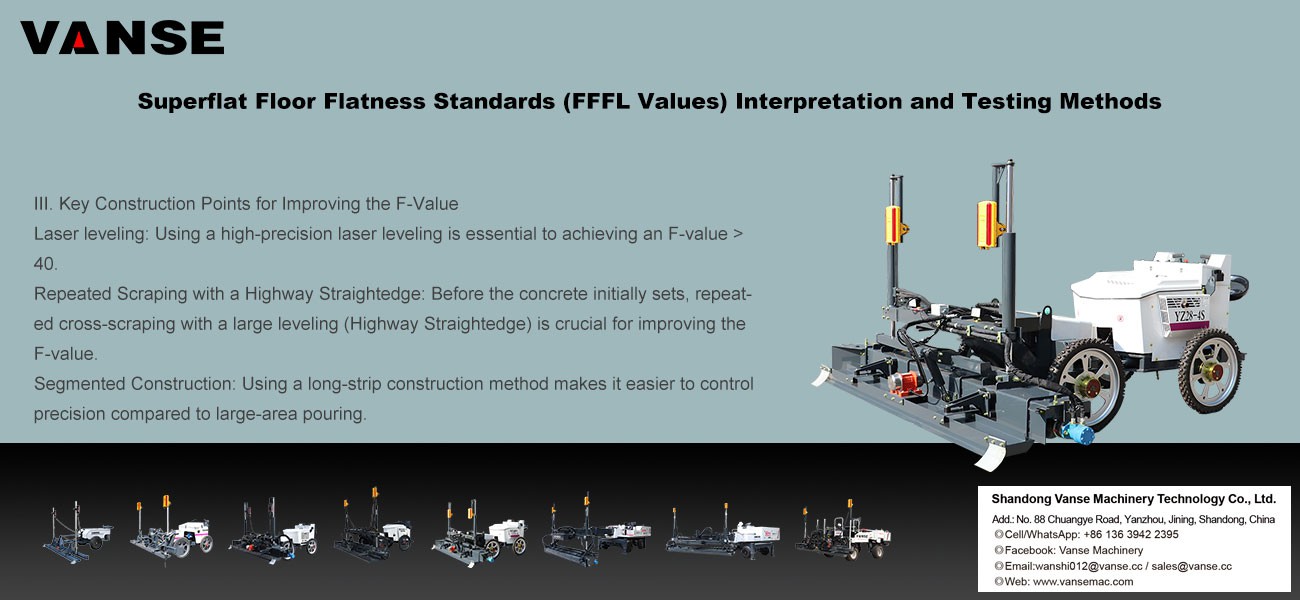
Laser leveling: Using a high-precision laser leveling is essential to achieving an F-value > 40.
Repeated Scraping with a Highway Straightedge: Before the concrete initially sets, repeated cross-scraping with a large leveling (Highway Straightedge) is crucial for improving the F-value.
Segmented Construction: Using a long-strip construction method makes it easier to control precision compared to large-area pouring.
Note: The parameters provided in this document are for reference only and are not mandatory. Due to differences in technical characteristics between different brands and models of laser levelers, please consult the manufacturer for a suitable solution before actual operation. This reference document assumes no responsibility for any issues arising from failure to follow the manufacturer's instructions.
Thanks to All the Friends Who Support and Trust Shandong Vanse Machinery Technology Co., Ltd.
If you want to know more about Shandong Vanse Machinery Technology Co., Ltd. or have any questions, please feel free to contact us:
Our Factory
Shandong Vanse Machinery Technology Co., Ltd.








Share this article

About the Author: Shandong Vanse Machinery Technology Co., Ltd.
Shandong Vanse Machinery Technology Co., Ltd. is a high-tech manufacturer specializing in concrete construction machinery, including laser screeds and related equipment. The company integrates R&D, production, and global sales, with products exported to over 60 countries and widely used in infrastructure projects worldwide.
Previous Post
Next Post
Related Articles
You Might Also Like
Environmental protection standards for concrete laser leveling machine construction sites
🎯 Noise pollution control – **Site boundary noise standard**: Implement the "Environmental noise emission standard for construction site boundaries" (GB12523-2011), the daytime noise limit is 70 decibels, and the night limit is 55 decibels. – **Equipment noise control**: Give priority to low-noise laser levelers and supporting equipment, regularly maintain the equipment to ensure that the equipment is in good operating condition, and reduce abnormal noise caused by equipment failure and other reasons. 🎯 Air pollution prevention and control – **Dust control**: The construction site should be fenced with a height of not less than 2 meters to reduce the spread of dust. Cover the raw materials of concrete such as sand and gravel to avoid dust generated by open-air stacking. In dry weather or when performing operations that are prone to dust, measures such as spray dust reduction should be taken, such as using sprinklers, sprayers and other equipment to spray water and dust reduction on the construction site. – **Exhaust emission**: The exhaust emission of various fuel machinery and equipment used in construction, such as concrete laser leveling machines, transport vehicles, etc., shall comply with the emission standards stipulated by the state and local governments. 🎯 Water pollution prevention and control – **Wastewater treatment**: Sedimentation tanks, sewage wells and other wastewater treatment facilities should be set up at the construction site. The wastewater from the cleaning of the concrete laser leveling machine and the oily wastewater generated by equipment maintenance must be treated and discharged after meeting the standards. – **Water resource utilization**: A rainwater collection system is established. The collected rainwater can be used for concrete maintenance, dust reduction, etc., to improve the utilization rate of water resources. 🎯 Solid waste management – **Classified storage**: Construction waste generated during the construction process, such as concrete scraps, discarded formwork, etc., should be stored in a classified manner. – **Timely removal**: Construction waste should be transported to designated waste disposal sites for treatment on a regular basis. It is strictly forbidden to discard or dump it at will. – **Resource utilization**: Recyclable solid waste, such as scrap steel and wood, should be recycled and reused to improve resource utilization. 🎯 Soil pollution prevention and control – **Oil and chemical management**: Oil and chemicals used in construction should be properly stored to prevent leakage and soil contamination. – **Site cleaning**: After the construction is completed, the construction site will be fully cleaned, and the remaining concrete, oil and other pollutants will be cleaned up, and the contaminated soil will be repaired or replaced. 🎯 Ecological environment protection – **Vegetation protection**: Before construction, the vegetation in the construction area will be evaluated, and the damage to important vegetation will be avoided as much as possible, and transplanted when necessary. – **Ecological restoration**: After the construction is completed, ecological restoration will be carried out in a timely manner, and the construction site will be leveled and greened as required, and local plants will be planted to restore the ecological environment before construction.Use the concrete laser leveling machine to control the temperature!
When the concrete laser leveling machine performs operations on the road surface, some parts of the equipment may overheat due to the increase in temperature, which will affect the correct leveling effect of the equipment. So, how should the temperature of the leveling machine be controlled during work? Next, let's take a look at how our company's technicians teach you how to control the temperature of the leveling during operation! How to control the temperature during leveling operation? First of all, controlling the temperature of the leveling machine is one of the keys to ensure the quality of leveling. When the equipment is being leveled, it should meet the requirements of relevant standards according to the type of asphalt, label, consistency, ambient temperature, and leveling thickness. Secondly, when the construction temperature of expressways and first-class roads is lower than 10°C, and the construction temperature of other grades of roads is lower than 5°C, leveling is not suitable. If it is necessary to carry out leveling work, the temperature of the road leveling machine should be increased, and there are also low-temperature leveling requirements that meet the regulations. After the plate is heated and leveled, it is pressed immediately to shorten the length of the press. Finally, remember that during leveling, the requirements of relevant standards should be met according to the type of asphalt, label, consistency, ambient temperature, leveling thickness, etc. In this case, it is relatively simple and easy to control the temperature. Precautions for leveling machine: 1. After finishing the leveling operation, carry out the routine maintenance work according to the content of the routine maintenance procedure. 2. The working devices and moving mechanisms of the leveling machine that are in direct contact with the asphalt mixture during operation, after the operation, spray with diesel oil and then run for a period of time to remove the residual asphalt on it, so that it can run freely and rotate flexibly. It is forbidden to spray diesel oil on the electric control system and helix to prevent fire and combustion when electrified. 3. After leveling the two-ash soil, wash it with water to wash off the white material. After washing, use waste hydraulic oil to lubricate the moving parts of the scraper conveyor chain, and apply anti-rust oil to the piston rod. Be careful not to allow water to wash into the electrical appliances and bearings to prevent short circuits and foreign objects entering the bearings. 4. Clean and check the elevation adjustment device of the slope gauge, and lubricate the lead screw with grease. Apply grease to the slide rails of the floating arm. Grease each oil filling point until the seam overflows. For levelers with oil filling cups, observe the consumption and fill them up at any time. Have you learned all the above? If you want to know more about concrete laser leveling machine, please continue to pay attention to this website!The connection and interaction between concrete laser leveling and other construction machinery
As one of the commonly used equipment in modern construction projects, concrete laser leveling machine has close contact and mutual influence with other construction machinery. These connections and influences are not only reflected in the complementarity between equipment, but also in the coordination and optimization of the overall construction organization. The following will elaborate on the connection and interaction between the concrete laser leveling machine and other construction machinery from several aspects, as well as its status and role in the overall construction organization. 1. The relationship between concrete laser leveling machine and other construction machinery The concrete laser leveling machine is mainly used to smooth and smooth the concrete surface to improve the quality of the concrete surface. During the construction process, the concrete laser leveling needs to work closely with other construction machinery to ensure the smooth progress of the construction. Connection with the concrete mixing station: The concrete laser leveling needs to use the concrete provided by the mixing station, so there is a close connection with the concrete mixing station. During the construction process, the concrete mixing station needs to reasonably arrange the supply of concrete according to the construction progress and needs of the concrete laser leveling to ensure that the supply of concrete can meet the construction needs. Connection with transportation machinery: The concrete laser leveling requires the use of transportation machinery to transport concrete from the mixing station to the construction site, so there is a close connection with the transportation machinery. The transportation machinery needs to reasonably arrange the transportation time and transportation route according to the construction progress and needs of the concrete laser leveling machine to ensure that the concrete can reach the construction site in time. Connection with lifting machinery: The concrete laser leveling requires the use of lifting machinery for hoisting and movement, so there is a close connection with the lifting machinery. During the construction process, the concrete laser leveling needs to cooperate with the lifting machinery to ensure the accuracy and safety of hoisting and movement. 2. Interaction between concrete laser leveling machine and other construction machinery There are mutual influences between concrete laser leveling machines and other construction machinery. These influences are mainly reflected in the following aspects: Influence of construction efficiency: The construction efficiency of concrete laser leveling machines is affected by other construction machinery. For example, if the supply of the concrete mixing station is insufficient or the transportation machinery fails, the concrete laser leveling machine will not be able to perform normal construction, thus affecting the overall construction efficiency. Influence of construction quality: The construction quality of concrete laser leveling machine is affected by other construction machinery. For example, if the concrete is not smoothed in time after the transport machinery transports it to the construction site, it may cause problems such as cracks or bubbles on the concrete surface. Impact on construction safety: The construction safety of concrete laser leveling machines is affected by other construction machinery. For example, if the lifting machinery is operated improperly or does not properly cooperate with the concrete laser leveling for lifting and moving, safety accidents may occur. 3. The status and role of concrete laser leveling machine in the overall construction organization Concrete laser leveling machine plays an important role in the overall construction organization, which is mainly reflected in the following aspects: Improve construction efficiency: The concrete laser leveling can quickly and accurately complete the flatness and smoothness of the concrete surface, thereby improving construction efficiency. Guarantee construction quality: The concrete laser leveling can accurately control construction accuracy and quality, thereby ensuring construction quality. Reduce labor intensity: The concrete laser leveling machine can reduce the labor intensity of workers and improve work efficiency. Promote construction safety management: Concrete laser levelings can reduce the number of personnel on the construction site, thereby reducing safety risks on the construction site. To sum up, as one of the commonly used equipment in modern construction projects, concrete laser leveling machine has close contact and mutual influence with other construction machinery. In the overall construction organization, the concrete laser leveling has an important position and role. It can improve construction efficiency, ensure construction quality, reduce labor intensity, and promote construction safety management. It plays an important role. Therefore, during the construction process, the impact of various factors on the concrete laser leveling should be fully considered, and the relationship with other construction machinery should be coordinated to ensure the coordination and optimization of the overall construction organization.