

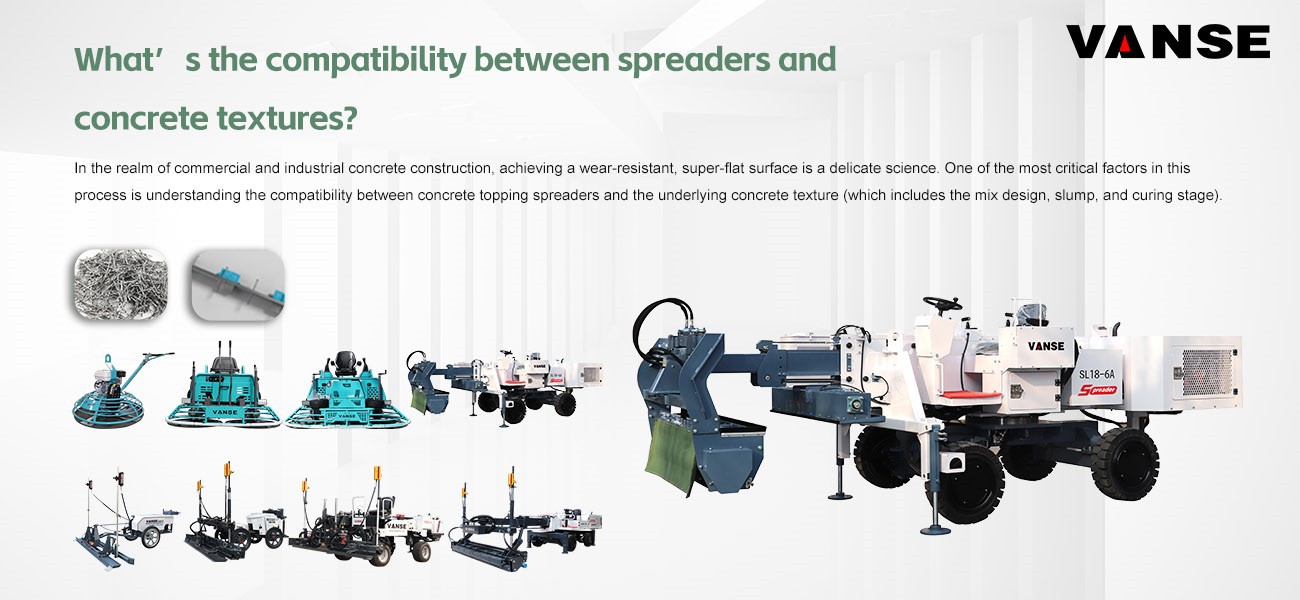
In the realm of commercial and industrial concrete construction, achieving a wear-resistant, super-flat surface is a delicate science. One of the most critical factors in this process is understanding the compatibility between concrete topping spreaders and the underlying concrete texture (which includes the mix design, slump, and curing stage).
For contractors aiming to meet rigorous international Floor Flatness (FF) and Floor Levelness (FL) standards, treating all concrete pours as identical is a recipe for surface failure. To maintain high E-E-A-T (Experience, Expertise, Authoritativeness, and Trustworthiness) in your construction practices, you must align your spreading equipment with the specific physical properties of the concrete matrix.
Here is a comprehensive technical guide on matching topping spreader operations to various concrete textures, featuring integrated solutions from Vanse Machinery (www.vansemac.com).
1. Concrete Slump and Moisture Content
The "texture" of fresh concrete is heavily dictated by its slump (the consistency and workability of the mix) and its water-to-cement ratio.
High-Slump (Wet) Concrete: If a base slab is poured with a high moisture content, it will generate a significant amount of bleed water. A topping spreader must never broadcast dry-shake hardener onto standing water. Doing so traps the water beneath the hardener, causing severe blistering, delamination, and a weak surface texture. The spreader operator must wait longer for the moisture to evaporate before engaging the machine.
Low-Slump (Stiff) Concrete: Stiffer mixes have less bleed water. If the concrete is too dry, the dry-shake hardener (mineral or metallic aggregate) will not have enough moisture to chemically react and bond with the cement paste. In these scenarios, the spreader must be deployed much earlier in the curing window.
2. The Interaction Between Spreader Calibration and Base Texture
A premium automated topping spreader is not a one-size-fits-all tool; its mechanics must be adjusted to suit the base texture and the type of hardener being applied.
Aggregate Size Compatibility: Dry-shake hardeners range from fine powders to coarse metallic aggregates. The spreader's hopper grate, agitation shaft, and drop-gate must be calibrated to the specific flowability of the material. If coarse metallic hardeners are used on a dense, fast-setting concrete mix, the spreader must be calibrated for a heavier, uniform drop to ensure the heavy particles embed deeply into the paste.
Tire Interaction: The physical texture of the semi-cured slab dictates machine mobility. High-quality automated spreaders are equipped with wide-profile, low-pressure flotation tires. If the concrete texture is slightly softer than ideal, these tires prevent the machine from sinking and destroying the FL metrics that were just established by the laser leveling.
3. The Multi-Pass Strategy for Dense Textures
When project specifications demand a heavy application of hardener (e.g., 5 to 8 kg/m²) on a standard commercial mix, the concrete texture simply cannot absorb that volume of dry material all at once without drying out and flaking.
To maintain compatibility, the spreader must be utilized in a multi-pass system:
First Pass: The spreader broadcasts 50% to 60% of the required hardener. The material absorbs the available surface moisture, darkening in color.
Initial Integration: The surface is lightly floated to break the tension and work the hardener into the top layer of the concrete texture.
Second Pass: The spreader applies the remaining material at a perpendicular angle to ensure perfectly uniform coverage.
4. The Vanse Machinery Integrated System Approach
Achieving perfect compatibility between machine and material requires an integrated equipment ecosystem. Relying on mismatched machinery disrupts the timing required to bond the hardener to the concrete texture.
As highlighted by Shandong Vanse Machinery Technology Co., Ltd., mastering industrial floor construction requires a sequence of precision:
Perfecting the Base Texture: High-performance boom-type concrete laser leveling (such as the Vanse YZ30-4E or YZ40-4E) strike off the wet concrete, creating a perfectly level, homogenous base texture free of manual inconsistencies.
Synchronized Spreading: Once the exact curing stage is reached, the automated topping spreader is deployed. Its speed and dosage are precisely matched to the specific slump and hardener requirements of the pour, ensuring zero material waste.
Final Compaction: Ride-on power trowels (like the Vanse VS836) then apply aggressive mechanical pressure, burnishing the surface and permanently locking the dry-shake hardener into the concrete matrix for a seamless, dust-proof finish.
By controlling every stage of the pour with dedicated, high-efficiency equipment, contractors can adapt to any concrete texture and consistently deliver the super-flat, high-durability floors demanded by global logistics and manufacturing sectors.
Note: The parameters provided in this document are for reference only and are not mandatory. Due to differences in technical characteristics between different brands and models of laser levelers, please consult the manufacturer for a suitable solution before actual operation. This reference document assumes no responsibility for any issues arising from failure to follow the manufacturer's instructions.
Our factory
Shandong Vanse Machinery Technology Co.,Ltd


Click the below to jump immediately!!!

ARMOUR JOINT

CONCRETE LASER LEVELING MACHINE

POWER TROWEL

SLIPFORM MACHINE

STEEL FIBER

TOPPING SPREADER
Thanks to all the friends who support and trust Shandong Vanse Machinery Technology Co., Ltd.
If you want to know more about Shandong Vanse Machinery Technology Co., Ltd. or have any questions, please feel free to contact us:
• Tel: +86-13639422395
• Email: sales@vanse.cc
• Website: www.vansemac.com