Technical Knowledge
What are the common problems of laser leveling machine during construction and how to solve them?

The following common problems and solutions may be encountered by the laser leveler during construction:
Laser signal problem
1. Laser signal loss
– Problem description: During construction, the laser leveler may suddenly lose the laser signal. This may be due to the laser transmitter being blocked, such as the surrounding building materials piled up, the construction workers walking and accidentally blocking the signal transmission path, or the bad weather (such as dense fog, heavy rain, etc.) affecting the propagation of the laser signal.
– Solution: First, check whether there are obstacles between the laser transmitter and the receiver. If there are, remove the obstacles to ensure that the signal transmission path is unobstructed. For signal loss caused by weather reasons, in dense fog or heavy rain, construction can be suspended and wait for the weather to improve. If construction cannot be suspended, consider adjusting the position and height of the laser transmitter to minimize the impact of weather on the signal, and at the same time strengthen the sensitivity setting of the signal receiving device (if the device has this function).
2. Inaccurate laser signal
– Problem description: The laser signal is deviated, resulting in an error between the working plane of the leveler and the design plane. This may be because the laser transmitter is not installed firmly and has a slight displacement; or it may be affected by external forces such as vibration and collision during the construction process, causing the transmitter's emission angle to change.
– Solution: Make sure the laser transmitter is installed firmly before construction, and calibrate it after installation. During the construction process, check the position and angle of the laser transmitter regularly. If the signal is found to be inaccurate, use professional calibration tools to recalibrate the horizontality and emission angle of the laser transmitter to make it consistent with the benchmark of the design plane.
The leveling effect is not good
1. The flatness of the ground does not meet the requirements
– Problem description: The ground after leveling is partially uneven. This may be due to uneven wear of the scraper of the leveling machine, or the scraper is subject to greater resistance during the work process, causing the scraper to not work properly. For example, there are hard foreign objects on the ground, such as large pieces of stone, steel bars, etc., which will affect the flatness control of the scraper.
– Solution: Check the wear of the scraper regularly, and replace the severely worn scraper in time. Before construction, clean up foreign objects on the ground to ensure that the construction site is flat. If the scraper encounters a large resistance during the construction process, stop the machine immediately for inspection, and continue construction after removing foreign objects. In addition, the leveling effect can be improved by adjusting the walking speed of the leveler and the working pressure of the scraper. Generally, a moderate walking speed and uniform scraper pressure can achieve a better leveling effect.
2. Cracks appear on the concrete surface
– Problem description: Cracks appear on the concrete surface after leveling. This may be due to unreasonable concrete mix ratio, such as excessive cement dosage, excessive water-cement ratio, etc., which causes excessive shrinkage of concrete during solidification; or improper maintenance of concrete after leveling, such as failure to timely moisturize and maintain in a high temperature and dry environment, causing the concrete surface to lose water too quickly and crack.
– Solution: Before construction, strictly control the mix ratio of concrete, and reasonably determine parameters such as cement dosage and water-cement ratio according to engineering requirements and environmental conditions. After leveling, timely maintain the concrete, cover the concrete surface with moisturizing materials such as plastic film or wet cloth, especially in hot and dry weather, increase the frequency and time of maintenance to prevent water loss on the concrete surface.
Mechanical failure of equipment
1. Travel system failure
– Problem description: The travel mechanism of the leveler cannot work properly, such as unstable travel speed, uncontrolled travel direction or inability to rotate the travel wheel. This may be caused by travel motor failure, loose or broken transmission chain or belt, or damaged bearing of the travel wheel.
– Solution: First check whether the travel motor is working properly, check whether the power cord of the motor is well connected, and whether there is a short circuit or open circuit. For the transmission chain or belt, check its tension. If it is loose, adjust the tensioning device in time; if it is found to be broken, replace a new chain or belt. For the bearing of the travel wheel, check whether it is damaged. If it is damaged, replace the bearing in time to ensure that the travel wheel can rotate normally.
2. Scraper lifting system failure
– Problem description: The scraper cannot be lifted and lowered normally, affecting the leveling operation of the leveler on concrete of different thicknesses. This may be due to a failure in the scraper lift cylinder, such as damage to the cylinder seal causing oil leakage, which prevents the cylinder from providing lifting power normally; or a problem with the lifting control system, such as a control circuit failure or solenoid valve damage.
– Solution: Check whether the scraper lift cylinder is leaking oil. If there is oil leakage, replace the cylinder seal. For the lifting control system, check whether the control circuit is well connected and whether there is any damage. If the solenoid valve is damaged, replace a new solenoid valve to ensure that the scraper lift system can work normally.
Thanks to All the Friends Who Support and Trust Shandong Vanse Machinery Technology Co., Ltd.
If you want to know more about Shandong Vanse Machinery Technology Co., Ltd. or have any questions, please feel free to contact us:
Our Factory
Shandong Vanse Machinery Technology Co., Ltd.








Share this article

About the Author: Shandong Vanse Machinery Technology Co., Ltd.
Shandong Vanse Machinery Technology Co., Ltd. is a high-tech manufacturer specializing in concrete construction machinery, including laser screeds and related equipment. The company integrates R&D, production, and global sales, with products exported to over 60 countries and widely used in infrastructure projects worldwide.
Previous Post
Next Post
Related Articles
You Might Also Like
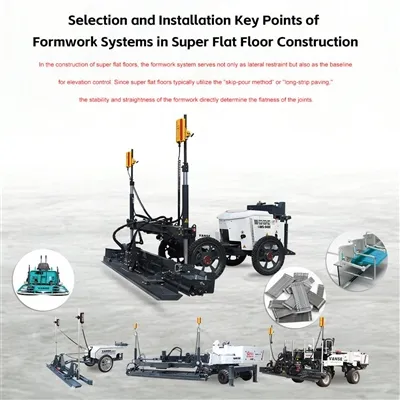
Selection and Installation Key Points of Formwork Systems in Super Flat Floor Construction
In the construction of super flat floors, the formwork system serves not only as lateral restraint but also as the baseline for elevation control. Since super flat floors typically utilize the "skip-pour method" or "long-strip paving," the stability and straightness of the formwork directly determine the flatness of the joints. The following are key points regarding the selection and installation of formwork systems for super flat floors: Traditional wooden formwork has been phased out in super-flat floor construction due to its susceptibility to deformation and low strength. The current mainstream solutions are as follows: Composition: Consists of two cold-drawn steel corner guards, load transfer bars, breakable bolts, and a lower steel plate. Advantages: No need to remove after construction; it remains in the floor as a permanent joint; effectively protects the concrete edges from impact damage by forklift wheels (prevents chipping). Applicable to: Longitudinal construction joints in very narrow aisle (VNA) areas. Requirements: Must possess sufficient rigidity, and the top surface must be machined and leveled. Advantages: When used with a laser leveling machine, it can serve as a physical reference for the leveling head. The accuracy of template installation directly affects the FL (Levelness) value, and the following steps must be followed: Precise elevation control: Use a high-precision leveling instrument (accuracy requirement within ± 0.5 mm ) for surveying. Denser measurement points: Set a fixed control point every 2 ~ 3 m along the template support trajectory to ensure straightness over long distances. Reinforcement design: The template must be firmly anchored to the base layer using steel reinforcement bars. In ultra-flat floor construction, the power trowel is heavy and vibrates strongly; even a 1 mm settlement of the template will result in unacceptable flatness in that area. Gap sealing: The gap between the bottom of the template and the base layer should be sealed with mortar to prevent leakage and the resulting "root rot" phenomenon, otherwise it will lead to honeycomb and pockmarked surfaces at the edges. Perpendicularity requirement: Dowel bars must be strictly parallel to the floor surface and perpendicular to the template surface. Displacement control: The use of dowel bar sleeves or supports is recommended. If the dowel bars tilt during pouring, it will cause irregular cracks in the concrete during shrinkage, rather than cracking at the predetermined joints. Key processes Technical Requirements Equipment coordination Top surface cleaning No old concrete or foreign objects shall remain on the top surface of the formwork. Manual inspection with a trowel is performed before pouring. Joint connection The connection between two formwork sections must have a "zero height difference" transition. A tongue-and-groove joint structure or reinforcing steel plates on the back are used. Demolding time The side formwork (non-armored joint) must be removed after the concrete strength reaches 2 to 3 MPa. Avoid using a sledgehammer to pry, to prevent damage to the edges of the newly poured concrete. When installing armored joints, it is important to pay attention to their three-dimensional adjustability. Adjustable height bolt supports are typically used, allowing for fine-tuning before concrete pouring to ensure the top surface of the angle steel is precisely at the design elevation. Misconception 1: Relying on laser Leveling without paying attention to formwork. Truth: When working near the edges of the formwork, laser Leveling are limited by the width of the Leveling blade and edge interference, often requiring the formwork as a physical reference. If the formwork is uneven, the flatness of the edges will inevitably be compromised. Misconception 2: Dowel bars are inserted directly through wooden formwork. Truth: This makes it very easy to dislodge the dowel bars during formwork removal, damaging the bond between the dowel bars and the initial setting concrete. It is recommended to use armored joints or steel formwork with professional sleeves. Note: The parameters provided in this document are for reference only and are not mandatory. Due to differences in technical characteristics between different brands and models of laser levelers, please consult the manufacturer for a suitable solution before actual operation. This reference document assumes no responsibility for any issues arising from failure to follow the manufacturer's instructions.What blade type fits different concrete hardness for power trowel?
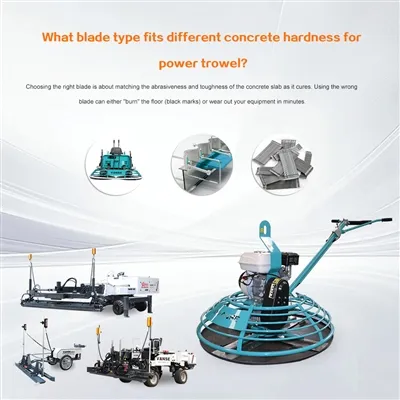
Choosing the right blade is about matching the abrasiveness and toughness of the concrete slab as it cures. Using the wrong blade can either "burn" the floor (black marks) or wear out your equipment in minutes. Here is the breakdown of blade types and when to swap them: Strictly speaking, these are large steel disks that clip onto the blades, but they are the first "type" you'll use. Concrete State: Wet/Plastic. You can leave a 1/4" to 1/2" footprint. Hardness Profile: Soft/Fresh. Use Case: To break down high spots and fill low spots left by the laser leveling. Pans provide the highest Floor Flatness (FF) because they have a massive surface area. The workhorse of the industry. Concrete State: Damp to Firm. Footprint is roughly 1/8". Hardness Profile: Standard setting concrete. Use Case: These are used as the concrete begins to harden. They are stiff enough to apply pressure but flexible enough to "flick" the cream back into the pores. The Catch: If the concrete is very "hard" or has high silica content, these blades will wear down quickly and can leave dark burnish marks if you aren't careful. The "Insurance Policy" for colored or decorative concrete. Concrete State: Firm to Hard. Hardness Profile: High-performance mixes or light-colored slabs. Use Case: If you are working on a white or light-gray floor where burn marks (black streaks from steel friction) would be a disaster. Plastic blades give a smooth finish without the metallic discoloration. A hybrid between a float blade and a finish blade. Concrete State: Medium-Firm. Hardness Profile: Versatile. Use Case: Designed for operators who don't want to swap blades mid-job. One side is wide (for floating) and the other is pitched for finishing. They are great for small-to-medium residential jobs but usually aren't precise enough for ultra-flat industrial floors. Concrete Hardness / Type Recommended Blade Primary Benefit Fresh / Soft Float Pans Maximum flatness; high "cream" Standard / Mid-Day Carbon Steel Finish High durability; classic shine Ultra-Hard / Fast-Set Blue Steel Blades Extra flexibility; prevents "chatter" Light Colored / Dyed Plastic (Poly) Blades Prevents black burnish streaks Epoxy / Specialty Stainless Steel Prevents rust contamination If you are dealing with High-Early strength concrete (which gets hard very fast), look for Blue Steel blades. Blue Steel is thinner and more flexible than standard gold or silver steel. This flexibility allows the blade to "give" a little when it hits a hard aggregate stone, preventing the machine from "chattering" or bouncing, which is common on hard-set slabs. Would you like me to explain how to tell if your blades are "spent" and actually damaging your floor flatness? Contact us NOW Note: The parameters provided in this document are for reference only and are not mandatory. Due to differences in technical characteristics between different brands and models of laser levelers, please consult the manufacturer for a suitable solution before actual operation. This reference document assumes no responsibility for any issues arising from failure to follow the manufacturer's instructions.How to use the concrete laser leveling do concrete work
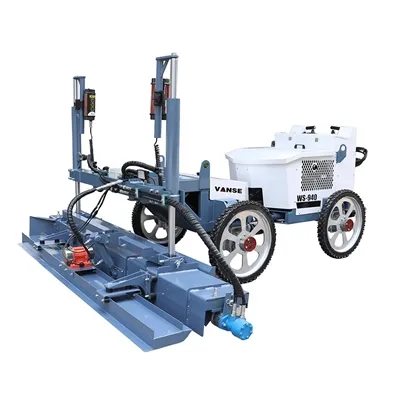
Laser leveling machine is developed according to the increasing demand of modern industrial plant, large shopping mall, warehouse and other large area cement concrete ground for ground quality, such as strength, flatness, levelness, etc. It has the characteristics of good performance and high efficiency. A. Preparations: (1) After the basic treatment, the laser paver is debugged and fixed reference level is drawn according to the original level; non-woven fabrics and side dies are laid, laser transmitters are erected, and ground elevation is introduced into laser leveller according to the original level. (2) The concrete is transported by commercial concrete. The commercial concrete is transported to the entrance and exit of the garage by tank truck, and then transported to the construction site by three-wheel dumper truck. (3) The elevation of the ground floor is checked by hand-held laser receiver, and the elevation is introduced into the laser paver to adjust the reference point (±0.00) on the leveller. B. Concrete Paving: (1) After the formwork is supported, the warehouse should be cleaned one day in advance and soaked with water before pouring concrete. When approaching pouring, drain open water, sweep cement slurry or interface agent. Obvious water accumulation is strictly prohibited at this time. If so, the concrete can be paved only if it is removed resolutely. (2) After the concrete is laid down, it is preliminarily flattened. The flattened height should be 3cm thicker than the elevation. Then it is leveled with a laser paver. The corners which can not be leveled can be leveled by gasoline leveling ruler or manual method. (3) For concrete mixer can not drive to the site area, but also use tractors to transport concrete. After the completion of the pouring, the floor lighting construction will begin when the concrete is initially solidified. (4) In construction, the laser signal received by the laser paver receiver (10 times per second ) automatically adjusts the elevation in real time to ensure that the construction elevation is always in the set standard. Because the laser transmitter is fixed after being set up, it can ensure that the construction of large area of the ground does not produce cumulative errors. (5) During the construction, the operator uses a hand-held laser receiver to inspect the ground after the construction of the machine to ensure that the smoothness error is within the controllable range again. *Notice: It is necessary to ensure that all parts of the laser leveling machine are connected perfectly, without any loosening, so as to prevent problems in the operation process. Add enough lubricating oil to laser leveling machine in advance to improve the flexibility of controller, so as to improve work efficiency. The surface insulation of cable must be complete, and the slightly damaged parts should be treated with caution until they are all in good condition. This can not only ensure the safety of construction personnel, but also the safety of passers-by. After turning on the power supply, it is necessary to check the direction of the motor rotation. If there is a mistake, it is necessary to change the line immediately in order to avoid greater problems in working hours. Laser leveling machine operators should undergo professional training, such as in the operation process, they can not tilt, can not grasp too tight and other elements should be mastered well, in order to avoid accidents accidentally. Laser leveling machine in the construction process, needs density of soil, can repeat consolidation, don't move back and forth, so even if the result is the same, it will spend more energy on moving, not economical. Welcome for asking if you had any needs in the concrete paving machine needs!!