Technical Knowledge
Safety techniques and precautions for operating a power trowel in a sloping (uphill or downhill) environment
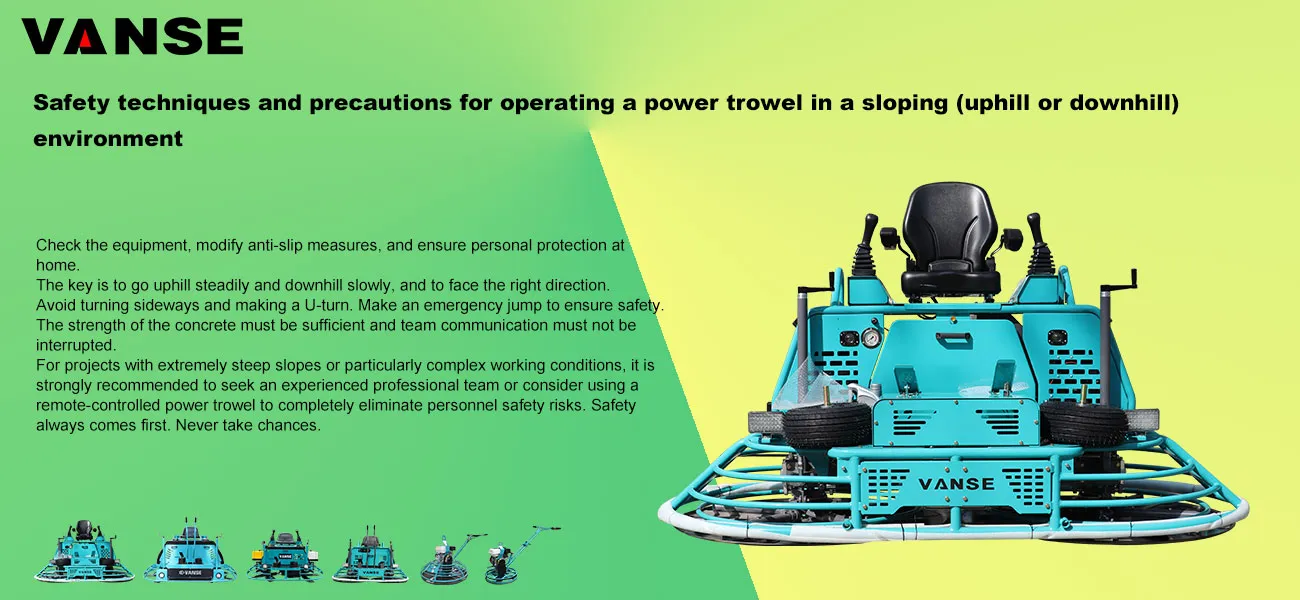
Operating a power trowel on slopes, especially those with initially set concrete, is one of the most risky and technically challenging conditions in ground construction. The following safety techniques and precautions must be strictly observed to prevent serious accidents.
Core risk
Operating a power trowel on a slope mainly involves two major risks:
Risk of equipment loss of control: The polishing machine is very heavy and is prone to sliding, side-sliding or rolling under the effect of gravity, which may injure the operator or damage the equipment.
Risk of personnel falling: Operators walking on inclined and smooth concrete surfaces are highly prone to slipping and may be seriously injured by the high-speed rotating polishing discs.
Ⅰ. Preparation and Planning Before Construction
Detailed technical briefing
All operators and auxiliary workers must be clear about the construction plan, slope, range and emergency response plan.
Clearly demarcate the operation area and set up clear warning signs.
Equipment inspection and modification
Comprehensive inspection: Ensure that the power trowel (especially the hydraulically driven type) is in good condition and that the braking system (if available) is sensitive and reliable. Check the wear of the power trowel and use a power trowel with uniform wear.
Personal protective equipment (PPE)
Anti-slip rubber shoes: It is necessary to wear anti-slip water shoes or rubber shoes with deep toothed soles that can firmly adhere to the concrete surface. Flat shoes or old shoes are strictly prohibited.
Safety rope/safety belt (for steep slopes) : When the slope is large (usually recommended to exceed 15°) or the working conditions are particularly dangerous, the operator should wear a safety rope and fix it to a firm anchor point at the top of the slope, and be supervised by a dedicated person.
Other equipment: Work clothes and gloves. Loose clothing is strictly prohibited to prevent being drawn in by rotating parts.
Environmental preparation
Reserve sufficient safety areas at the top and bottom of the slope and remove all obstacles.
Make sure there are no debris, steel bars, etc. on the slope.
Prepare sufficient lighting, especially when there is insufficient light.
Ⅱ. Safety Techniques and Key Points in Operation
Uphill operation
Basic principle: Relatively safe, but control the speed and Angle well.
Technical essentials
Keep the machine upright: Position the machine directly towards the top of the slope and do not drive diagonally.
Steady and slow upward movement: Use a low gear and a stable throttle to maintain a steady forward speed.
Utilizing the machine's own weight: Moving the center of gravity of the machine backward can provide better adhesion. However, always be vigilant to prevent the machine from suddenly shutting down and sliding back due to insufficient power or slippage.
Downhill operation
Basic principle: The highest risk! Extreme caution must be exercised.
Technical essentials
Always keep the machine facing the downhill direction. It is strictly forbidden to go downhill horizontally or diagonally.
Utilize gravity and braking: Let the machine move slowly down relying on gravity, and control it with a low gear and intermittent braking (if there is a braking function) to achieve the effect of "engine braking".
Do not coast with the engine off: The engine power must be maintained to provide hydraulic and braking assistance.
Center of gravity control: The operator should stand on the uphill side of the machine, use their own body as a counterweight, and be ready to jump upward to the side at any time when the machine loses control.
Lateral movement and U-turns
Try to avoid moving sideways or making U-turns on slopes. If you need to change direction, you should try to do it in a pre-leveled and relatively flat area (such as a rest platform).
It is strictly forbidden to make sharp turns on slopes, as this can easily cause the machine to tip over.
Ⅲ. Key Precautions and Taboos
Taboo: Instinctive reactions in emergencies
When the machine slides down, it is strictly forbidden to block it with your feet or hands! This can lead to serious crush injuries. The correct approach is to quickly release the control lever (to stop the rotation of the power trowel) and jump to the uphill side to clear the machine's descent path.
If you slip, stay away from the machine immediately! Curl up your body and roll upwards to the side, away from the rotating power trowel disc of the power trowel.
Stay focused and communicate
The operator must remain fully concentrated throughout the process, always being aware of the machine's condition and the road surface beneath their feet.
Maintain effective communication with the auxiliary personnel at the top and bottom of the slope (such as using walkie-talkies or gestures) to ensure they are not on the potential out-of-control path of the machine.
Concrete condition judgment
The operation of the machine can only be carried out after the concrete has reached sufficient initial setting strength (the depth of the footprints left by people when stepping on it does not exceed 5mm). When the strength is insufficient, the equipment will sink and damage the concrete structure.
Pay attention to the moisture on the surface of the concrete. If there is excessive bleeding, the surface will become abnormally slippery, significantly increasing the risk of personnel and equipment slipping.
Teamwork
A dedicated person must be assigned to a safe location for supervision, always ready to cut off the power supply or provide assistance in case of an accident.
Cables or hydraulic hoses must be led down from the top of the slope and someone should be responsible for organizing them to prevent them from being crushed or entangled by machinery.
Summary: Safety mnemonic for operating a slope power trowel
Check the equipment, modify anti-slip measures, and ensure personal protection at home.
The key is to go uphill steadily and downhill slowly, and to face the right direction.
Avoid turning sideways and making a U-turn. Make an emergency jump to ensure safety.
The strength of the concrete must be sufficient and team communication must not be interrupted.
For projects with extremely steep slopes or particularly complex working conditions, it is strongly recommended to seek an experienced professional team or consider using a remote-controlled power trowel to completely eliminate personnel safety risks. Safety always comes first. Never take chances.
Note: The parameters provided in this document are for reference only and are not mandatory. Due to differences in technical characteristics between different brands and models of laser levelers, please consult the manufacturer for a suitable solution before actual operation. This reference document assumes no responsibility for any issues arising from failure to follow the manufacturer's instructions.
Thanks to All the Friends Who Support and Trust Shandong Vanse Machinery Technology Co., Ltd.
If you want to know more about Shandong Vanse Machinery Technology Co., Ltd. or have any questions, please feel free to contact us:
Our Factory
Shandong Vanse Machinery Technology Co., Ltd.








Share this article

About the Author: Shandong Vanse Machinery Technology Co., Ltd.
Shandong Vanse Machinery Technology Co., Ltd. is a high-tech manufacturer specializing in concrete construction machinery, including laser screeds and related equipment. The company integrates R&D, production, and global sales, with products exported to over 60 countries and widely used in infrastructure projects worldwide.
Previous Post
Next Post
Related Articles
You Might Also Like
Is the concrete laser leveling machine easy to use? Is it worth buying?
The concrete laser leveling has been officially on the market for 8 years so far, and the quality technology has become mature and stable. There are fewer and fewer young people working in the construction and flooring industry. A project requires at least 20 people. According to the minimum wage standard of 150 yuan/person per day, the daily personnel expense is 3,000 yuan, and the average age of the personnel is 50 years old. Above, work efficiency cannot be guaranteed. In addition, formwork and channel steel need to be supported, which is a considerable expense. It takes up to eight people to complete a job with a laser leveling machine. The daily salary cost is 1,200 yuan, which saves 600,000 yuan a year. The money saved can be used to buy a luxury car. Today's laser leveling machines are becoming more and more intelligent, and the operation is very simple and can be learned in a while. The ground error made by the laser leveling machine is also small and easily reaches the standard. The results produced by the laser leveling machine will quickly make you famous, and many people will come to you to work for you. You can also rent out your machine to make some extra money if it is idle. In the future, you don't have to worry if you encounter projects that require fast construction deadlines and small error requirements. I can do 300 square meters in one hour, and I guarantee that it will be completed on time, and the work will be done beautifully and you will be waiting for payment. Nowadays, the configuration of laser leveling machines is becoming more and more perfect, and there are many configurations for you to choose from. Some are suitable for sloping, some are suitable for workshop floors, some are suitable for pig farms, some are suitable for residential floor steel mesh, and some are suitable for basement garages. Yes, you can also customize it according to your actual situation. VANSE Laser Leveling Machine has been in the industry for so many years and has been constantly researching and innovating. The technology is getting better and better, and the machines are getting better and better to use. Every new laser leveling machine developed is sought after by the market. Small laser leveling machines, large laser leveling machines, and heavy-duty concrete telescopic arm leveling machines are all mature. With stable production experience, the quality of laser leveling machines has been recognized and affirmed by customers. VANSE's after-sales service is also well-known in the industry. VANSE always puts the interests of customers first. Any needs for laser leveling machines will be solved as soon as possible, which is something other companies cannot do. When choosing a laser leveling machine, don't we just look at the quality and after-sales service? 13 years of production and sales experience are enough to prove the quality of the machine, and the good after-sales reputation and word-of-mouth from old customers are enough to prove our after-sales service. And we can provide you with professional construction plans based on our many years of experience.Laser leveling machine purchase tips
Now the sales of laser leveling machines in the market are becoming more and more fierce. Many manufacturers are competing for sales, and dealers are blooming everywhere. All sellers are doing their best to expand marketing, while consumers are mostly in a waiting state. Consumers feel very confused and don't know how to start when purchasing equipment. They are afraid that the quality of the purchased products is not good, the seller does not have enough integrity, the after-sales service is not in place after the purchase, and the boss is not satisfied with the purchased products. A series of problems. The editor knows the difficulties of being a purchaser, so the editor is here to solve everyone's confusion today. How to buy a laser leveling machine that you are satisfied with can be considered from these aspects: channel, quality, brand, and after-sales. These four aspects can be used to evaluate whether the laser leveling machine is the product you want to buy. First of all, the channel, the channel here refers to the source of the equipment. Everyone knows that the manufacturer is always the choice of the customer. Shandong Vanse Machinery has focused on the research and development of laser leveling machines for more than ten years. The laser leveling machine is sold directly by the manufacturer. Compared with dealers, customers will save a lot of costs, one-step, convenient and fast, and quality guaranteed. Quality is the core of a product. All equipment that is not produced for quality will be eliminated. Without quality, there will be no product survival. Shandong Vanse Machinery's laser leveling machine uses imported engines, integrates high-tech technologies such as laser, integrated hydraulics, and closed-loop control technology, and its high-standard design appearance has won praise from many old customers. Brand is the soul of the product. Without a soul, it is like a walking corpse. The brand is given by the enterprise. An enterprise with a positive energy culture has a full of positive energy in its product soul. Shandong Vanse Machinery has always adhered to the development concept of technological innovation and providing excellent products to users in the field of laser leveling machine industry. This is also an important reason why Shandong Vanse Machinery Technology Co., Ltd. has been at the forefront of the industry and has become the first brand for users. After-sales service is even more assured. Shandong Vanse Machinery is located in Yanzhou, Shandong, the birthplace of Confucianism. It has a large production plant and an excellent technical team. Many years of good service reputation have accumulated many good praises for the company. If you have any needs for laser leveling machines, the company will accept your questions at any time and answer your questions with professional equipment technology.How can the concrete laser leveling machine process be coordinated with the design of concrete construction to achieve the best level effect?
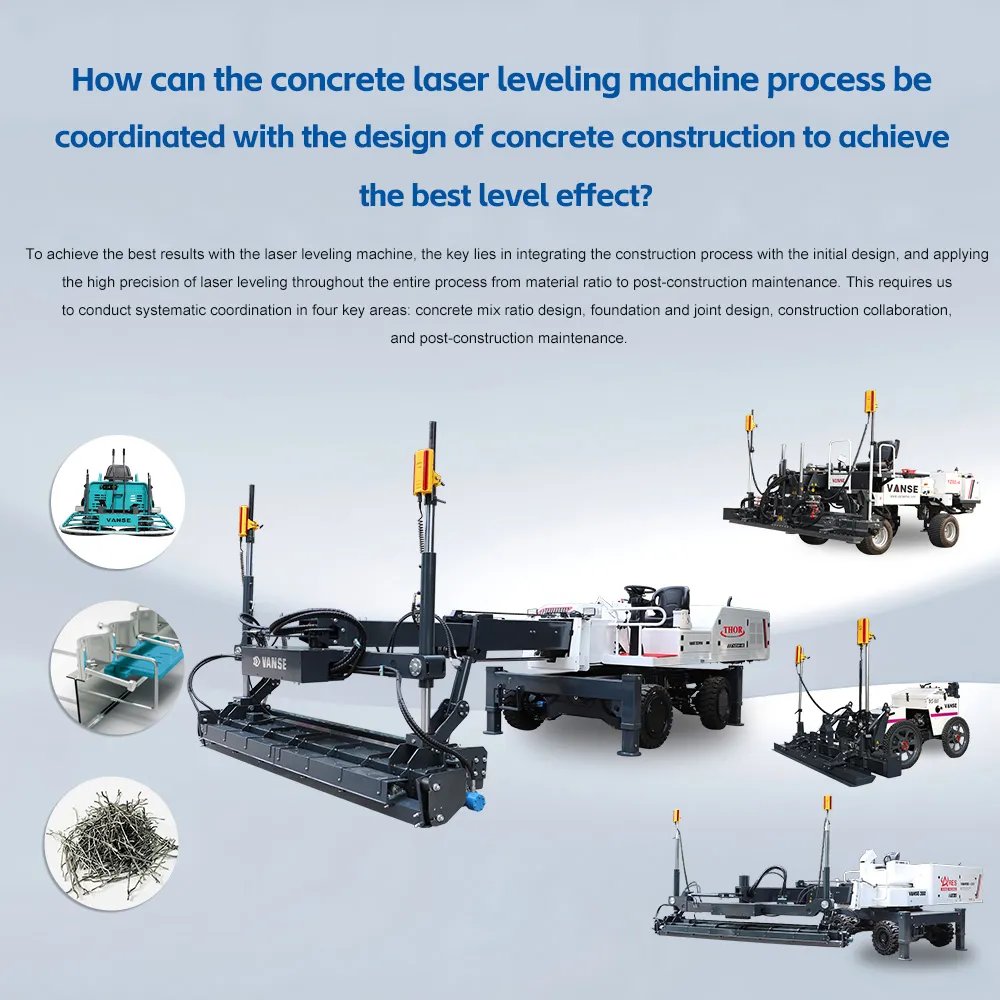
To achieve the best results with the laser leveling machine, the key lies in integrating the construction process with the initial design, and applying the high precision of laser leveling throughout the entire process from material ratio to post-construction maintenance. This requires us to conduct systematic coordination in four key areas: concrete mix ratio design, foundation and joint design, construction collaboration, and post-construction maintenance. Objective: To prevent problems before they occur and promptly identify potential issues through daily observation. The high-frequency vibration and precise leveling of the laser leveling machine require that the concrete itself have good and stable working performance. Mix ratio design is the foundation. Design parameters Recommendation requirements: The influence on the laser leveling effect Water-cement ratio Not more than 0.5, no water addition allowed on site Controlling the water-cement ratio can ensure the strength and volume stability of the hardened concrete, preventing shrinkage cracks or insufficient strength due to excessive moisture. Adding water on-site will disrupt the mix ratio, causing segregation and bleeding, which seriously affects the leveling accuracy. Consistency 14 ± 2 cm (maximum 16 cm) This slump range can ensure that the concrete has good fluidity, facilitating the leveling by the laser leveling machine, while not being too thin to maintain the shape after leveling, which is the key to ensuring the stability of the leveling accuracy. Setting time Initial setting time controlled within 3-5 hours It provides sufficient operation windows for the spreading, vibrating and repeated leveling of the laser leveling machine, ensuring the continuity of large-scale construction and avoiding cold joints. Aggregate gradation Maximum particle size of coarse aggregate ≤ 25 mm; sand ratio controlled within 35% – 40% Good gradation can ensure the concrete is dense and uniform, avoiding surface defects (such as cracking and sanding) caused by aggregate segregation, creating a uniform working surface for laser leveling. Without a solid foundation and scientific joint design, the accuracy of laser leveling will be impossible to achieve. Foundation preparation: Before concrete pouring, it is necessary to ensure that the base has been leveled, compacted, and precisely controlled in terms of elevation. This is the fundamental measure to prevent ground settlement and deformation after completion, thereby ensuring the final levelness. Joint design: Construction joints: In design, efforts should be made to minimize the occurrence of construction joints. When they cannot be avoided, a force transmission system should be set up. This can effectively transfer the load between the slabs and prevent misalignment at the joint, thus avoiding damage to the overall flatness of the ground. Expansion joints/cutting joints: The design should clearly define the time and method for cutting the joints. To overcome concrete shrinkage and temperature stress, the cutting should be carried out as early as possible (usually within 24 hours), and the quality of the cutting should be strictly controlled to prevent the edges from cracking or the formation of irregular cracks. The laser leveling machine is the core, but it cannot function without the close collaboration between humans and the environment. Human-machine collaboration: The equipment operator is responsible for precise leveling, while 3-4 workers are needed to assist, responsible for quickly leveling the concrete, handling the formwork, the edges of columns, and the corner areas that the machine cannot cover. This "machine operator with human assistance" model is the key to ensuring overall flatness without any blind spots. Process control: Material supply stability: It is necessary to ensure continuous concrete supply (speed ≥ 40m³/h), and the slump and initial setting time of each truckload of concrete should be highly consistent to avoid affecting the construction quality and progress due to material fluctuations. Leveling verification: During the leveling process, the ground elevation should be regularly rechecked to ensure that the laser emitter is working properly. Once any problems are identified, they should be immediately adjusted to prevent large-scale rework. Environmental protection: The ground that has just been leveled must not be exposed to direct sunlight, strong winds, or rainwater. At the same time, the construction site should avoid electric welding operations and reflective objects to prevent interference with the reception of the laser signal. The later maintenance and surface treatment are the final procedures for protecting and enhancing the laser-levelled finished products. Timely maintenance: Use the maintenance agent compatible with the floor material for maintenance. This can form a high-density crystalline film, effectively locking in moisture and preventing concrete from developing dry shrinkage cracks or surface dusting due to rapid water loss, ensuring strength and flatness. Wear resistance and joint sealing: For floors with wear resistance requirements, apply high-performance floor hardener at the appropriate time (determined by the concrete setting time). After cutting the joints, use polyurethane joint sealing adhesive of the same color as the floor to handle the joints, to ensure the tear resistance, aging resistance and aesthetic performance of the joints. To achieve the best results with the laser leveler, it must be regarded as a systematic project. From the design stage, create the best conditions for this efficient and high-precision process, and strictly control the entire construction process. If you can provide more information about your project, such as whether it is a logistics warehouse with super-leveling or a basement with decoration requirements, I can provide you with more targeted design suggestions. Contact us NOW Note: The parameters provided in this document are for reference only and are not mandatory. Due to differences in technical characteristics between different brands and models of laser levelers, please consult the manufacturer for a suitable solution before actual operation. This reference document assumes no responsibility for any issues arising from failure to follow the manufacturer's instructions.