Technical Knowledge
Key points for routine inspection, fault early warning and maintenance of the hydraulic system of concrete laser leveling
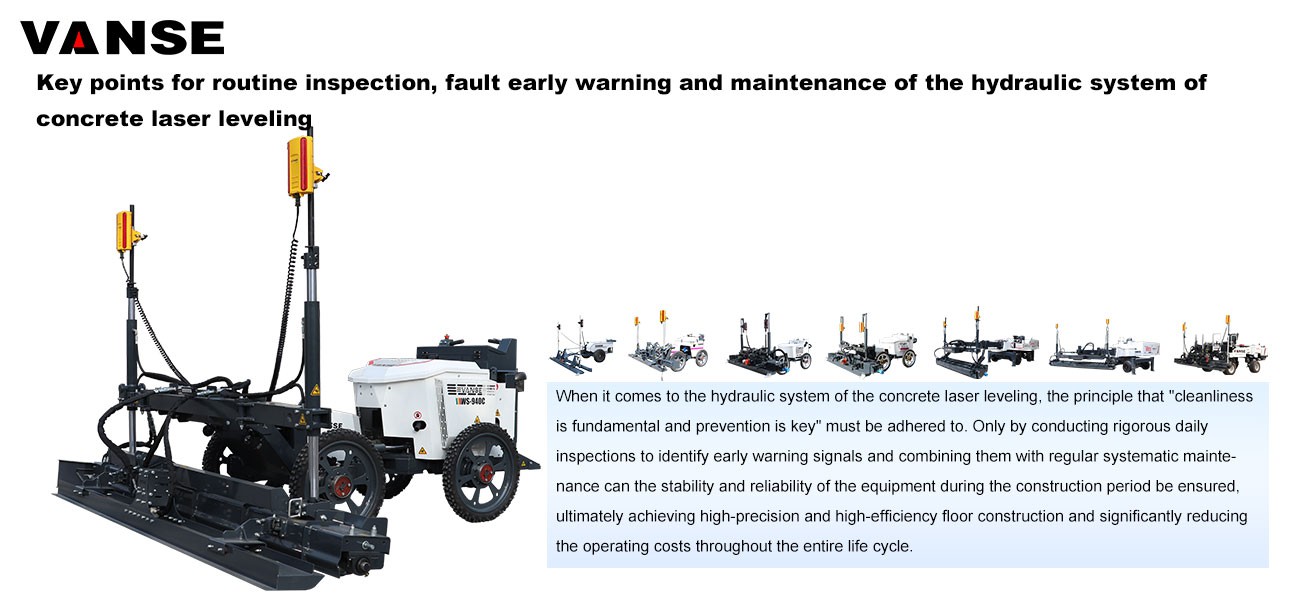
The routine inspection, fault early warning and maintenance points of the hydraulic system of the concrete laser leveling are a crucial topic, as the health condition of the hydraulic system directly determines the construction efficiency, leveling accuracy and equipment service life of the leveling.
The following is a detailed and systematic guide.
Ⅰ. Routine Inspection (Before and after daily/Each shift's work)
Objective: To prevent problems before they occur and promptly identify potential issues through daily observation.
Visual inspection
Oil level check: When the equipment is parked on a level ground and the hydraulic system is not started (or the cylinder has been retracted), check the oil level gauge in the hydraulic oil tank. The oil level should be between the marked upper and lower scale lines. Low oil level can cause the pump to run dry, the system to overheat and get damaged. If the oil level is too high, it may cause excessive pressure or oil leakage from the breather valve when the oil temperature rises.
Leak inspection: Carefully inspect the entire hydraulic system, including:
Pipe joints: Check for oil stains or dripping oil.
Cylinder piston rod: Check for any scratches, bends or continuous leakage.
Hydraulic pump, valve block, motor: Check if there is any leakage at the mating surface.
Fuel tank surface: Whether it is clean and free of oil stains.
Oil color: Observe the color of the hydraulic oil through the oil level gauge. New hydraulic oil is usually transparent amber in color. If it is found to be turbid and opaque (possibly water ingress), darker and blackened in color (possibly oxidation and deterioration), or milky white (definitely water ingress and emulsification), further treatment is required.
Auditory and tactile examination
Abnormal noise: Start the engine and operate various hydraulic actions (lifting, walking, vibration, etc.). Listen carefully for any sharp "click-click" sounds (cavitation sounds) or continuous dull abnormal noises from the hydraulic pump (possibly due to internal wear of the pump or motor).
Vibration and Pulse: Touch the hydraulic pipeline with your hand to feel if there is any abnormally intense vibration or pulse sensation. This may be a sign of oil circuit blockage or pump/motor failure.
Temperature: After working for a period of time, touch the outer shell of the hydraulic oil tank with your hand. If it feels hot to the touch (the temperature may exceed 60-70°C), it indicates that the system is overheated and needs to be shut down for inspection.
Operational performance check
Slow movement: Test the movement of all cylinders and motors to see if there is any slowdown in speed, weakness or jamming.
Pressure maintenance: For the lifting cylinder, observe whether there is obvious "sinking" (i.e., internal leakage) after it is lifted.
Ⅱ. Fault Warning Signals
Objective: Identify early symptoms of faults to prevent minor issues from evolving into major ones.
| Warning signal | Analysis of Possible causes | Potential risk |
|
Slow and weak movements
|
1. Insufficient hydraulic oil or incorrect viscosity of the oil. | The leveling accuracy has declined, making it impossible to work normally and resulting in low efficiency. |
| 2. The main pump is worn out and internal leakage occurs, resulting in insufficient pressure/flow. | ||
| 3. The set pressure of the relief valve (safety valve) is too low or the valve core is stuck. | ||
| 4. Severe internal leakage of the actuator (cylinder/motor). | ||
|
Abnormal noise from the system (pump
|
1. The oil suction pipeline is clogged or the filter element is dirty. | The hydraulic pump will be severely damaged in the short term and must be shut down immediately. |
| 2. When the oil level is too low, the pump sucks air, causing cavitation. | ||
| 3. Air mixed into the hydraulic oil (due to poor sealing of the pipelines). | ||
| 4. The bearings or internal components of the pump itself are damaged. | ||
|
The system is severely overheating.
|
1. The hydraulic oil cooler is clogged (air-cooled or water-cooled). | Accelerate the oxidation and deterioration of the oil, the aging of seals, and the wear of all hydraulic components. |
| 2. The relief valve is frequently opened or the set pressure is too high. | ||
| 3. Improper viscosity or deterioration of the hydraulic oil. | ||
| 4. Severe leakage inside the pump or valve causes energy loss, which is converted into heat energy. | ||
|
The cylinder is crawling and shaking
|
1. There is air in the cylinder. | It affects the stability of the leveling operation, causing waves to appear on the ground. |
| 2. The wear of the piston seal in the oil cylinder leads to unstable pressure. | ||
| 3. Oil contamination leads to the valve core of the control valve getting stuck and discontinuous movement. | ||
|
The hydraulic oil deteriorates rapidly
|
1. The oil temperature has been too high for a long time, leading to oxidation. | Cause abrasive wear and corrosion of all hydraulic components. |
| 2. Water enters the oil (such as leakage from the water cooler). | ||
| 3. Contaminants (dust, metal shavings) invade the system. | ||
| External leakage | Aging of seals, damage to oil seals, loose joints, and wear and rupture of pipelines. | Waste of oil, environmental pollution, insufficient system pressure, and even fire. |
Ⅲ. Key Points for Systematic Maintenance
Objective: Establish a scientific maintenance system to maximize the system's lifespan.
Keep the oil clean – this is the "lifeline" of the hydraulic system
Regularly change the hydraulic oil and filter elements: Strictly follow the oil change cycle specified by the equipment manufacturer (usually 500-1000 working hours). In harsh and dusty environments, the cycle should be shortened. When changing the oil, all hydraulic filter elements (suction oil filter, return oil filter, pressure oil filter) must be replaced simultaneously.
Refueling must be filtered: When adding or replacing new oil, it is essential to use a dedicated fuel pump and filtering device. It is strictly forbidden to directly pour the oil drum into the fuel tank.
Keep the fuel tank clean: Clean the area around the fuel tank cap before refueling to prevent debris from falling in. Regularly clean the magnetic plugs inside the fuel tank.
Keep the oil temperature normal
Regularly clean the fins of the hydraulic oil radiator to ensure good ventilation and no blockage from concrete, dust, etc.
Avoid the equipment operating under extremely high load for a long time.
If the ambient temperature is high, an auxiliary cooler can be considered for installation.
Prevent air and moisture from entering
Ensure the sealing of all suction pipelines to prevent the pump from being sucked empty.
Regularly check whether the fuel tank breathing valve is unobstructed.
After the machine stops, regularly check the water outlet at the bottom of the fuel tank for any water.
Regularly conduct oil testing (oil analysis)
For key equipment, samples can be taken regularly and sent to professional laboratories for testing. The analysis report can inform you of the contamination degree of the oil, the composition of worn metals, water content and physical and chemical indicators, thereby accurately predicting faults, achieving oil replacement based on quality and saving costs.
Correct operating habits
Avoid operating the hydraulic cylinder piston rod only when it reaches the end of its stroke. Instead, release the operating rod before approaching the end to take advantage of inertia to reach the position and reduce the impact.
When starting up in winter, it should first run at low speed without load for a period of time to allow the oil temperature to rise and the viscosity to decrease before commencing operations.
Maintenance cycle recommendation table
| Maintain the project | Daily/ Per shift | Weekly/ 50 hours | Month/ 250 hours | Every six months / 1,000 hours |
| Check the hydraulic oil level | ✓ | |||
| Check for leakage, abnormal noise and temperature | ✓ | |||
| Clean the surface of the fuel tank and radiator | ✓ | ✓ | ||
| Check the tightness of the pipelines and joints | ✓ | |||
| Replace the hydraulic return oil filter element | ✓ | |||
| Take oil samples for testing (suggested) | ✓ | |||
| Completely replace the hydraulic oil and all filter elements | ✓ (As per the manufacturer's regulations |
Summary
When it comes to the hydraulic system of the concrete laser leveling, the principle that "cleanliness is fundamental and prevention is key" must be adhered to. Only by conducting rigorous daily inspections to identify early warning signals and combining them with regular systematic maintenance can the stability and reliability of the equipment during the construction period be ensured, ultimately achieving high-precision and high-efficiency floor construction and significantly reducing the operating costs throughout the entire life cycle.
Note: The parameters provided in this document are for reference only and are not mandatory. Due to differences in technical characteristics between different brands and models of laser levelers, please consult the manufacturer for a suitable solution before actual operation. This reference document assumes no responsibility for any issues arising from failure to follow the manufacturer's instructions.
Thanks to All the Friends Who Support and Trust Shandong Vanse Machinery Technology Co., Ltd.
If you want to know more about Shandong Vanse Machinery Technology Co., Ltd. or have any questions, please feel free to contact us:
Our Factory
Shandong Vanse Machinery Technology Co., Ltd.








Share this article

About the Author: Shandong Vanse Machinery Technology Co., Ltd.
Shandong Vanse Machinery Technology Co., Ltd. is a high-tech manufacturer specializing in concrete construction machinery, including laser screeds and related equipment. The company integrates R&D, production, and global sales, with products exported to over 60 countries and widely used in infrastructure projects worldwide.
Previous Post
Next Post
Related Articles
You Might Also Like
Safety & environmental protection measures for fine stone concrete floor construction
Construction of fine aggregate concrete floor: Safety protection and environmental protection measures To ensure the smooth progress of the fine aggregate concrete floor construction process, safeguard the safety and health of the workers, and minimize the negative impact on the environment, the following measures are specially formulated. Safe construction should follow the principle of "safety first, prevention foremost, and comprehensive governance". Head protection: All personnel entering the construction site must wear qualified safety helmets correctly. Foot protection: Construction workers should wear safety shoes that are resistant to impact, puncture and slip. Concrete operators are advised to wear rubber boots to prevent cement slurry corrosion. Respiratory protection: When handling, mixing and dry spreading cement and sand and gravel, especially in poorly ventilated environments, dust masks must be worn to prevent inhalation of cement dust. Hand protection: Operators should wear rubber or plastic gloves to prevent skin burns from cement and alkaline substances. Eye protection : When mixing, pumping or using power tools for cutting and grinding, protective glasses should be worn to prevent concrete slurry or debris from splashing into the eyes. High-altitude work protection: When working near edges or openings, safety belts must be fastened. Before use, check the electrical circuits, insulation conditions and whether the protective covers are in good condition. When in operation, it is strictly forbidden to insert hands or tools into the mixing drum. When cleaning or conducting maintenance, the power supply must be cut off, and a dedicated person should be assigned for supervision. A warning sign reading "Do Not Close the Switch" should be hung. Before operation, check whether the cable, switch, blade/grinding disc are in good condition and securely fastened. Operators need to be familiar with the equipment operation procedures, hold the control lever tightly with both hands to prevent the machine from getting out of control. The cable should be suspended to prevent it from being caught or dragged by the machine. The support of the pump pipe must be firm, especially at the elbows and joints. When pumping, it is strictly prohibited for anyone to stand at the outlet of the pump pipe. When cleaning the pipeline, there must be no personnel in front of the outlet. All electric tools must be powered by a power supply equipped with a leakage protection device. Cables must not be dragged on the ground, rolled over or immersed in water. They should be installed overhead or buried underground. Non-professional electricians are strictly prohibited from privately connecting wires or repairing electrical equipment. Openings and edge protection: The reserved openings on the floor, staircase entrances, and elevator shaft openings must be covered with solid covers or guardrails, and safety warning signs must be hung. Material stacking safety: Materials such as cement and sand and gravel should be stacked neatly, and the height should not be too high to prevent collapse. The stacking area should be kept away from slopes and pits. Safety of cross-operation: Arrange the construction sequence reasonably and reduce vertical cross-operation. When it is unavoidable, a safety isolation layer should be set up, and a dedicated person should be assigned to direct and communicate between the upper and lower floors. Fire prevention measures: Smoking is strictly prohibited at the construction site, and sufficient fire-fighting equipment (such as fire extinguishers) should be provided as required. When conducting thermal construction (such as using a furnace for heating in winter construction), there must be a dedicated person to supervise and keep away from flammable materials. Lighting and ventilation: When conducting construction in the basement or at night, there must be sufficient lighting. When working in a closed space, good ventilation should be ensured. Environmental protection should follow the principle of "source control, process management and end-of-pipe treatment". Cement and sand: Cement should be stored in a dedicated warehouse or tightly covered with tarpaulin. Sand and gravel storage sites should be appropriately watered to reduce dust or covered. Mixing operation: Pre-mixed commercial fine aggregate concrete is preferred. If on-site stirring is carried out, it should be set up in a closed or semi-closed stirring shed and equipped with dust suppression devices. Transportation and paving: Transport vehicles should be protected from spillage. When laying manually, avoid raising dust. Cutting and grinding: When performing ground cutting and grinding, it is necessary to use dedicated equipment with dust collection devices or carry out wet water spraying operations to effectively suppress dust. Equipment selection: Give priority to using construction machinery with low noise and high efficiency. Work time: Reasonably arrange the time for high-noise operations (such as cutting and grinding), and try to avoid construction at night or during lunch breaks. If continuous operation is required, it should be reported to the environmental protection department in advance and the surrounding residents should be informed. Sound insulation measures: For fixed high-noise equipment (such as fixed mixers), sound insulation sheds can be set up. Mobile device operators should wear earplugs. Classified collection: Separate construction waste from household waste. Discarded concrete blocks, mortar, packaging bags, etc. should be sorted and stacked. Recycling: Discarded concrete blocks, bricks, etc. can be crushed and used as backfill materials or roadbed materials. Timely removal: Assign dedicated personnel to be responsible for transporting the waste to the designated construction waste storage area in a centralized manner. It is strictly prohibited to dump or landfill it at will. Cleaning of mixing equipment: The wastewater from cleaning mixers and transport vehicles should be discharged into a dedicated sedimentation tank. After sedimentation treatment, the supernatant can be recycled for water spraying and dust suppression. It is strictly prohibited to directly discharge it into the municipal water network or natural water bodies. Curing wastewater: The wastewater generated during the curing stage (such as watering and covering with a wet cloth) is basically clean water, but the flow rate should be controlled to avoid surface runoff, which could lead to water resource waste and site mud. Material conservation: Accurately calculate the amount of concrete used, adopt advanced construction techniques, and reduce unnecessary waste and loss. Water conservation: It is recommended to use spray moisture retention during maintenance and avoid flooding with water. Promote the use of water-saving curing agents (film curing liquid) to replace traditional watering curing. Energy conservation: Select construction equipment with high energy efficiency, rationally arrange the process, and reduce the idling time of equipment. The safety and environmental protection management of fine aggregate concrete floor and ground construction is a dynamic and full-process management. All construction personnel must receive detailed safety and technical briefings before taking up their posts, clearly defining all risks and response measures. Only through strict on-site management and continuous education can safety accidents be effectively prevented and the goal of green and civilized construction be achieved. Note: The parameters provided in this document are for reference only and are not mandatory. Due to differences in technical characteristics between different brands and models of laser levelers, please consult the manufacturer for a suitable solution before actual operation. This reference document assumes no responsibility for any issues arising from failure to follow the manufacturer's instructions.How to effectively prevent and solve the problem of cracks in diamond wear-resistant floor?
How to effectively prevent and solve the problem of cracks in diamond wear-resistant floor Abstract: Diamond wear-resistant floor is widely used in the construction industry due to its high strength and good wear resistance. However, the problem of floor cracks has always been a key factor affecting its service life and aesthetics. This article will focus on how to effectively prevent and solve the problem of diamond wear-resistant floor cracks, and put forward specific and practical methods and suggestions from the aspects of cause analysis, material selection, construction technology, preventive measures, treatment and repair, and maintenance. 1. Analysis of the causes of floor cracks The causes of diamond wear-resistant floor cracks are varied, mainly including the following points: ☑ Improper foundation treatment: The ground foundation treatment is not thorough, and there are impurities such as oil, dust, etc., which leads to the weak bonding between the floor and the base layer, and cracks are easy to occur. ☑ Material quality problem: The quality of diamond wear-resistant materials does not meet the standards, such as excessive mud content and uneven particles, which will reduce the strength and wear resistance of the floor, and then cause cracks. ☑ Irregular construction process: If the construction process is not strictly carried out in accordance with the operating procedures, such as uneven pouring and insufficient vibration, cracks may occur in the floor. ☑ Changes in temperature and humidity: Changes in ambient temperature and humidity will cause thermal expansion and contraction of the floor material, resulting in cracks. 2. Material selection and quality control In order to prevent cracks in corundum wear-resistant floor, the material selection and quality control links should be strictly controlled: ☑ Select high-quality corundum wear-resistant materials: Ensure that the materials meet national standards and industry specifications and have good strength and wear resistance ☑ Strictly control the quality of raw materials: Inspect the incoming raw materials to ensure that indicators such as mud content and particle uniformity meet the requirements. ☑ Control the concrete mix ratio: According to the design requirements and actual conditions, reasonably adjust the concrete mix ratio to ensure the strength and durability of the floor. 3. Construction process optimization Optimizing the construction process is a key measure to prevent floor cracks: ☑ Strengthen foundation treatment: Thoroughly clean the ground foundation to ensure that there are no impurities such as oil and dust, and improve the adhesion between the floor and the base. ☑ Pouring and vibrating: Use layered pouring and uniform vibration to ensure that the concrete is dense inside and avoid hollowing and cracks. ☑ Smoothing and finishing: Smoothing is performed before the initial setting of the concrete to ensure the surface is flat; finishing is performed before the final setting to improve the gloss and wear resistance of the floor. ☑ Maintenance and cutting: After the floor construction is completed, timely maintenance is carried out to maintain appropriate temperature and humidity; at the same time, according to the design requirements and actual conditions, the cutting seams are reasonably set to reduce the impact of temperature stress on the floor. 4. Crack prevention measures In order to effectively prevent the occurrence of cracks in diamond wear-resistant floor, the following measures can be taken: ☑ Strengthen construction supervision: Establish a strict construction supervision system to ensure that construction personnel perform operations in accordance with operating procedures to avoid cracks caused by human factors. ☑ Control the construction environment: Try to carry out construction in an environment with suitable temperature and humidity to avoid the impact of extreme weather on the quality of the floor. ☑ Add anti-cracking measures: Add anti-cracking agent to concrete to improve the anti-cracking performance of the floor; at the same time, set anti-slip and anti-cracking textures on the floor surface to enhance the safety of the floor. 5. Crack treatment and repair When cracks appear on the floor, they should be treated and repaired in time: ☑ Clean the cracks: First remove the debris and oil in the cracks to ensure that the cracks are dry and clean. ☑ Fill and repair materials: Select suitable repair materials (such as epoxy mortar, polymer repair agent, etc.) to fill and repair the cracks. The repair material should have good adhesion, wear resistance and crack resistance. ☑ Polishing and finishing: After the repair is completed, polish and finish the repaired part to keep it consistent with the surrounding floor surface to ensure the overall aesthetics. 6. Maintenance recommendations In order to extend the service life of diamond wear-resistant floor and reduce the possibility of cracks, it is recommended to strengthen daily maintenance work: ☑ Regular cleaning: Clean the floor regularly to remove impurities such as oil and dust to keep the floor surface clean and tidy. ☑ Avoid heavy objects rolling: Avoid placing heavy objects on the floor or performing high-intensity rolling operations to avoid damage to the floor. ☑ Repair damaged parts in time: When the floor is damaged or cracked, it should be treated and repaired in time to prevent the problem from expanding. 7. Case analysis and experience summary Through the analysis of actual cases, we can summarize some experiences and lessons in preventing and solving the problem of cracks in diamond wear-resistant floors: ☑ In a certain project, due to the excessive humidity in the construction environment, many cracks appeared after the floor construction. In response to this problem, we strengthened the control of the construction environment in subsequent projects, and ensured the appropriate humidity of the construction environment by building temporary rainproof facilities and using hygrometers for monitoring, which effectively reduced the occurrence of cracks. ☑ In another project, we used high-quality diamond wear-resistant materials and advanced construction technology, and at the same time conducted professional training for construction personnel to ensure standardized construction operations. Through the implementation of these measures, the floor quality of the project has been significantly improved, and the crack problem has been effectively controlled. In summary, effective prevention and solution of cracks in diamond wear-resistant flooring needs to start from multiple aspects. By optimizing material selection, strengthening quality control, improving construction technology, taking preventive measures, and timely handling and repairing cracks, we can improve the quality and durability of the floor and reduce the occurrence of cracks. At the same time, maintenance is also an important step to maintain floor performance and extend service life. Regular cleaning and inspection, and timely handling of possible problems can effectively prevent the expansion of cracks and further damage to the floor. In the case analysis, it is not difficult to find that the specific conditions of each project are different, so the prevention and solution of floor cracks needs to be flexibly responded to according to the actual situation. Summarizing experience and lessons, and constantly improving and optimizing prevention and repair measures are the key to improving floor quality. In addition, with the advancement of science and technology and the continuous emergence of new materials, the construction technology and materials of diamond wear-resistant flooring are also constantly updated. We should actively pay attention to industry development and the latest research results, introduce advanced construction technology and materials, and improve the quality and performance of the floor. In the design and construction stage of diamond wear-resistant flooring, it is also necessary to fully consider the use environment and use requirements. For example, in places with heavy loads and high frequency of use, higher strength and more wear-resistant materials should be selected, and more stringent construction processes and quality control measures should be adopted. In addition, environmental protection and sustainable development are also important issues in the current construction industry. When selecting floor materials and construction processes, materials and processes with excellent environmental performance and low energy consumption should be selected as much as possible to reduce the impact on the environment. In short, the effective prevention and solution of the problem of cracks in diamond wear-resistant floors requires comprehensive measures from multiple aspects such as material selection, construction process, preventive measures, treatment and repair, and maintenance. By constantly summarizing experience, introducing new technologies and new materials, paying attention to environmental protection and sustainable development, we can continuously improve the quality and performance of the floor, meet the needs of customers, and contribute to the sustainable development of the construction industry. Looking to the future, with the continuous development of the construction industry and the advancement of technology, the application scope of diamond wear-resistant floors will be wider, and its performance and quality will be further improved. We have reason to believe that through continuous efforts and innovation, the problem of cracks in diamond wear-resistant floors will be better solved, providing a safer, more comfortable and beautiful environment for people's lives and work. Before concluding this article, it should be emphasized that the prevention and solution of cracks in diamond wear-resistant floor is not a one-shot process, but requires long-term efforts and continuous improvement. Therefore, we should keep an open mind and continue to learn and explore new methods and technologies to cope with various challenges and problems that may arise. Finally, it should be pointed out that although this article has made a relatively comprehensive discussion on the prevention and solution of cracks in diamond wear-resistant floor, due to the complexity and diversity of actual projects, there may still be some situations that have not been involved or fully considered. Therefore, in actual projects, we should flexibly apply the measures and suggestions mentioned in this article according to the specific situation, and carry out targeted treatment and improvement in combination with the actual situation. In summary, the prevention and solution of cracks in diamond wear-resistant floor is a systematic project, which requires us to start from multiple aspects, take comprehensive measures, and continuously improve and innovate. Only in this way can we ensure that the quality and performance of the floor are effectively improved and create a better environment for people's life and work. The above is an in-depth discussion on how to effectively prevent and solve the problem of cracks in diamond abrasive wear-resistant flooring. We hope that it can provide certain reference and reference value to relevant practitioners and readers. At the same time, we also look forward to more research and innovative results in the field of diamond abrasive wear-resistant flooring in the future to promote the sustainable development and progress of the industry.What floor materials are suitable for metal power trowels?
– Newly poured concrete: Metal trowels are hard and strong, and are very suitable for rough and fine grinding of newly poured concrete floors. After the initial setting of concrete, the use of metal trowels can effectively compact the concrete surface, eliminate pores and tiny cracks on the surface, and make the floor smoother. For example, when building the floor of a large industrial plant, the use of metal trowels can quickly handle large areas of newly poured concrete, improve construction efficiency and floor quality. – Old concrete repair: For the repair of old concrete floors, such as floor wear and sanding, metal trowels can grind and trim the damaged parts. It can remove the loose layer on the surface and provide a good bonding foundation for subsequent repair materials (such as epoxy floor paint, concrete repair mortar, etc.). – Floor leveling layer: In interior decoration, cement mortar is often used for floor leveling. Metal trowels can be used for smoothing after the cement mortar has initially set, so that the surface of the leveling layer is flat, which is convenient for the subsequent laying of floor tiles, wooden floors and other floor materials. Its hardness can ensure that it will not be excessively worn due to the sand particles in the cement mortar during the smoothing process, and at the same time it can effectively compact the cement mortar. – Decorative cement mortar floor: For some cases where colored cement mortar is used as a decorative floor, metal trowels can make the floor achieve a better finish and enhance the decorative effect. For example, in some retro-style buildings, using metal trowels to smooth the colored cement mortar floor can show delicate texture and luster. – Rough grinding stage: There are multiple stages in the production process of terrazzo floor, such as rough grinding, fine grinding and polishing. In the rough grinding stage, metal trowels can be used to remove excess stone and cement slurry on the surface of terrazzo, so that the stone is evenly exposed, laying the foundation for subsequent fine grinding and polishing. Since the terrazzo floor contains hard stones, the high hardness of the metal trowel can withstand the friction of the stones and will not be easily damaged. – Surface defect repair: During the use of the terrazzo floor, if there are surface scratches, pits and other defects, the metal trowel can be used to polish and repair these local areas. Through proper polishing, the damaged area can be restored to the level with the surrounding ground, and then polished to restore the original beauty of the ground. – Forming trowel: The emery wear-resistant floor is formed after the emery wear-resistant material is spread in the initial setting stage of concrete. The metal trowel plays a key role in this process. It can fully combine the emery wear-resistant material with the concrete surface, compact and smooth it. Because the emery itself has a high hardness, the metal trowel can cooperate with it to form a hard and wear-resistant surface on the ground, which is widely used in industrial workshops, warehouses and other places. – Post-maintenance: In the post-maintenance of diamond abrasive wear-resistant floors, metal polishing sheets can be used to regularly polish and clean the floors to remove surface dirt and slight wear marks, thereby extending the service life of the floors.