

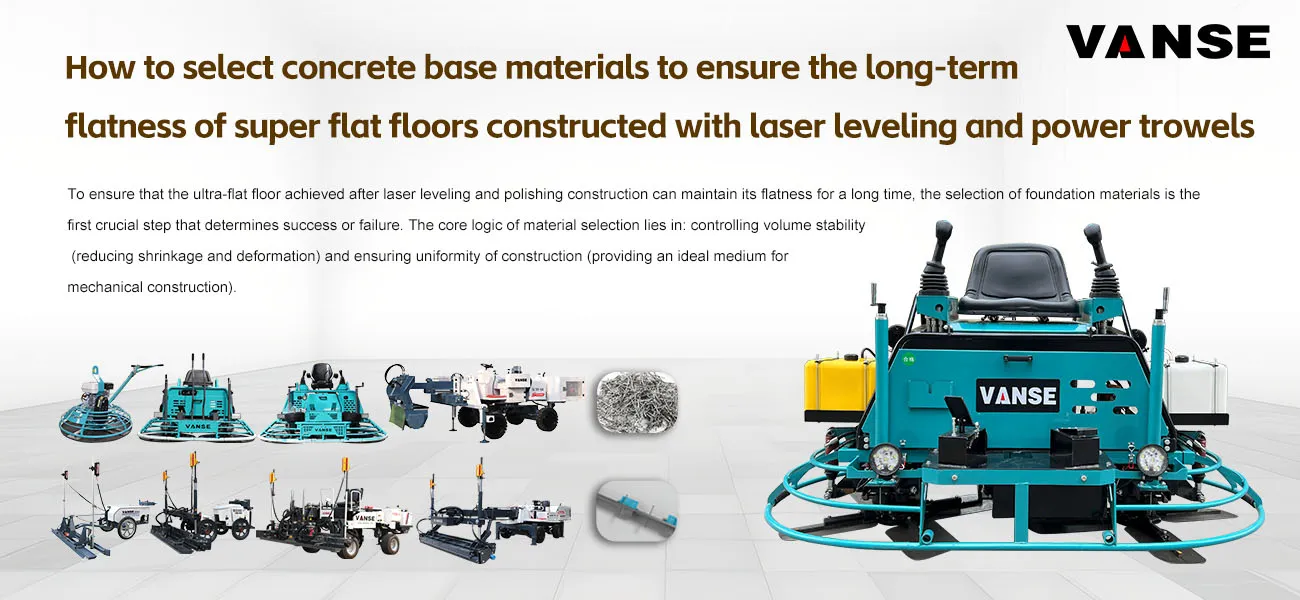
To ensure that the ultra-flat floor achieved after laser leveling and polishing construction can maintain its flatness for a long time, the selection of foundation materials is the first crucial step that determines success or failure. The core logic of material selection lies in: controlling volume stability (reducing shrinkage and deformation) and ensuring uniformity of construction (providing an ideal medium for mechanical construction).
The following are the key material selection points summarized based on engineering practice and technical specifications:
🏗️ Core load-bearing layer: Selection of concrete base material
The design of the concrete mix ratio directly determines the shrinkage rate and crack resistance of the hardened floor, which is the fundamental factor for long-term flatness.
| Material category | Key indicators / recommended requirements | The mechanism of the long-term flatness effect |
| Cement | Ordinary Portland cement; in the same area and of the same batch number | It reduces the surface color difference and internal stress unevenness caused by the chemical shrinkage difference of cement, and lowers the risk of warping. |
| Water-cement ratio | ≤0.48 | Strictly controlling the water-cement ratio is the fundamental means to reduce the dry shrinkage rate of concrete. The larger the water-cement ratio, the more severe the shrinkage, and the more likely it is to crack and deform in the later stage. |
| Slump | For pumping: 100-140mm | Provide stable operation for the laser leveling machine. If the slump fluctuates too much, it will make it difficult for the machine to level properly, resulting in local height errors. |
| For non-pumping: 30-35mm | ||
| Aggregate | Sand: Grade II grading, strictly control the clay content | A good gradation forms a stable framework structure, reducing the amount of cement paste and thereby lowering shrinkage. High clay content can damage the adhesion between cement and aggregates, causing cracks. |
| Gravel: Continuous grading, maximum particle size ≤ 2/3 of the plate thickness | ||
| The maximum particle size of the aggregate | Recommendation: ≤25mm | Excessive particle size will be lifted by the machine during the leveling and polishing processes, thereby damaging the surface flatness and appearance. |
💪 Enhancement and Crack Resistance: Application of Functional Materials
For high-standard ultra-flat floors, ordinary concrete alone is often insufficient. Functional materials need to be introduced to enhance the overall performance.
| Steel fibers | Concentration reference: 15kg/m³ (determined based on design load) | Significantly enhances the tensile and flexural strength of concrete, effectively prevents the expansion of micro-cracks, and prevents plate warping. Compared to steel mesh, steel fiber concrete is more suitable for continuous operation by laser leveling machines, with higher efficiency. |
| Synthetic fibers | Macroscopic polypropylene fibers, etc. | Mainly controls early plastic shrinkage cracks, reduces surface micro-cracks caused by excessive early water loss, laying a foundation for later flatness. |
| Wear-resistant aggregate | Metal or non-metallic aggregates (such as diamond powder, aluminum oxide, etc.) | Sprayed on the concrete surface, after being compacted by a trowel, it forms a high-density, high-maintenance surface layer. This "armor" can resist wear and uneven settlement caused by long-term rolling by forklifts. |
| Sealing curing agent | Lithium-based or sodium-based liquid hardeners | Penetrates into the concrete interior, reacts with calcium hydroxide to form hard calcium silicate, permanently sealing the capillary pores. It can greatly enhance surface hardness, density and impact resistance, preventing damage to flatness caused by later dusting and sanding. |
🧱 Not to be overlooked: Foundation and cushion layer
If the foundation is unstable, the floor will deteriorate. All the selection of upper materials is based on a stable foundation.
Foundation treatment: It is necessary to ensure that the compaction degree meets the design requirements (such as the ground endurance K value is greater than 0.06 N/mm³). Uneven settlement is the fatal flaw that leads to floor cracking and loss of flatness.
Base layer design: Usually, a C15 concrete base layer is set up, and a PE moisture-proof membrane is laid to block the upward movement of capillary water and prevent interlayer separation or expansion deformation caused by water vapor.
Reinforced mesh (if applicable): For non-steel fiber concrete, the reinforced mesh needs to be configured according to the design to control shrinkage. However, it should be noted that the construction efficiency of the reinforced mesh is lower than that of steel fibers.
💎 Summary
To achieve long-term flatness of the super-level flooring, the selection of materials should follow the principle of "combining hardness and softness, and advancing steadily while maintaining stability":
The foundation must be stable: Use concrete with a low water-cement ratio and high-quality graded aggregates as the base to ensure volume stability.
The framework must be strong: Enhance the crack resistance by using steel fibers or steel mesh sheets to counteract shrinkage stress.
The surface layer must be resilient: Create a high-strength and durable surface with wear-resistant aggregates and seal curing agents to resist usage wear.
What is the specific grade requirement for the flooring flatness in your project (for example, does it need to meet free passage or VNA narrow aisle shelving)? This directly relates to whether steel fiber concrete is needed and the amount of wear-resistant aggregates. Please tell me these details so that I can further optimize the material plan for you. Contact us NOW
Note: The parameters provided in this document are for reference only and are not mandatory. Due to differences in technical characteristics between different brands and models of laser levelers, please consult the manufacturer for a suitable solution before actual operation. This reference document assumes no responsibility for any issues arising from failure to follow the manufacturer's instructions.
Our factory
Shandong Vanse Machinery Technology Co.,Ltd


Click the below to jump immediately!!!

ARMOUR JOINT

CONCRETE LASER LEVELING MACHINE

POWER TROWEL

SLIPFORM MACHINE

STEEL FIBER

TOPPING SPREADER
Thanks to all the friends who support and trust Shandong Vanse Machinery Technology Co., Ltd.
If you want to know more about Shandong Vanse Machinery Technology Co., Ltd. or have any questions, please feel free to contact us:
• Tel: +86-13639422395
• Email: sales@vanse.cc
• Website: www.vansemac.com