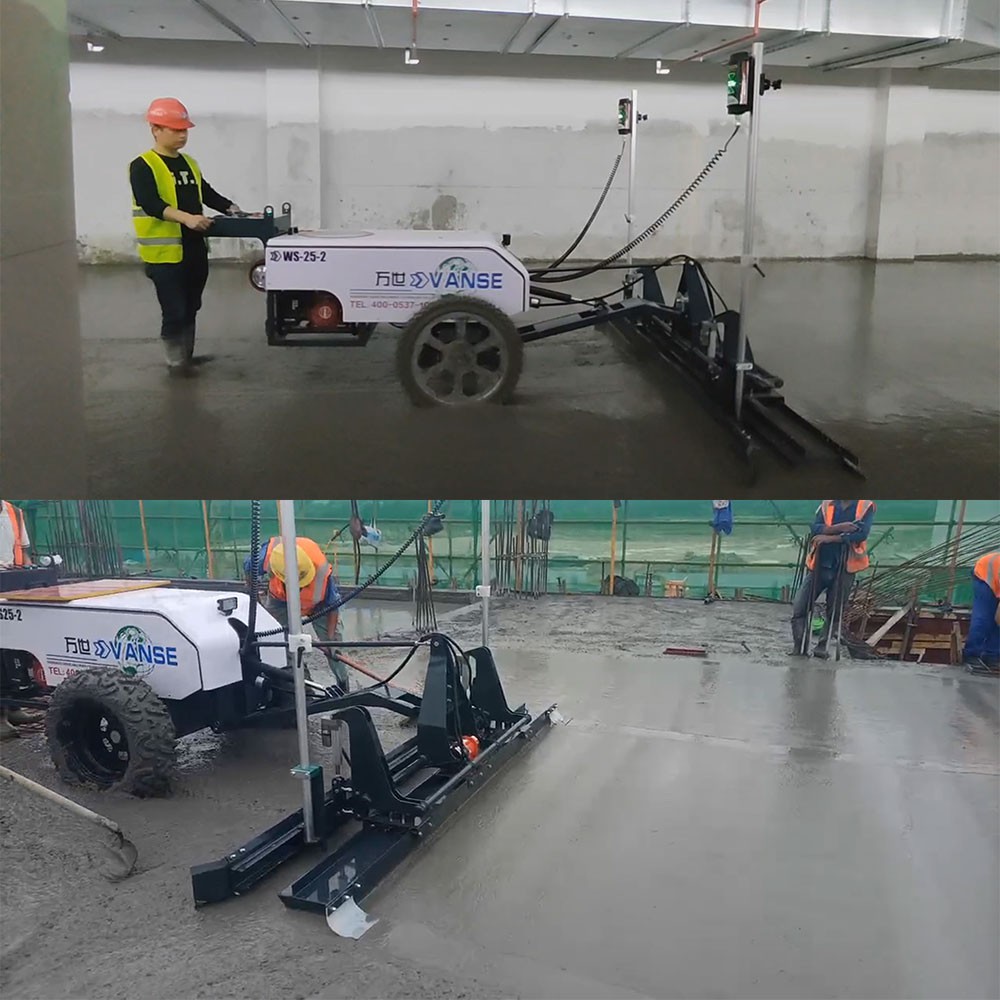
The main methods for using a concrete laser screed to improve the flatness of the floor include the following steps:
1. Laser positioning: First, the laser leveling machine uses a laser rangefinder for positioning. This is a critical step in ensuring a smooth floor, as the laser rangefinder provides precise horizontal and vertical reference lines. Regular inspection and calibration of the laser rangefinder is an important measure to ensure its accuracy.
2. Preliminary leveling of concrete: After the concrete is laid, the initial leveling work is carried out first. The purpose of preliminary leveling is to make the concrete surface basically reach the preset elevation and prepare for subsequent fine leveling work. The concrete surface after initial leveling should be higher than the preset elevation to facilitate subsequent leveling work.
3. Laser leveling: After the initial leveling, use a concrete laser leveling machine to perform fine leveling work. The screed works according to the reference line provided by the laser distance finder, ensuring that the concrete surface exactly matches the reference line. During this process, the leveler works at a constant speed to avoid uneven floors caused by being too fast or too slow.
4. Regular inspection and adjustment: During the construction process, the flatness of the floor needs to be checked regularly. If any unevenness is found, adjustments need to be made in time. This can be accomplished by adjusting the speed and height of the leveler. At the same time, a certain amount of expansion joints should be reserved every day to cope with possible downtime during the leveling process.
5. Maintenance after construction: After the construction is completed, it is also very important to perform proper maintenance on the floor. Maintenance measures include covering with plastic film in the early stage and covering with non-woven fabric after cutting to prevent cracking and other problems caused by the floor drying too quickly.
In general, improving floor smoothness relies on accurate laser positioning, proper concrete primary leveling, accurate laser leveling, regular inspections and adjustments, and proper post-construction maintenance. These steps require professional operators to ensure the flatness and construction quality of the floor.