Technical Knowledge
How can maintenance of a concrete laser leveling machine extend its service life?
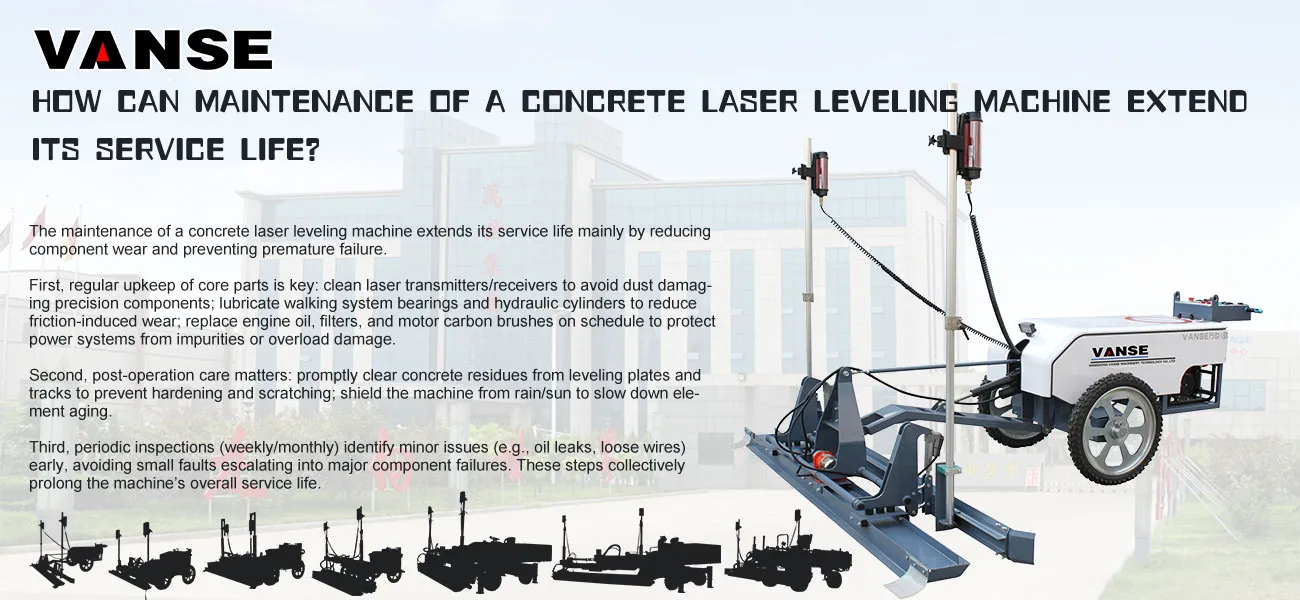
As high-precision, high-load engineering equipment, the core goal of maintenance for concrete laser leveling is to reduce component wear, prevent potential failures, and maintain stable performance, thereby fundamentally extending the equipment's service life. The following details key maintenance measures and their mechanisms for extending service life from four perspectives: daily, regular, specialized, and long-term.
Ⅰ. Daily Maintenance: Daily "Checkups" to Prevent Minor Problems from Escalating into Major Failures
Daily maintenance is the first line of defense for equipment life and must be rigorously performed before, during, and after each operation. Focusing on inspecting components prone to wear and high-frequency operation, this ensures that operating with defects exacerbates component degradation.
| Maintenance phase | Core inspection items | Specific operations | Effect on life extension |
| Before the working | 1. Powertrain (Engine/Motor) | 1. Check the engine oil level (must be within the dipstick range), coolant/antifreeze level, and motor wiring for security and damage. | 1. Prevents engine seizure due to lack of oil or coolant, and motor burnout due to wiring problems. |
| 2. Hydraulic System | 2. Check the hydraulic oil tank level (must meet the "operating fluid level" indicated on the equipment), hydraulic pipe joints for leaks, and hydraulic oil for emulsification/discoloration. | 2. Prevents insufficient pressure in the hydraulic system due to lack of oil or leakage, which can cause stalling in the travel or leveling motion and increase wear on the hydraulic pump. | |
| 3. Laser System | 3. Clean the laser transmitter/receiver lens (use a soft cloth to avoid scratches) and test the laser signal for stability (no flickering or disconnection). | 3. Ensures laser accuracy, avoids leveling errors caused by signal anomalies, and prevents lens scratches that could affect subsequent use. | |
| 4. Travel/leveling mechanism | 4. Check the scraper blades and blades for deformation/wear (wear exceeding 3mm requires prompt repair), and check whether the tire pressure/track tension of the travel wheels are normal. | 4. Reduce the additional load on the scraper/blade due to deformation and avoid bearing wear on the traveling mechanism due to abnormal tire pressure/tension. | |
| Working | 1. Equipment operating sound | 1. Listen for any unusual noises from the engine/motor (such as "tapping" or "buzzing" due to overload), and any "hissing" or leaks from the hydraulic system. | 1. Promptly detect abnormal component friction (such as bearing wear) to prevent component "stuck" and resulting in scrapping. |
| 2. Temperature monitoring | 2. Touch the outer wall of the hydraulic oil tank (temperature not exceeding 60°C) and the motor housing (temperature not exceeding 70°C). If the temperature exceeds the threshold, immediately shut down the machine. | 2. Prevent hydraulic oil from oxidizing and deteriorating due to high temperatures (which can corrode hydraulic components) and motor winding burnout due to overheating. | |
| 3. Laser signal stability | 3. Monitor the laser receiver indicator light in real time. If it flashes frequently, pause and inspect (this may indicate lens contamination or a transmitter malfunction). | 3. Avoid repeated operations due to laser signal issues, reducing unnecessary equipment wear. | |
| After the working | 1. Equipment cleaning | 1. Use a high-pressure water jet (avoiding electrical connections) to flush any remaining concrete from the machine body (especially around the leveling scraper and wheel gaps, as hardened concrete can cause components to seize). Dry the laser lens. | 1. Prevent wear on component surfaces (such as scraper blades) caused by hardened concrete, preventing component "stuck" from overloading the drive motor. |
| 2. Component repositioning and tightening | 2. Check the scraper and blade mounting bolts for looseness (tighten with a torque wrench according to the manufacturer's instructions). Store the laser transmitter and place it in a dedicated protective case. | 2. Prevent loose bolts from causing component vibration and friction (such as blades colliding with the frame), protecting the laser components from external damage. | |
| 3. Storage environment | 3. Park the machine on a dry, flat surface to avoid water accumulation that could corrode the chassis or uneven ground that could cause frame deformation. If the machine is not in use for an extended period, use outriggers to prop it up off the ground. | 3. Reduce chassis rust and frame deformation (frame deformation will lead to a decrease in leveling accuracy and indirectly increase equipment load). |
Ⅱ. Regular Maintenance: Replace wearing parts according to schedule to restore equipment performance.
Regular maintenance should be scheduled based on the equipment's usage (or workload) (refer to the equipment manual; typically, it is divided into four levels: 50 hours, 200 hours, 500 hours, and 1000 hours). The core goal is to replace aging components, repair worn parts, and optimize system performance to avoid cascading failures caused by overuse of components.
1. 50-Hour Maintenance (Light Cycle, approximately 1-2 weeks)
Key components: Air filter, fuel filter (diesel engine), and leveling scraper.
Operation:
Remove the air filter element and blow out any dust from the inside out with compressed air (0.2-0.3 MPa). (If the filter element is damaged or contains excessive dust, it should be replaced to prevent dust from entering the engine cylinder and increasing piston wear.)
Replace the fuel filter (to filter impurities from the diesel fuel, preventing them from clogging the injectors and causing reduced engine power and increased fuel consumption).
Inspect the leveling scraper blade for wear and sharpen it with an angle grinder. (Keep it sharp to reduce leveling resistance and prevent the scraper from overloading the motor due to a blunt edge.)
2. 200-hour maintenance (medium interval, approximately 1-2 months)
Key components: Hydraulic oil, engine oil, oil filter, and travel wheel bearings.
Operation:
Replace the hydraulic oil (use the type specified in the equipment manual, such as 46# anti-wear hydraulic oil; do not mix different types). Clean the hydraulic oil tank filter (to remove impurities and prevent clogging of the hydraulic valves).
Replace the engine oil (according to the type specified in the manual, such as 15W-40 diesel oil) and the oil filter (to filter out metal debris in the oil to prevent scratches on the engine cylinder walls).
Remove the travel wheels, inspect the bearings for any unusual noise or looseness, and apply high-temperature grease (such as lithium-based grease to reduce bearing friction and wear and prevent burnout).
3. 500-hour maintenance (heavy duty cycle, approximately 3-6 months)
Key components: Laser system, hydraulic pump/motor, and leveling mechanism gearbox.
Operation:
Have the laser transmitter calibrated by a professional (the accuracy error must be within ±0.5mm/10m to avoid overcorrection of the leveling mechanism due to accuracy deviation, which may increase component wear).
Check the operating pressure of the hydraulic pump/motor (use a pressure gauge and ensure it complies with the specifications in the manual. Abnormal pressure may indicate seal deterioration and should be replaced promptly to prevent internal leakage in the hydraulic components, which can lead to reduced efficiency and increased temperatures).
Replace the gearbox lubricant (such as 85W-90 gear oil) and inspect the gears for wear. (If pitting/flaking is observed on the tooth surfaces, repair or replace them promptly to prevent gear breakage and machine downtime.)
4. 1000-hour maintenance (deep cycle, approximately 1 year)
Key components: Engine piston rings, motor windings, and frame structure.
Operation:
Disassemble the engine cylinder head and inspect the piston rings for wear (if the gap exceeds 0.5mm, replace them to prevent "burning" of the engine oil, which can lead to reduced power and increased carbon deposits).
Use an insulation resistance meter to check the motor winding insulation resistance (must be ≥ 0.5MΩ. If it falls below the standard, dry or replace the windings to prevent leakage or burnout).
Inspect the frame welds for cracks (especially at the connection between the leveling mechanism and the frame. Use a flaw detector to inspect. Cracks should be repaired promptly to prevent frame breakage and potential safety hazards).
Ⅲ. Specialized Maintenance: Targeted Protection for Special Operating Conditions/Components
Concrete laser leveling often face special operating conditions such as high dust levels, high humidity, and long-term continuous operation. These conditions require targeted maintenance to prevent accelerated wear and tear.
1. Dusty Operating Conditions (e.g., Dry-Mix Mortar Concrete Operations)
Increase the frequency of air filter changes (check every 20 hours and replace every 50 hours) to prevent dust from entering the engine.
Install a dust cover on the laser receiver housing (provided it does not affect signal reception). Clean the receiver interface with compressed air after daily operation to prevent dust from causing poor contact.
Install a dust filter on the hydraulic oil tank vent to prevent dust from entering the hydraulic oil and increasing wear on hydraulic components.
2. High humidity conditions (such as rainy days and basement operations)
After work, use dry compressed air to dry the interior of the electrical box (such as the controller and wiring terminals) and apply insulating paste to prevent rust on the terminals, which can cause circuit failure.
Spray anti-rust paint on chassis welds and bolted joints every three months to prevent rust from loosening components.
Place desiccant in the laser transmitter battery compartment to prevent moisture and leakage, which could damage the transmitter motherboard.
3. During extended continuous operation (e.g., daily operations exceeding 8 hours):
Stop the machine every 4 hours to check the hydraulic oil temperature (if above 60°C, stop the machine to cool down) and refill coolant.
Check the tightness of the leveling scraper bolts between operations (high-frequency vibration can easily loosen bolts).
At the end of each day's operation, re-grease the travel wheel bearings (high-frequency rotation accelerates grease consumption).
Equipment Cleaning: Clean any remaining concrete from the equipment, inspect all components for damage or looseness, and refill lubrication points to prepare for the next use.
Site Cleanup: Arrange tools, remove warning signs, and ensure the construction site is clear of safety hazards before leaving.
IV. Long-Term Idle Maintenance: Preventing Equipment from "Downtime"
If equipment needs to be idle for more than three months (e.g., during project breaks), "static wear" (such as rust, grease solidification, and battery depletion) can seriously affect its lifespan. The following maintenance is necessary:
Thorough Cleaning: Rinse the machine body of any concrete residue, wipe dry, and spray rust-proof oil (on metal parts such as the frame and leveling blades).
Fluid Treatment: Replace the engine and hydraulic oil with fresh oil (old oil contains impurities and oxidation products, which can corrode components if left idle for a long time). Run the hydraulic system at no load for 10 minutes to ensure the new oil is fully in the lines.
Electrical Protection: Remove batteries (such as the laser transmitter battery and the starting battery), fully charge them, and store them separately. (Recharge them monthly to prevent battery plate sulfation due to low power, which is irreversible.) Place desiccant in the electrical compartment.
Parking Protection: Prop the machine with outriggers to keep the wheels/tracks off the ground to prevent tire deformation and track aging due to prolonged pressure. Cover with rain and dust covers to protect rubber components from direct sunlight, which can degrade them.
Periodic Activation: Start the machine once a month and run it at no load for 30 minutes (to activate all components and prevent grease solidification and bearing seizure). At the same time, test the laser system and travel/leveling functions for proper operation.
V. The Core Logic of Maintenance: The Essence of Extending Lifespan
Equipment lifespan is essentially a trade-off between component wear and repair speed. Scientific maintenance extends lifespan through the following three key points:
Reduce sources of wear: Clean, dustproof, and waterproof components to prevent abrasive wear and chemical corrosion caused by impurities and moisture.
Reduce the wear rate: Regularly lubricate and replace the oil to create an oil film and reduce dry friction between components.
Repair wear promptly: Regularly inspect and replace wearing parts to prevent minor wear from escalating into component failure, thus preventing a chain reaction of failures (e.g., a stuck bearing causing a motor to burn out).
Summary
Concrete laser leveling maintenance should adhere to the principle of "do not miss routine tasks, do not exceed scheduled tasks, do not neglect special tasks, and do not neglect tasks during idle time." This integration of maintenance into the entire lifecycle of the equipment should be practiced. Through consistent and precise maintenance, the service life of core components (such as the engine, hydraulic pump, and laser system) can be extended by over 50%, increasing the overall service life of the equipment from the typical 3-5 years to 6-8 years. This ensures that the equipment always operates with high precision and efficiency, reducing overall operating costs.
Note:
The parameters provided in this document are for reference only and are not mandatory. Due to differences in technical characteristics between different brands and models of laser levelers, please consult the manufacturer for a suitable solution before actual operation. This reference document assumes no responsibility for any issues arising from failure to follow the manufacturer's instructions.
Thanks to All the Friends Who Support and Trust Shandong Vanse Machinery Technology Co., Ltd.
If you want to know more about Shandong Vanse Machinery Technology Co., Ltd. or have any questions, please feel free to contact us:
Our Factory
Shandong Vanse Machinery Technology Co., Ltd.








Share this article

About the Author: Shandong Vanse Machinery Technology Co., Ltd.
Shandong Vanse Machinery Technology Co., Ltd. is a high-tech manufacturer specializing in concrete construction machinery, including laser screeds and related equipment. The company integrates R&D, production, and global sales, with products exported to over 60 countries and widely used in infrastructure projects worldwide.
Previous Post
Next Post
Related Articles
You Might Also Like
Key points for quality control of diamond wear-resistant floor construction
What are the key points of quality control in the construction of diamond wear-resistant flooring? With the continuous development of the industrial and commercial fields, diamond wear-resistant flooring is increasingly widely used in factories, warehouses, parking lots and other places due to its high strength, wear resistance, anti-slip and beautiful appearance. However, the construction quality of diamond wear-resistant flooring is directly related to its service life and performance. Therefore, it is very important to strictly control the key points of quality during the construction process. This article will elaborate on the key points of quality control in the construction of diamond wear-resistant flooring in order to provide a useful reference for the majority of construction personnel. 1. Material selection and testing standards The selection of materials is the basis for ensuring the quality of diamond wear-resistant flooring. First of all, high-quality diamond aggregates that meet national standards should be selected to ensure that their performance indicators such as hardness, wear resistance, and particle size distribution meet the requirements. Secondly, a high-performance special binder for wear-resistant flooring should be selected to ensure that it has good bonding properties with diamond aggregates. Finally, for other auxiliary materials required for construction, such as interface agents and sealants, products with reliable quality and stable performance should also be selected. In terms of material testing, the materials such as diamond aggregate and binder entering the factory should be strictly inspected and accepted, including appearance inspection and performance testing. Materials that do not meet the requirements should be resolutely returned to ensure the qualification of the construction materials. 2. Base treatment and flatness requirements Base treatment is a key link in the construction of diamond wear-resistant floor. Before construction, the base should be thoroughly cleaned to remove oil, floating dust and other debris to ensure that the base is clean and dry. For bases with defects such as cracks and potholes, repairs and leveling should be carried out to ensure that the base is flat and dense. Flatness is one of the important indicators for evaluating the quality of diamond wear-resistant floor. During the construction process, the flatness should be strictly controlled to ensure that the surface of the floor after construction is flat and smooth. To this end, mechanical grinding, scraping and other methods can be used to pre-treat the base to improve the flatness of the base. 3. Construction environment and temperature and humidity control The construction environment has a significant impact on the quality of the gold side sand floor. During the construction process, the construction environment should be kept dry and well ventilated to avoid construction in a humid and rainy environment. At the same time, the temperature of the construction site should be strictly controlled to avoid construction under conditions of too high or too low temperature, so as not to affect the curing speed of the material and the performance of the floor. In addition, temperature is also a key factor affecting the construction quality. In a high temperature environment, the moisture in the material is not easy to volatilize, which may cause problems such as sanding and opening of the floor. Therefore, the material ratio and construction process should be adjusted according to the ambient temperature during construction to ensure the quality of the floor. 4. Construction process and technical points The construction process of diamond wear-resistant floor includes primer construction, diamond aggregate spreading, wear-resistant layer construction, sealing treatment and other steps. In each step, the construction specifications should be strictly followed to ensure the construction quality. In the primer construction, the primer should be ensured to be uniform and leak-free to enhance the adhesion between the floor and the base. The spreading of diamond aggregate should be uniform and appropriate to avoid problems such as uneven thickness and aggregate accumulation. The construction of the wear-resistant layer should be carried out in multiple times, and polishing and trimming should be carried out in time after each construction to ensure that the floor surface is flat and smooth. Finally, sealing treatment is carried out to improve the wear resistance and aesthetics of the floor. In terms of technical points, the following points should be noted: First, control the construction speed to avoid quality problems caused by too fast or too slow; second, ensure the cleanliness and integrity of the construction equipment to avoid equipment failure affecting the construction quality; third, strengthen on-site construction management to ensure the continuity and stability of the construction process. 5. Post-maintenance and hardening period management After the construction of diamond wear-resistant floor is completed, it needs to be maintained and hardened for a certain period of time. During the maintenance period, the floor surface should be kept dry and clean to avoid damage to the floor by liquids such as water and oil. At the same time, heavy rolling or mechanical operation on the floor should be avoided to avoid damage to the floor. The hardening period is a critical period for the formation of floor strength and wear resistance. During the hardening period, the maintenance and care of the floor should be strengthened to ensure its normal curing. After the hardening period, the floor can be comprehensively inspected to ensure that it meets the design requirements. 6. Quality inspection and acceptance standards Quality inspection is an important means to ensure the construction quality of diamond wear-resistant floor. During and after the construction, the floor should be regularly inspected for quality, including flatness, hardness, wear resistance, compressive strength and other indicators. For parts that do not meet the requirements, rectification and treatment should be carried out in a timely manner. Acceptance standards are an important basis for evaluating the construction quality of diamond wear-resistant floor. During the acceptance process, acceptance should be carried out in strict accordance with national standards and design requirements to ensure that all indicators of the floor meet the requirements. For floors that fail the acceptance, they should be rejected and the construction unit should be required to make rectifications. 7. Common problems and preventive measures During the construction of diamond wear-resistant floor, common problems such as sanding, cracking, and unevenness may occur. The occurrence of these problems is often related to factors such as material quality, construction technology, and environmental conditions. Therefore, during the construction process, effective preventive measures should be taken to avoid the occurrence of these problems. For the problem of sanding, reliable diamond aggregate and binder can be selected to ensure that the material has good bonding properties. At the same time, strengthen the base treatment to improve the density and flatness of the base. For cracking problems, the construction speed and temperature should be controlled to avoid construction at too fast or too high a construction speed and too high or too low a temperature. In addition, strengthen the post-maintenance and hardening period management to ensure the normal solidification of the floor. Unevenness is an important factor affecting the aesthetics and performance of the floor. In order to prevent the occurrence of unevenness, the flatness of the base layer should be strictly controlled, and the base layer should be pre-treated by mechanical grinding, scraping and other methods. In addition to the above-mentioned aspects, the quality control points of diamond wear-resistant floor construction also involve the professional quality of construction personnel, the selection and maintenance of construction equipment, and safety management during construction. These aspects will be further elaborated below. First of all, the professional quality of construction personnel is crucial to ensuring construction quality. Construction personnel should undergo professional training, be familiar with the construction process and technical requirements of diamond wear-resistant floor, and be able to master the operation methods of construction equipment. At the same time, construction personnel should also have a high sense of responsibility and a rigorous work attitude, operate strictly in accordance with construction specifications, and ensure that each construction step meets quality requirements. Secondly, the selection and maintenance of construction equipment are also key factors affecting construction quality. Construction equipment with stable performance and easy operation should be selected to ensure that the equipment can operate normally during the construction process. At the same time, regularly maintain and service the construction equipment, check the wear and performance of the equipment, replace damaged parts in time, and ensure the integrity and reliability of the equipment. In addition, safety management during the construction process is also an aspect that cannot be ignored. Strict safety management systems and operating procedures should be formulated to ensure the personal safety of construction personnel and the stable operation of construction equipment. Obvious safety warning signs and protective measures should be set up at the construction site to avoid safety accidents. At the same time, safety education and training should be carried out for construction personnel to improve their safety awareness and self-protection ability. In the construction process of diamond wear-resistant floor, attention should also be paid to environmental protection and energy saving. Select materials and construction equipment with good environmental performance to reduce the emission of pollutants such as noise and dust during construction. At the same time, optimize the construction process and process, reduce energy consumption and resource consumption, and achieve green construction and sustainable development. In summary, the quality control points of diamond wear-resistant floor construction involve many aspects, which require the cooperation and guarantee of construction personnel, equipment, materials, environment and other aspects. Only under the premise of strictly controlling the quality points of each construction link can the construction quality and performance of diamond wear-resistant floor be guaranteed to reach the expected goals. Finally, it should be emphasized that the construction quality control of diamond wear-resistant flooring is not only related to the current use effect, but also to its long-term service life and performance. Therefore, construction units and construction personnel should always adhere to quality as the core, user demand as the guide, and continuously improve their own technical level and professional quality to provide users with more high-quality and reliable diamond wear-resistant flooring products and services. Before concluding this article, it should also be pointed out that with the continuous advancement of science and technology and the continuous innovation of construction technology, the construction quality control of diamond wear-resistant flooring will continue to face new challenges and opportunities. In the future, we should continue to strengthen the research and exploration of diamond wear-resistant flooring construction technology, continuously improve and optimize construction technology and processes, improve construction quality and efficiency, and make greater contributions to promoting the healthy development of the flooring industry. In summary, the key points of quality control of diamond wear-resistant flooring construction are a complex and systematic project, which requires us to strictly control every link in the construction process, pay attention to details and standardization. Only in this way can we ensure that the quality and performance of diamond wear-resistant flooring are in the best state and create a safe, comfortable and beautiful use environment for users.What are the methods to repair poor concrete pavement flatness?
– Applicable situations: Applicable to situations where there are small bulges or unevenness in the concrete pavement, the height of the bulge is generally within a few millimeters, and the unevenness is relatively mild. – Operation method: Use a pavement grinder to grind the uneven parts, and grind off the raised parts to make the pavement flat. When grinding, pay attention to controlling the depth and range of grinding to avoid excessive grinding causing the pavement to become thinner or new unevenness. After grinding, clean up the debris and dust on the pavement in time. – Applicable situations: Applicable to situations where there are shallow potholes or local depressions on the pavement, the depth is usually less than 2-3 cm, and the area is not large. – Operation method: First clean the potholes and remove debris, dust and loose concrete fragments. Then use cement mortar or special pavement repair materials with the same or higher strength grade as the pavement concrete to fill them. When filling, the material should be fully compacted and smoothed to ensure that the surface after filling is consistent with the surrounding road surface. In order to ensure the adhesion between the repair material and the original road surface, a layer of interface agent can be applied to the surface of the pothole before filling. – Applicable conditions: When the road surface unevenness is more obvious, the depth of the potholes or depressions is about 3-5 cm, and the area is large, the thin layer repair method can be used. – Operation method: First, cut the area to be repaired into a regular shape. The depth is determined according to the degree of unevenness, generally about 3-5 cm. Then clean up the loose concrete in the cut area and treat the base appropriately, such as compaction, cleaning, etc. Then lay a thin layer of repair material that matches the performance of the original road concrete, such as polymer-modified concrete or high-performance repair mortar. When laying, use tools such as flat vibrators or trowels to vibrate and compact the materials, smooth them, and ensure that the repair layer is tightly combined with the original road surface and the surface flatness meets the requirements. – Applicable situations: Applicable to large areas with poor road flatness, serious unevenness, multiple potholes of varying depths, wavy unevenness, etc. – Operation method: Use a road milling machine to mill off the uneven surface of the road. The milling depth is generally about 5-10 cm, and the specific depth is determined according to the actual situation of the road surface. After milling, clean up the debris and dust, inspect and treat the base layer, and repair and compact any damaged or loose parts. Then re-pave the concrete road surface according to the design requirements, including paving, vibration, troweling and other processes to ensure that the flatness of the newly laid concrete road surface meets the standard. After the concrete is poured, it should be maintained in time to prevent quality problems such as cracks. – Applicable situations: When the concrete pavement is severely broken, sunken or uneven over a large area, and the base is also severely damaged, partial plate replacement is required. – Operation method: First determine the range of the plates that need to be replaced, use a cutting machine to cut the plates neatly around, then remove the broken concrete plates, and clean up the debris and loose materials on the base. Reinforce the base, such as using compaction, replacement and other methods to ensure that the bearing capacity and stability of the base meet the requirements. Then re-pour the concrete plates according to the design requirements, including installing the formwork, tying steel bars (if required), pouring concrete, vibrating and compacting, and smoothing. After pouring, strict maintenance must be carried out, and traffic will be opened after the concrete reaches the design strength. – Applicable situations: If the overall flatness of the concrete pavement is extremely poor, and there are large-scale defects such as severe cracks, potholes, and subsidence, and after evaluation, it is believed that the repair can no longer meet the use requirements, or the repair cost is too high, overall renovation can be considered. – Operation method: First, the original pavement should be demolished, the concrete pavement should be crushed and transported away, and the base layer should be thoroughly inspected and treated. If there are weak soil layers or poor geological conditions, corresponding treatments should be carried out, such as replacement and reinforcement. Then, according to the design plan, the pavement structure should be re-laid, including the base layer, subbase layer, surface layer, etc., and the construction should be carried out in accordance with the construction specifications, and the thickness, compaction and flatness of each layer should be strictly controlled. During the construction process, quality inspection and control should be strengthened to ensure that the performance indicators of the new pavement meet the design requirements. The pavement after overall renovation needs to be maintained and debugged for a period of time. After all indicators are stable, it can be officially opened to traffic. ARMOUR JOINT CONCRETE LASER LEVELING MACHINE LIGHT TOWER STEEL FIBER TRACKED MINI DUMPER POWER TROWELAnalysis of the electrical and mechanical causes of walking faults such as deviation in the direction of the power trowel machine
Faults such as deviation in direction and poor movement of the power trowel during operation are common but affect the efficiency and quality of construction. This is usually caused by both mechanical and electrical reasons, either jointly or separately. The following is a detailed analysis of the causes of the walking failure of the power trowel machine: The electrical system is mainly responsible for providing power and control to the walking motor. Its faults are usually manifested as one side of the motor not rotating, unstable speed or weak power. Internal cable breakage: The outer sheath is intact but the internal core wire (especially the neutral wire or a certain phase wire) is broken, causing single-phase motors or three-phase motors to operate with phase loss, resulting in a significant drop in motor output torque and inability to run normally. Loose/oxidized terminal blocks: The terminal blocks where the power supply is connected to the machine are loose or oxidized, resulting in excessive contact resistance and insufficient power supply voltage. Leakage protection device failure: The leakage protection device or circuit breaker of the main power supply itself malfunctions, resulting in unstable output voltage. Poor contact of the walking switch (button) : The switch controlling the walking motor has internal contacts eroded or oxidized due to frequent operation, water ingress or dust, resulting in increased contact resistance and inability to connect the full voltage. Ac contactor failure: The high-power relay (contactor) responsible for turning on and off the main circuit of the traveling motor has burned contacts and unstable coil engagement, which can cause the motor to rotate intermittently or be powered by a single phase. Speed regulator failure (frequency conversion/voltage regulation type) : For speed-adjustable polishing machines, if the internal frequency converter or voltage regulation module fails, it will cause unstable output frequency or voltage, directly resulting in abnormal motor speed and deviation. Motor winding burnout or local short circuit: The stator winding of the motor is damaged due to overload, water ingress or aging. It is manifested as severe motor heating, a burnt smell, weak operation or no rotation at all. Water ingress or moisture inside the motor: The insulation performance declines, causing inter-turn short circuits during operation and a reduction in output power. Severe wear of carbon brushes (series-excited motor) : Many power trowelers use series-excited motors, and carbon brushes are vulnerable parts. Excessive wear of carbon brushes can lead to poor contact with the commutator, increased sparks, decreased motor speed and insufficient torque. Mechanical reasons are the most common causes of deviation, mainly concentrated in the transmission system and the traveling mechanism itself. Loose or worn drive belts: This is the most common cause of deviation. The motor output is transmitted to the reducer or traveling wheels through a belt. If one side of the belt is loose, aged, stretched or worn, it will cause insufficient driving force on that side, and the machine will deviate from that side. Reducer failure Gear wear or broken teeth: This leads to a decrease in transmission efficiency or jamming. Lack or deterioration of lubricating oil: It leads to abnormal wear of gears and bearings and increases transmission resistance. Bearing damage: It causes the output shaft to rotate inflexibly and even get stuck. Chain drive failure (for a few models) : The chain is loose, worn or the sprocket teeth are sharpened, resulting in tooth skipping and unstable transmission. Uneven wear of the walking wheels: After long-term use, rubber walking wheels may experience uneven wear and deformation, causing changes in the friction force with the ground and leading to deviation. Uneven air pressure on the running wheels (pneumatic tires) : If the air pressure on both sides of the tires is inconsistent, it will cause different rolling radii and resistance, similar to a car running off course due to uneven tire pressure. Axle bearing damage: If the bearings of the traveling wheels are damaged, rusted or lack oil, it will greatly increase the rolling resistance of the wheel, and the machine will deviate severely to the side with greater resistance. The brake is not fully released (for models with brakes) : If the brake pads on one side do not fully return to their original position, they will always carry a certain braking force, causing difficulty in walking on that side. The installation height of the blades is inconsistent: The four blades (power trowels) of the power trowel machine are not installed parallel. During operation, the pressure and friction on the ground are different, which will generate a turning torque and cause the machine to not move straight. This is a very crucial but easily overlooked mechanical cause. Deformation of the machine body structure: The machine has been subjected to a violent impact, causing the chassis or bracket to deform, resulting in the two traveling wheels not being parallel and causing the "tire eating" phenomenon. It is suggested to conduct the investigation in accordance with the principle of "from simple to complex and from outside to inside" When the power is off, check whether the walking wheels on both sides rotate flexibly (by hand) and feel if the resistance is consistent. Check the tightness and wear of the belt/chain. Check if the heights of the blades are consistent (measure the distance from the blade tip to the ground with a ruler). Check if there is any obvious damage to the cable. Lift the machine off the ground to lift the traveling wheels. Start the left and right walking motors respectively and observe whether both wheels can rotate normally, smoothly and powerfully. This is the most effective way to determine whether the problem is electrical or mechanical. If one side is normal while the other does not rotate or is weak: The problem lies in the electrical system or drive system on that side. If both sides rotate normally and forcefully: The problem is likely to lie with the traveling wheel itself or the blade adjustment. For the faulty side: Use a multimeter to measure whether the voltage at the motor input terminal is normal. Measure the voltage section by section along the path from power supply → switch → contactor → motor to find the points where the voltage drops or is missing. Check the wear of the carbon brushes (if it is a series-excited motor). For the faulty side: If the motor rotates normally but the wheels do not turn or are weak, the problem lies in the transmission system. Check if the belt is slipping and if there is any abnormal noise from the reducer. Disassemble and check whether the bearings of the walking wheels are stuck. Recalibrate the heights of the four blades to ensure they are on the same plane. Fault phenomenon The electrical cause of priority suspicion The mechanical cause of priority suspicion Keep running off course to one side The carbon brushes of the motor on this side are worn out and the wiring is loose The belt on this side is loose, the bearing of the traveling wheel is damaged, and the height of the blade is uneven I walk with weakness on both sides Main power phase loss, main switch/contactor failure, motor winding problem Both sides of the belts are loose and the lubrication of the reducer is poor It starts and stops intermittently, and the operation is unstable Poor contact of the switch/contactor contacts and intermittent connection inside the cable The chain teeth are jumping and the bearing is about to get stuck For most on-site operators, first adjusting the blade height and checking the tightness of the belt can often solve more than 80% of the deviation problems. If the problem persists, conduct more complex electrical and mechanical disassembly inspections. Note: The parameters provided in this document are for reference only and are not mandatory. Due to differences in technical characteristics between different brands and models of laser levelers, please consult the manufacturer for a suitable solution before actual operation. This reference document assumes no responsibility for any issues arising from failure to follow the manufacturer's instructions.