Technical Knowledge
What is the proper maintenance schedule for the boom sections of the concrete laser leveling machine?
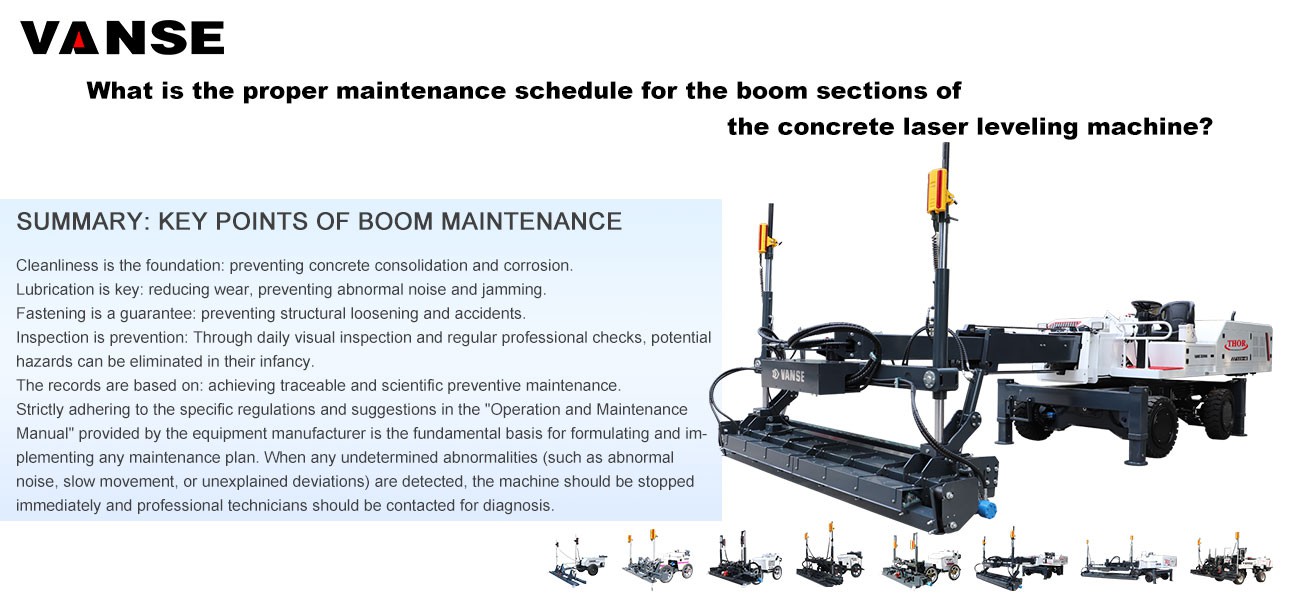
The boom (also known as the telescopic boom or large boom) of the concrete laser leveling is its core structure and power transmission component, bearing the vibrating rammer and scraper. The reliability of its maintenance is directly related to the accuracy, service life and construction safety of the equipment. The following is a systematic and comprehensive correct maintenance plan for the boom section, covering daily, regular and professional-level maintenance.
Ⅰ. Daily Maintenance (Before and after each shift's work)
This is the most fundamental and crucial step in preventing malfunctions.
Pre-work inspection
Structural visual inspection: Carefully inspect the main body of the boom, the connection points of each section, and the hinge seats connected to the main unit for any visible cracks, open welds, severe deformations or corrosion. Focus on inspecting areas with stress concentration.
Fastener inspection: Use manual tools to check whether all key bolts (especially hinge pin shaft bolts, boom extension and retraction fixing bolts, and cylinder connection pin bolts) are loose. Tighten regularly according to the torque specified by the manufacturer.
Grease lubrication: Apply grease to all lubrication points (grease nipples) until all the old grease is completely squeezed out. Including:
All articulated pin shafts
Boom telescopic slide/slider (if any)
The connection support between the vibrator and the boom
Preliminary inspection of the hydraulic system: Check whether there are scratches, dents or leaks on the surface of the piston rods of the boom lifting and telescopic cylinders. Check whether there is any oil leakage at the hydraulic pipeline joints.
Cleaning and storage after work:
Thorough cleaning: Use a high-pressure water gun (with moderate pressure, avoid direct impact on bearing seals and electrical components) to remove all solidified concrete slurry and debris from the boom, scraper, and tamper plate. Residual concrete will increase the load, disrupt the dynamic balance and cause corrosion.
Inspect the slider/slide: After cleaning, check the wear condition of the slider of the boom extension mechanism (usually made of wear-resistant polymer materials), and remove the sand particles in the slide.
Proper storage: Retract and lower the boom, place it on a stable support, and release the stress. Avoid storing for a long time in a fully extended or suspended state.
Ⅱ. Regular Maintenance (by the hour or weekly/monthly)
Deep lubrication (weekly or every 50 working hours) :
Replenish the daily lubrication points and ensure the use of the correct type of grease specified in the equipment manual.
For sliding contact surfaces without grease nipples, a thin layer of grease can be applied to prevent rust.
Bolt tightness review (monthly or every 250 working hours) :
Use a torque wrench to systematically retighten all key bolts of the boom structure strictly in accordance with the torque values provided by the manufacturer. Vibration is the primary cause of bolt loosening.
Hydraulic system inspection (monthly)
Cylinder: Check the sealing condition of the cylinder more carefully and inspect whether the piston rod is bent.
Pipes and joints: Inspect all hydraulic hoses for signs of wear, bulging, cracking or friction with structural components. Fix it in time with a rubber hose protective sleeve or re-bind it.
Hydraulic oil status: Check the oil level and quality (color, odor, and presence of foam) of the entire machine's hydraulic oil. Contaminated or deteriorated hydraulic oil can damage the valve groups that control the movement of the boom.
Non-destructive testing of structural components (every six months or every 1,000 working hours, or after experiencing major shocks) :
For equipment used at high intensity, it is recommended to use professional methods such as magnetic particle testing or ultrasonic testing to inspect key welding areas and stress zones, in order to detect micro-cracks that are invisible to the naked eye.
Ⅲ. Seasonal/Major Overhaul Maintenance (annually or every 2,000 working hours)
Comprehensive disassembly inspection and maintenance
Disassemble and inspect key pin shafts and bushings: Disassemble the main hinged pin shafts, check their wear and scratches, and measure the diameter. Check the wear clearance of the bushing/bearing. If it exceeds the wear limit, it must be replaced.
Check the deformation of the boom: Use professional instruments or the wire pulling method to check whether the straightness and parallelism of the boom are within the allowable range.
Replace worn parts: Replace worn telescopic sliders, scraper cutting edges, ramming plate bottom plates and other vulnerable parts.
Hydraulic system maintenance: Replace hydraulic oil and filter elements, and clean the hydraulic oil tank. Check and adjust the working pressure and synchronization of the boom control valve group.
Anti-corrosion treatment:
Thoroughly remove the rust from the areas where the paint layer has peeled off and rusted, and reapply the same grade of anti-rust primer and topcoat as the original factory.
Ⅳ. Enhanced Maintenance under Special Working Conditions
High-intensity continuous operation: Shorten the interval between lubrication and inspection (such as adding one intermediate inspection per shift).
Corrosive environments (coastal areas, near chemical plants) : Enhance cleaning and carry out anti-corrosion treatment more frequently.
Extreme temperature difference environment: Pay attention that the type of hydraulic oil and grease must meet the temperature requirements. After cold start, low-speed preheating operation is required.
Ⅴ. Maintenance Records and Operation Norms
Establish a maintenance log: record in detail the date of each maintenance, the project, the replaced components, the problems found and the handling measures. This is helpful for tracking the status of devices and predicting their lifespan.
Standardized operation: The maintenance plan must be combined with standardized operation. Operators should avoid:
Use the boom to forcefully push materials or collide.
Driving at high speed or turning when the boom is not lifted.
Allow the equipment to extend, retract or lift before it has completely stopped.
Overloading or operating beyond the designed slope.
Summary: Key points of boom maintenance
Cleanliness is the foundation: preventing concrete consolidation and corrosion.
Lubrication is key: reducing wear, preventing abnormal noise and jamming.
Fastening is a guarantee: preventing structural loosening and accidents.
Inspection is prevention: Through daily visual inspection and regular professional checks, potential hazards can be eliminated in their infancy.
The records are based on: achieving traceable and scientific preventive maintenance.
Strictly adhering to the specific regulations and suggestions in the "Operation and Maintenance Manual" provided by the equipment manufacturer is the fundamental basis for formulating and implementing any maintenance plan. When any undetermined abnormalities (such as abnormal noise, slow movement, or unexplained deviations) are detected, the machine should be stopped immediately and professional technicians should be contacted for diagnosis.
Note: The parameters provided in this document are for reference only and are not mandatory. Due to differences in technical characteristics between different brands and models of laser levelers, please consult the manufacturer for a suitable solution before actual operation. This reference document assumes no responsibility for any issues arising from failure to follow the manufacturer's instructions.
Thanks to All the Friends Who Support and Trust Shandong Vanse Machinery Technology Co., Ltd.
If you want to know more about Shandong Vanse Machinery Technology Co., Ltd. or have any questions, please feel free to contact us:
Our Factory
Shandong Vanse Machinery Technology Co., Ltd.








Share this article

About the Author: Shandong Vanse Machinery Technology Co., Ltd.
Shandong Vanse Machinery Technology Co., Ltd. is a high-tech manufacturer specializing in concrete construction machinery, including laser screeds and related equipment. The company integrates R&D, production, and global sales, with products exported to over 60 countries and widely used in infrastructure projects worldwide.
Previous Post
Next Post
Related Articles
You Might Also Like
How does the concrete laser leveling machine achieve automatic control and laser positioning?
The key to automatic control and laser positioning of concrete laser leveling machines lies in its internal control system and laser technology. The equipment integrates advanced technologies such as automation technology, electronic technology, laser technology and computer technology to achieve high-precision automated construction. In terms of automatic control, the control system of the concrete laser leveling machine is its core part. The system usually uses a programmable logic controller (PLC) or microprocessor, which can automatically control the operation of the leveling machine according to preset parameters and conditions. For example, it can automatically control the walking speed, amplitude, frequency, etc. of the leveling machine to ensure the concrete paving and leveling effect. At the same time, the system can also receive and process various sensor signals, such as height sensors, level sensors and flow sensors, to monitor the paving status and leveling effect of concrete in real time. Based on the feedback from these sensors, the control system can automatically adjust the operating parameters of the leveling machine to ensure the stability and quality of the leveling effect. In terms of laser positioning, concrete laser levelings mainly rely on laser technology for high-precision positioning and paving control. Laser technology has the characteristics of high precision, high speed and high reliability, enabling fast and accurate positioning and measurement. Concrete laser levelings are typically equipped with laser transmitters and receivers capable of emitting and receiving laser beams. The laser transmitter emits a laser beam into the work area and forms a beam on the surface of the compacted soil. The receiver will receive and process the signal of this laser beam to obtain the height and level information of the current location. This information will be used by the control system to monitor and control the operation of the leveling machine in real time. Specifically, when the concrete laser leveling machine is working, the laser transmitter emits a laser beam to the work area and scans the entire work area. The receiver will continuously receive and process the signal of the laser beam to obtain the three-dimensional coordinates of each point in the working area. By comparing with the preset three-dimensional model, the control system can calculate the error value of each point, and adjust the walking trajectory of the leveling and the concrete paving thickness based on the error value. In this way, by continuously adjusting and optimizing the operating parameters of the leveling machine, high-precision automated construction can be achieved and the paving quality and leveling effect of concrete can be improved. In addition, the concrete laser leveling machine is also equipped with a variety of sensors and auxiliary equipment to achieve more comprehensive automated control and monitoring. For example, some advanced models may be equipped with automatic control systems, sensor integration networks, visual interfaces, etc. These technologies and equipment enable the leveling machine to work continuously without human intervention, greatly improving construction efficiency and quality. To sum up, the concrete laser leveling machine achieves high-precision automated construction by integrating advanced technologies such as automation technology, electronic technology, laser technology and computer technology. Its automatic control system can automatically adjust the operating parameters of the leveling machine based on preset parameters and real-time feedback; laser positioning technology provides high-precision, high-speed positioning and measurement capabilities. These technologies work together to ensure the quality of concrete paving and smoothing effects. With the continuous advancement of technology and the expansion of application fields, concrete laser leveling machines are expected to achieve higher and smarter automated construction in the future.The correct methods and protective measures for long-term storage of concrete laser leveling (such as placing them on a flat ground, dry and well-ventilated)
Let's delve into the correct methods and protective measures for long-term storage of concrete laser leveling machines (especially their precision components), such as across projects, during winter or the rainy season. This is a crucial topic. Proper storage can greatly prevent equipment from malfunctioning when it is used next time, save maintenance costs and extend its service life. Before driving the equipment into the warehouse, a thorough "physical examination" and "maintenance" must be carried out. Overall machine cleaning: Use a high-pressure water gun or steam cleaner to thoroughly remove all concrete slurry, oil stains and dust from the machine body. Focus on cleaning the accumulated materials around the tracks, scrapers and vibrators. Specialized cleaning of precision components Laser emitter/receiver: Use lens paper and blow balloons to carefully clean all lens and sensor surfaces to ensure there are no stains. Sensors and circuits: Clean the elevation sensors, tilt sensors, etc. at all parts. Thorough drying: After cleaning, park the equipment in a well-ventilated area to ensure that all components, especially electrical interfaces and precision parts, are completely dry. Compressed air can be used to dry the moisture in the gaps. Engine: Replace the engine oil and oil filter. Inject a small amount of engine oil into the cylinder and evenly distribute it by turning the crankshaft to prevent rusting inside. Fuel system: Fill the fuel tank to the brim to prevent water droplets from condensing on the inner walls of the tank and causing rust. At the same time, add fuel stabilizers to prevent diesel from deteriorating and forming gum during long-term storage. Hydraulic system Check the oil level and quality of the hydraulic oil, and replace it if necessary. Start the machine and retract all the hydraulic cylinders (such as the lifting cylinder and the leveling cylinder) to the shortest stroke state (that is, retract the piston rod into the cylinder). This is because the exposed surface of the piston rod is the most prone to rust. Lubrication and rust prevention Apply an adequate amount of grease to all lubrication points (such as pins and bearings), and squeeze out the old and potentially contaminated grease to form a new protective layer. For exposed metal surfaces, such as the base plate of the scraper and the housing of the vibrator, a thin layer of anti-rust oil or grease can be applied. Remove the batteries: It is strongly recommended to remove the batteries of the leveling and the laser emitter. Battery storage: Store the battery in a cool, dry and well-ventilated place. The ideal temperature is between 0°C and 25°C. Battery charging: Charge the battery to about 50%-70% of its capacity and store it. Perform a complete charge and discharge cycle every 1-2 months to maintain its activity and prevent permanent damage caused by "undercharging". Electrical interface: Unplug all sensor plugs, spray them with electronic contact cleaner, then cover them with dust caps or wrap them with insulating tape. Indoor priority: The best choice is a dry, well-ventilated and dust-free indoor warehouse. It can prevent exposure to the sun, rain, sudden temperature changes and dust invasion. Outdoor storage (if unavoidable) Terrain: A high, flat, solid and well-drained area must be selected to prevent the equipment from deforming due to ground subsidence or being soaked by water accumulation. Covering: Use professional waterproof and dustproof tarpaulins for covering. Avoid using ordinary plastic sheeting, as plastic sheeting is not breathable and water vapor is likely to condense inside, accelerating rusting. Make sure the tarpaulin is securely tied up to withstand strong winds. Park on a flat ground: Ensure that all tracks or tires of the equipment are steadily on the ground to release the stress on the frame. Raise the tracks/tires: Place wooden boards or rubber pads under the tracks or tires to isolate them from the wet ground and slightly release the track tension (refer to the equipment manual) to reduce rubber aging and the pressure on the load-bearing wheels. This is of Paramount importance in protecting the "brain and eyes" of the device. Laser emitter, receiver, control box It must be disassembled and put back into its original dedicated transport box. Place desiccants inside the box and replace them regularly. Store the boxes on the shelves or in safety cabinets in the warehouse, ensuring a stable temperature and humidity environment and keeping them away from any possible risks of heavy objects falling or colliding. Sensors and cables All sensors should be removed from the machine, cleaned and then placed in the drying oven as well. The cable should be coiled loosely (with a diameter of no less than 30 centimeters). It is strictly prohibited to fold it tightly or bend it excessively. It should be bound with cable ties. Hang or lay it flat on the shelf to avoid pressure. Long-term storage does not mean a one-time solution; regular inspections must be carried out. Monthly inspection: Check whether the tarpaulin is intact and if there is any leakage. Check if there is any new rust on the surface of the equipment. Check the tire/track pressure and replenish it if necessary. Perform charge and discharge maintenance on the battery. Manually rotate the tracks or move each working device several times to change the force application points of the hydraulic cylinder and bearings, preventing the seals and bearings from deforming due to long-term pressure at a single position. Project Specific measures Clean and dry Thoroughly clean the entire machine and its precision components and ensure they are completely dry. Oil and fluid management Change the engine oil, fill up the fuel and add stabilizer, and withdraw all the cylinders. Rust prevention and lubrication Apply anti-rust oil to exposed metal parts and add new grease to all lubrication points. Battery management Remove the battery, charge it to 50%-70%, store it in a cool place, and charge and discharge it regularly. Electrical system Unplug and protect all plugs, and properly wrap the cables. Storage environment First choose indoor Spaces, then outdoor high ground areas and cover them with professional tarpaulins. Equipment parking Stop on a flat ground, raise the tracks/tires, and release the tension of the tracks. Precision components It must be disassembled, placed in the original box and desiccant added, and stored safely separately. Regular inspection Check the tarpaulin, rust, battery, etc. every month and move all working devices. By following the above methods and measures, your concrete laser leveling can safely get through any long idle period. When it starts up at the next construction site, it can quickly return to its best condition and continue to create a smooth and mirror-like high-quality floor for you. Note: The parameters provided in this document are for reference only and are not mandatory. Due to differences in technical characteristics between different brands and models of laser levelers, please consult the manufacturer for a suitable solution before actual operation. This reference document assumes no responsibility for any issues arising from failure to follow the manufacturer's instructions.How much does a concrete laser leveling machine cost?
The price of concrete laser leveling machines varies based on model, brand, configuration and other factors. Generally speaking, the price range ranges from tens of thousands to hundreds of thousands. Specifically, the price will be affected by the following factors: Model: Different models of concrete laser leveling machines have different functions and application ranges, so the prices will also be different. Generally speaking, the price of large machines will be higher. Brand: Different brands of concrete laser leveling machines also differ in quality, after-sales service, etc., so the prices will also vary. Configuration: The configuration of the concrete laser leveling machine will also affect the price. For example, the quality and performance of the laser, motor, control system and other components will affect the price of the complete machine. Region: Market demand and competition in different regions will also affect the price of concrete laser leveling machines. In general, if you need to purchase a concrete laser leveling, it is recommended that you choose the appropriate model and brand based on your actual needs and budget. At the same time, you should pay attention to purchasing through formal channels to ensure the reliability of quality and after-sales service.