Technical Knowledge
Summarization and Application of Reinforced Concrete Cutting Technology
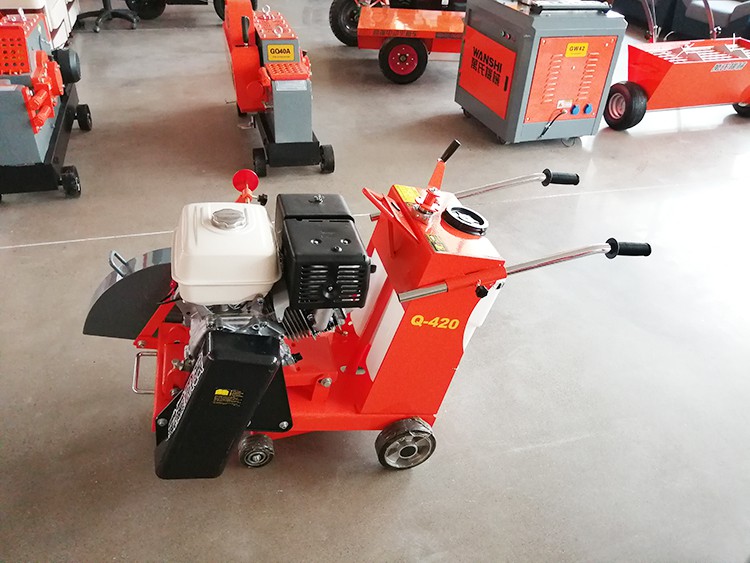
Concrete cutting process With the accelerated pace of urbanization, urban construction with each passing day. In the big city, the ground has been unable to meet the traffic requirements, urban traffic up to the elevated, light rail, down to the subway. Some elevated posts now seem to be factors that constrain urban development. It is inevitable that some of the elevated structures are to be demolished, and that part of it is not affected and reused, which has become a problem before us. In the traditional demolition of this construction can not do anything, advanced reinforced concrete cutting method is safe, efficient and environmentally friendly features.
Reinforced concrete cutting technology mainly disc cutting method and diamond wire cutting method. Diamond wire cutting method has faster speed, greater flexibility and lower construction noise. Especially in the construction renovation project has been more and more applications. Disc cutting method to break the traditional wind pick chisel after the gas cutting or directional blasting construction methods, with diamond particles with cutting disc cutting, construction incision neatly, straight, without post-processing, free from construction sites, environmental protection , Duration, safety reasons and other conditions, is widely used in various types of large-scale building structural transformation and cutting construction. The steel wire cutting method is composed of high power hydraulic press, transmission locating pulley and steel wire with diamond sawtooth. The hydraulic motor drives the steel wire around the cutting object to rotate at high speed through the drive pulley. It has the advantages of fast construction and noise Low, no vibration, no dust and other advantages of waste gas pollution, and incision straight and smooth, no need to do after the processing. The use of the technology, for some of the special requirements of the construction of the project, such as tight schedule, high environmental requirements, as well as some large concrete structure demolition, cutting works, these problems can be solved.
Thanks to All the Friends Who Support and Trust Shandong Vanse Machinery Technology Co., Ltd.
If you want to know more about Shandong Vanse Machinery Technology Co., Ltd. or have any questions, please feel free to contact us:
Our Factory
Shandong Vanse Machinery Technology Co., Ltd.








Share this article

About the Author: Shandong Vanse Machinery Technology Co., Ltd.
Shandong Vanse Machinery Technology Co., Ltd. is a high-tech manufacturer specializing in concrete construction machinery, including laser screeds and related equipment. The company integrates R&D, production, and global sales, with products exported to over 60 countries and widely used in infrastructure projects worldwide.
Previous Post
Next Post
Related Articles
You Might Also Like
What are the construction options for a concrete laser leveling machine?
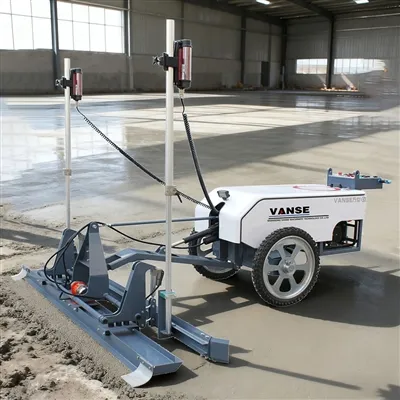
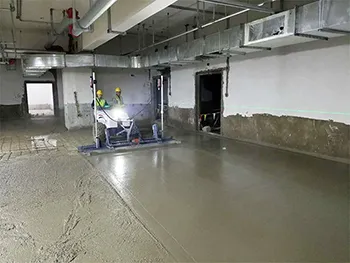
The construction plan for a concrete laser leveling machine must be tailored to the project type (e.g., industrial plant, underground garage, large plaza, etc.), concrete grade, and site conditions. The core design principle is "standardized processes and controllable precision." The following is a general plan framework and examples of typical scenarios: Floor Flatness Error: ≤3mm/2m (core indicator for laser leveling); Concrete Density: ≥98% (avoiding sanding and hollowing); Construction Schedule: Planned based on a "500-800㎡/shift" (per machine). Stages Key Work Areas Core Requirements 1. Construction Preparation ① Base Preparation: Compaction (compaction degree ≥ 95%), debris removal, and watering (no water accumulation); Base leveling error ≤ 5mm/2m; Laser signal unobstructed (avoid metal and strong light). ② Laser System Commissioning: Transmitter calibration (horizontal error ≤ 0.1mm/m), receiver sensitivity test; ③ Material Preparation: Concrete (slump 120-160mm, initial setting ≥ 4h), geotextile/plastic film curing 2. Concrete Pouring ① Spreading: Use a tanker or concrete spreader to spread the material evenly, 30-50mm above the design elevation (allowing for leveling margin); Material spreading speed matches leveling speed (no accumulation or material shortages); Bin seams align with subsequent expansion joints. ② Combination Casting: For large areas, divide the concrete into 6-8m wide compartments (with temporary dividers) to prevent cracking after initial setting. 3. Laser Leveling ① Equipment Movement: Drive at a constant speed (0.8-1.2m/min), following a "horizontal back-and-forth" pattern with staggered overlaps; Real-time monitoring of the laser receiver (steady green indicates normal operation); immediate shutdown and calibration if deviation exceeds 2mm. ② Vibration Control: Insert the vibrator ≥ 50mm (penetrating the current paving layer) to ensure the connection between the upper and lower layers. 4. Finishing ① Rough Finishing: After the leveling passes, manually use a scraper to assist with leveling (to address any minor vibration leaks or unevenness). Timing of fine cutting is critical: premature cutting can lead to sanding, while delayed cutting may prevent surface air bubbles. ② Fine Finishing: After the concrete surface has cleared of water seepage (no noticeable indentations when pressed with a finger), use a trowel (with a disc) to smooth the surface 2-3 times. 5. Curing ① Covering: Cover with geotextile/plastic film within 1-2 hours of completion (before initial setting). No personnel or material stacking is permitted during the curing period; avoid freeze-thaw cycles in winter. ② Moisturizing: Water the surface every 2 hours in summer (to keep the film moist), and cover with a thermal blanket in winter (curing temperature ≥ 5°C). ③ Curing Time: ≥ 7 days (≥ 14 days for C30 and above concrete). 6. Expansion Joint Cutting ① Timing: 24-48 hours after pouring (surface hardness reaches 1.2 MPa, and no visible marks are visible when scratched with a fingernail). Clean the seams after cutting and apply sealant later to prevent water seepage. ② Specifications: Joint depth = 1/3-1/4 of the floor thickness, spacing ≤ 6 meters (required for areas over 36 square meters), joint width 5-8 mm. Key Differentiations: Concrete Grade: C35/C40 (one grade higher than standard flooring) is used, with polypropylene anti-cracking fiber (0.9 kg/m³) added to reduce thermal cracking. Laser System: Due to obstruction by pillars in the garage, a "multi-transmitter zoned coverage" system (one transmitter every 15-20 meters) is used to avoid signal blind spots. Surface Optimization: After finishing, diamond wear-resistant aggregate (5-6 kg/m²) is applied, followed by finishing with a high-speed trowel to improve surface hardness (Mohs hardness ≥ 6). Key Differentiators: Base Reinforcement: 300mm thick graded sand and gravel with a 150mm thick C25 cushion layer (50% thicker than standard flooring) ensures a load capacity of ≥5t/m2; Leveling Parameters: Vibration frequency is adjusted to 60-70Hz (compared to 50Hz for standard flooring) and travel speed is reduced to 0.6-0.8m/min to enhance concrete density; Post-treatment: After curing, a sealant and curing agent treatment (penetration depth ≥5mm) is applied to improve the floor's compressive strength (≥80MPa) and impermeability. Key Differentiations: Optimized Compartmentalization: Compartments are divided into 10m x 10m squares (common flooring requires 6-8m). Expansion joints (filled with foam board) are provided to relieve thermal stress. Concrete Control: Low-heat cement (heat of hydration ≤ 270kJ/kg) is used, and a retarder is added in summer (extending the initial setting time to 6-8 hours) to prevent cracking due to temperature differences. Laser Calibration: Transmitter levelness is rechecked every 2 hours (common flooring requires 4 hours). Because the plaza is unobstructed, a wind shield is required to prevent strong winds from interfering with the signal. Staffing: Each machine is equipped with one operator (certified) + two fabricators + two finishers + one laser monitor. Equipment Inspection Checklist: Before starting the machine, check the laser transmitter battery, vibrator wear, and tire pressure (tolerance ≤ 0.1 MPa). Emergency Plan: If the initial setting of the concrete is too rapid, immediately activate the backup leveling. If the laser signal is lost, switch to manual mode (using the adjacent leveled surface as a reference). Note: The parameters provided in this document are for reference only and are not mandatory. Due to differences in technical characteristics between different brands and models of laser levelers, please consult the manufacturer for a suitable solution before actual operation. This reference document assumes no responsibility for any issues arising from failure to follow the manufacturer's instructions.Construction method of laser leveling machine/ laser leveling flooring
Laser leveling machine is developed according to the increasing demand of modern industrial plant, large shopping mall, warehouse and other large area cement concrete ground for ground quality, such as strength, flatness, levelness, etc. It has the characteristics of good performance and high efficiency. Preparations: (1) After the basic treatment, the laser paver is debugged and fixed reference level is drawn according to the original level; non-woven fabrics and side dies are laid, laser transmitters are erected, and ground elevation is introduced into laser leveller according to the original level. (2) The concrete is transported by commercial concrete. The commercial concrete is transported to the entrance and exit of the garage by tank truck, and then transported to the construction site by three-wheel dumper truck. (3) The elevation of the ground floor is checked by hand-held laser receiver, and the elevation is introduced into the laser paver to adjust the reference point (±0.00) on the leveller. Concrete Paving: (1) After the formwork is supported, the warehouse should be cleaned one day in advance and soaked with water before pouring concrete. When approaching pouring, drain open water, sweep cement slurry or interface agent. Obvious water accumulation is strictly prohibited at this time. If so, the concrete can be paved only if it is removed resolutely. (2) After the concrete is laid down, it is preliminarily flattened. The flattened height should be 3 cm thicker than the elevation. Then it is leveled with a laser paver. The corners which can not be leveled can be leveled by gasoline leveling ruler or manual method. (3) When the warehouse near the wall is being poured, it must be scraped with a scraper ruler in time after the leveller has passed. (4) For concrete mixer can not drive to the site area, but also use tractors to transport concrete. After the completion of the pouring, the floor lighting construction will begin when the concrete is initially solidified. C. In construction, the laser signal received by the laser paver receiver (10 times per second ) automatically adjusts the elevation in real time to ensure that the construction elevation is always in the set standard. Because the laser transmitter is fixed after being set up, it can ensure that the construction of large area of the ground does not produce cumulative errors. D. During the construction, the operator uses a hand-held laser receiver to inspect the ground after the construction of the machine to ensure that the smoothness error is within the controllable range again. 1. It's necessary to ensure that all parts of the laser leveling machine are connected perfectly, without any loosing, so as to prevent problems in the operation process 2. It is necessary to ensure that all parts of the laser leveling machine are connected perfectly, without any loosening, so as to prevent problems in the operation process. Add enough lubricating oil to laser leveling machine in advance to improve the flexibility of controller, so as to improve work efficiency. 3. The surface insulation of cable must be complete, and the slightly damaged parts should be treated with caution until they are all in good condition. This can not only ensure the safety of construction personnel, but also the safety of passers-by. 4. After turning on the power supply, it is necessary to check the direction of the motor rotation. If there is a mistake, it is necessary to change the line immediately in order to avoid greater problems in working hours. 5. Laser leveling machine operators should undergo professional training, such as in the operation process, they can not tilt, can not grasp too tight and other elements should be mastered well, in order to avoid accidents accidentally. 6. Laser leveling machine in the construction process, needs density of soil, can repeat consolidation, do not move back and forth, so even if the result is the same, it will spend more energy on moving, not economical.The key technical points of using power trowel to handle large-span floor slabs, high-standard factories, airports, large parking lots and other projects
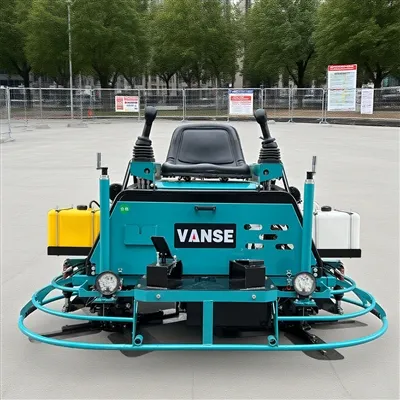
Using a power trowel to handle large-span and high-standard floor projects is a systematic project, and it is by no means as simple as "starting up and smoothing". It involves the meticulous management of the entire process from the initial preparation, concrete batching, laser leveling to power troweling and finishing. The following are the key technical points of these large-scale and high-standard projects, which are elaborated at three levels: "Basic guarantee", "core control", and "advanced advancement". These key points are the prerequisites for success or failure. If they cannot be achieved, there is no need to talk about anything else. Density and flatness: The foundation must be uniformly compacted to prevent uneven settlement in the later stage. The flatness of the cushion layer (usually gravel or plain concrete) is of vital importance. Its elevation error should be strictly controlled (such as within ±10mm), otherwise a large amount of concrete will be wasted and the final flatness will be affected. Waterproofing and moisture-proofing: In areas with high groundwater levels, reliable waterproof and moisture-proof layers must be applied to prevent water vapor from rising and affecting the quality and service life of concrete. Low water-binder ratio: This is the lifeline of high-strength and wear-resistant floors. The water-cement ratio is usually required to be controlled below 0.45, and the lower the better. A low water-cement ratio can reduce bleeding, enhance strength and wear resistance, and minimize shrinkage cracks. Aggregate selection: Choose coarse and fine aggregates with good gradation and high hardness. The maximum aggregate particle size should not be too large (usually ≤25mm) to ensure the uniformity of the surface slurry. Admixtures and additives Mineral powder/fly ash: Reasonable use can improve workability, reduce hydration heat, and decrease temperature difference cracks. Water reducing agent: Highly efficient water reducing agents must be used to significantly reduce water consumption while ensuring fluidity. Fiber: In large-span floor slabs, it is strongly recommended to add polypropylene synthetic fibers, which can effectively suppress plastic shrinkage cracks in concrete. Reasonable pouring sequence and direction: Develop a detailed pouring plan to ensure continuous supply of concrete and avoid cold joints. For large-scale construction, it is necessary to pour in separate compartments and arrange the construction joints reasonably. This is the core operational step to achieve high flatness and high finish. High-precision laser leveling Equipment selection: A laser leveler with a laser emitter + laser receiver + automatic control hydraulic system must be used. This is the only way to achieve ultra-high flatness. Reference setting: The position of the laser emitter must be stable to ensure that there is no signal obstruction throughout the entire operation area. The elevation control points need to be rechecked multiple times. The "one-time molding" concept: The laser screed integrates scraping, vibration and leveling into one, leveling the concrete at the designed elevation in one go to form a dense and uniform base layer. This is the foundation for the subsequent work of the polishing machine. The "golden time window" for operating a power trowel machine The operation of the power trowel must closely follow the initial setting process of the concrete and be carried out in stages: Phase One: Preliminary slurry extraction (before initial setting) Timing: After the concrete pouring and laser leveling, when a person stands on it and sinks by about 3-5mm. Equipment: Use a disc smear. Operation: Run at low speed, press down the protruding aggregates on the surface, bring up the slurry, eliminate the slight tooth marks left by the screed, and make the surface tend to be uniform. The aim is not to smooth it out, but to compact and lift the slurry. Phase Two: Compaction and Polishing (initial setting to final setting) Timing: When a person stands and sinks about 1-2mm, there is no standing water on the surface, and a slight indentation appears when pressed with a finger. This is the most crucial moment. Equipment: Replace with a blade (power trowel). Operation Angle control: At the beginning, the Angle between the power trowel blade and the ground should be small (almost parallel) to perform low-speed and large-area finishing. Multiple cross-operation: Cross the light at least 2 to 3 times along both the longitudinal and transverse directions. Each time, increase the blade Angle appropriately compared to the previous time and raise the rotational speed. Objective: Eliminate the marks left by the disc, fully compact the surface slurry, and achieve a dense and bright effect. Phase Three: Final Calendering (before final setting) Timing: When standing on it, there is almost no sinking. Only by pressing hard with fingers can marks be left. Operation: The blade is at the maximum Angle to the ground and runs at high speed. This polishing is done to achieve an extremely high degree of smoothness and eliminate all spatula marks. Note: All operations must be completed before the concrete loses its plasticity. It is strictly prohibited to sprinkle water or cement for finishing. For airports, high-standard factories, etc., the following key points also need to be considered: Seam treatment technology Precise joint cutting: Cutting should be carried out immediately when the concrete reaches a certain strength (usually 6 to 12 hours after pouring, when it can be cut with a toothless saw without chipping). The depth of the cut seam should be 1/3 to 1/4 of the plate thickness, aiming to induce shrinkage cracks to occur at the predetermined position. Grouting material: Use high-quality and durable grouting glue to protect the seam edge from being damaged by hard objects such as forklifts. A complete maintenance system Timeliness: Start curing immediately after the final finishing is completed and the concrete surface is about to dry. Method selection Spray curing agent: Most suitable for large-scale construction, it can form a film to prevent water evaporation. It is necessary to ensure that the spraying is uniform and full coverage. Covering and water retention maintenance: If geotextiles, films, etc. are used for covering and continuous watering for moisture retention, the effect is the best but the cost is relatively high. Curing period: At least 7 days. For high-grade concrete with crack resistance requirements, it is recommended to cure for 14 days. Construction of special functional layers (if necessary) Wear-resistant aggregates (quartz sand, metal, alloy) : The timing of spreading: It should be carried out after laser leveling and before initial setting when the base concrete reaches a state "sufficient to bear the weight of people and spreader". Spread in several portions: Spread at least twice (60%/40% of the total amount) to ensure even distribution. Integrated finishing: After spreading, the wear-resistant aggregate is completely pressed into the surface layer of the concrete through the disc and blade operation of the power trowel machine and integrates with it. Sealant curing agent Construction should be carried out after the curing period has expired and the floor is completely dry. Through effective penetration and chemical reactions with the components in concrete, it can significantly enhance surface hardness, wear resistance and impermeability, making it a powerful tool for creating ultra-long-life floors. Stage Key points Objectives and Descriptions Preparatory work The foundation cushion layer is flat and dense Provide a stable foundation for the floor Low water-cement ratio concrete + fiber Ensure the material's own strength and crack resistance Core construction High-precision laser leveling The foundation for achieving ultra-high flatness (FF/FL value) Master the "Three Stages" of polishing The initial setting involves extracting the slurry, finishing before the final setting, and finally calendering to achieve a smooth finish Post-processing Cut the seams accurately and promptly Guide and control shrinkage cracks Maintain with sufficient time and materials Ensure the development of concrete strength and prevent cracking Function improvement Wear-resistant aggregates are evenly spread and integrated Enhance the surface wear resistance and impact resistance Penetrating sealant curing agent Significantly enhance hardness, density and chemical resistance The key to success lies in integrating all the above points into a seamless and controlled process. Any oversight in any link may lead to all previous efforts being wasted. Therefore, a high-quality construction team, advanced equipment and strict on-site management are all indispensable. Note: The parameters provided in this document are for reference only and are not mandatory. Due to differences in technical characteristics between different brands and models of laser levelers, please consult the manufacturer for a suitable solution before actual operation. This reference document assumes no responsibility for any issues arising from failure to follow the manufacturer's instructions.