Technical Knowledge
Power Trowel trowelling machine
Daily maintenance

-
After each work, clean the concrete and dust on the machine timely.
-
It is recommended to replace the air filter once every 100 hours. In many dust areas, the frequency of cleaning and replacement should be increased.
-
Replace the oil after the first 20 hours of operation, and then replace it every 100 hours. When disposing of the waste oil, it is recommended to put it in a sealable container and give it to the recycling center to protect the environment and soil
-
Grease the grease nipple above the cross for daily maintenance
Thanks to All the Friends Who Support and Trust Shandong Vanse Machinery Technology Co., Ltd.
If you want to know more about Shandong Vanse Machinery Technology Co., Ltd. or have any questions, please feel free to contact us:
Our Factory
Shandong Vanse Machinery Technology Co., Ltd.








Share this article

About the Author: Shandong Vanse Machinery Technology Co., Ltd.
Shandong Vanse Machinery Technology Co., Ltd. is a high-tech manufacturer specializing in concrete construction machinery, including laser screeds and related equipment. The company integrates R&D, production, and global sales, with products exported to over 60 countries and widely used in infrastructure projects worldwide.
Previous Post
Next Post
Related Articles
You Might Also Like
The detection methods and acceptance standards for the flatness and smoothness of the floor after the construction by the concrete laser leveling machine
The detection methods and acceptance standards for the flatness and smoothness of the floor after the construction by the concrete laser leveling machine are a very professional and important issue. Although laser levelings can achieve extremely high quality standards, the final acceptance relies on objective data. The following are the detailed testing methods and acceptance criteria: Flatness is the greatest advantage of the laser leveling machine, and its acceptance criteria are much higher than those of traditional processes. Straightedge and feeler gauge method (traditional, commonly used) Tools: 2-meter or 3-meter national standard straightedge (or electronic straightedge), feeler gauge. Method: Place the straightedge steadily on the ground and use a feeler gauge to measure the maximum gap between the bottom of the straightedge and the ground. At least 10 points should be measured in the same area (such as a slab or a room), and the measurement points should be randomly distributed and cover key parts such as the edges of walls and the bases of columns. Advantages: Simple tools, convenient operation and intuitive. Disadvantage: It reflects local "wavy" undulations and cannot accurately measure the overall flatness of a large area. Level or total station measurement method (elevation method) Tools: High-precision level, tower ruler or total station. Method: Set up measurement points on the ground in a certain grid (for example, 1m×1m or 2m×2m), measure the elevation value of each point with a level, and then calculate the height difference between any two points or the standard deviation of the entire area. Advantages: The data is precise and can generate an elevation map of the entire ground, making it the most scientific. Disadvantages: It takes a long time and requires high technical skills from the operators. F-Number System (Internationally recognized and the most scientific method) This is the method stipulated in the ASTM E1155 standard of the United States. It is currently the mainstream and highest standard for evaluating the flatness of the floor internationally, and is particularly suitable for high-standard floors constructed by laser levelings. Tools: Specialized floor profile meters (such as DipStick, DynaPulse, etc.) or continuous inertial profile measurement vehicles. Evaluation index F<sub>F</sub> value (flatness value) : It measures the undulation of the large wavelength (>600mm) of the floor, reflecting the degree of "tilt" or "wave" of the floor. The larger the F<sub>F</sub> value, the flatter the overall floor. F<sub>L</sub> value (levelness value) : It measures the undulation of the small wavelength (<600mm) of the floor surface, reflecting the degree of "roughness" or "micro-vibration" of the floor surface. The larger the F<sub>L</sub> value is, the smoother the local area of the floor will be. Method: Measurement and calculation are carried out by professionals and equipment in accordance with standard procedures. Domestic traditional standard (ruler method Ordinary industrial floor: Within a 2-meter straightedge range, the flatness deviation is ≤ 4mm. High-standard industrial floor /VNA ultra-flat floor: Within a 2-meter straightedge range, the flatness deviation is ≤ 2mm. For VNA flooring, it is usually required to be ≤ 1.5mm / 2m. International F-Number Standard (Recommended for high-standard projects) Ordinary industrial floor: F<sub>F</sub> 20 / F<sub>L</sub> 15 High-standard warehouse/logistics center: F<sub>F</sub> 35 / F<sub>L</sub> 25 VNA narrow channel library/super flat floor: F < sub > F < / sub > 50 / F < sub > L < / sub > 40 or higher (F < sub > F < / sub > 60 / F < sub > L < / sub > 50) Commercial floor (such as supermarkets) : F<sub>F</sub> 25 / F<sub>L</sub> 20 Note: The specific F value should be clearly stipulated in the project contract or design documents. Smoothness is a comprehensive concept, encompassing appearance, wear resistance, dust resistance, etc., and it is more dependent on visual inspection and functional acceptance. Visual inspection method Method: Observe the floor surface from different angles under well-lit conditions. Inspection contents Color uniformity: Whether the surface color is consistent, and whether there are obvious color differences, water marks, excessive or insufficient cement slurry. Defects: Whether there are honeycombs, pitted surfaces, holes, peeling, sanding, or exposed stones. Cracks: Check for visible plastic shrinkage cracks and dry shrinkage cracks to the naked eye. Focus on inspecting corners and areas with stress concentration. Bubbles: The quantity and size of surface bubbles. Generally, it is required that there should not be too many bubbles with a diameter greater than 2mm. Mark and gloss: Whether the surface is smooth and if there are any obvious machine marks or manual marks. Hard object scratching method Tools: Keys, coins and other hard objects. Method: Use a hard object to scratch the surface with a certain force. Judgment: If only light white scratches are left, it indicates that the surface hardness is good. If there is obvious sand grain shedding or deep grooves, it indicates that the surface strength is insufficient and sanding may occur. Rebound instrument method Tool: Concrete rebound tester. Method: Indirectly calculate the strength of the floor surface through the rebound value. This method has certain errors and needs to be corrected in accordance with the standards. Judgment: The rebound value should meet the design strength requirements. Abrasion resistance test (Laboratory) For places with high wear resistance requirements, cores can be taken on-site and sent to the laboratory for "abrasion tests" (such as ASTM C779). Visual quality Color: The surface color is uniform and consistent, without obvious color differences or contamination. Defects: The surface is dense and smooth, free from quality defects such as honeycombing, pitting, cracks, sanding, peeling, and hollowing. Seam: The cutting seam should be straight, with uniform width and depth, and no missing edges or corners. Surface hardness and anti-dusting property Scratching with a hard object should not produce sanding or loose substances. In daily use, the movement of vehicles and the movement of people should not cause dust to rise on the ground. In addition to flatness and smoothness, the following indicators also need to be paid attention to Elevation and slope Tools: Level, total station. Standard: The allowable deviation between the measured elevation and the designed elevation is usually ±10mm. In areas with drainage requirements, the slope should comply with the design requirements and there should be no water accumulation. Levelness (not flatness) Tools: Laser leveler, level. Standard: It refers to the degree of inclination of the entire floor relative to the absolute horizontal plane. For equipment foundations with strict level requirements, the allowable error is very small (such as ±3mm/10m). Inspection items Main detection tools Reference for High-standard acceptance Flatness 2-meter straightedge, feeler gauge ≤ 2mm / 2m (Recommended ≤ 1.5mm / 2m) F-Number measurement system F<sub>F</sub> 50 / F<sub>L</sub> 40 (Applicable to VNA floor) Smoothness Visual inspection, hard object scratches The color is uniform, without cracks, sanding or holes, and there is no sanding when scratched Elevation Level, total station ±10mm Slope Level, total station It meets the design requirements and there is no water accumulation Important Notice Prior agreement: All acceptance criteria (especially the methods and standards for flatness) must be clearly stipulated in the contract before construction to avoid disputes later on. Comprehensive inspection: During the acceptance process, a combination of a thorough census and key spot checks should be conducted; it is not advisable to merely focus on a few points. Environmental conditions: The inspection should be carried out after the concrete has reached a certain strength and the surface should be cleaned thoroughly. For high-standard floors constructed by laser leveling machines, it is strongly recommended to introduce the F-Number system for acceptance, as it can most scientifically and comprehensively evaluate the quality and performance of the floor, especially suitable for projects with extreme requirements for the ground such as automated warehouses and logistics centers. Note: The parameters provided in this document are for reference only and are not mandatory. Due to differences in technical characteristics between different brands and models of laser levelers, please consult the manufacturer for a suitable solution before actual operation. This reference document assumes no responsibility for any issues arising from failure to follow the manufacturer's instructions.The use of concrete edge power trowel to maintain flatness at the corners of laser-leveled floors
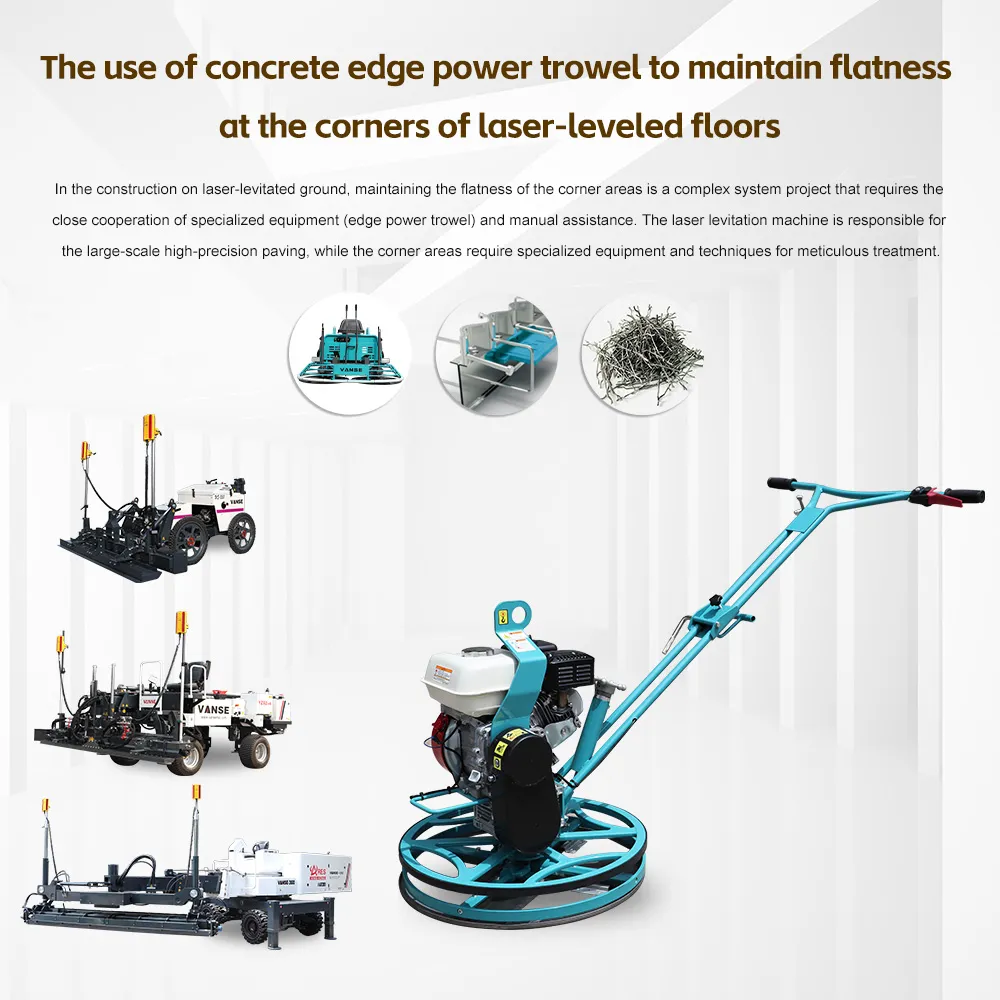
In the construction on laser-levitated ground, maintaining the flatness of the corner areas is a complex system project that requires the close cooperation of specialized equipment (edge power trowel) and manual assistance. The laser levitation machine is responsible for the large-scale high-precision paving, while the corner areas require specialized equipment and techniques for meticulous treatment. For areas along the walls or at the base of columns that the laser leveling machine cannot reach, the edge power trowel (also known as the corner smoothing machine) is the core tool for maintaining the levelness. It is compact in size and can penetrate into narrow areas, extending the flatness of the large surface to every corner. Process stage Core equipment/tools Key operation points: Functions and Objectives 1. Laser leveling and rough leveling Laser leveling machine After the concrete is poured, the laser leveling machine conducts large-scale vibration and leveling, setting the overall ground elevation benchmark. Establish an initial flatness of ±3mm/3m for the entire floor, which serves as the foundation for corner treatment. 2. Initial treatment of corner areas Manual trowel, iron trowel After the laser leveling machine operation, immediately use the manual trowel to level the concrete at the corners, making it consistent with the leveled large surface elevation. Eliminate local height differences caused by the machine's inability to operate, and incorporate the overall flatness into the corners. 3. Edge power trowel for slurry application and compaction Edge power trowel (requires installation of a disc) Before and after the initial setting of the concrete (when footprints are about 3-5mm deep when stepped on), install the circular disc of the edge trowel and compact and smooth the corner area. Completely compact the concrete, remove the marks left by the trowel, and make the surface structure consistent with the large area. 4. Edge power trowel for finishing Edge power trowel (requires replacement with a blade) As the concrete further hardens, replace the circular disc with a blade, adjust the blade angle, and perform fine polishing to make the corner surface reach the same density and glossiness as the large surface. Complete the final surface effect, ensuring uniform color and density of the corners and the entire floor. 5. Manual detail adjustment Handmade steel trowel For the extremely small areas that the edge trowel cannot reach (such as the corner dead space of columns), finally use the manual steel trowel for final polishing. Ensure there are no missed areas and achieve a perfect overall effect. To ensure the best performance of the corner smoothing machine, effective coordination during the construction process is crucial: Timing accuracy: The operation of the edge power trowel must be synchronized with that of the large surface smoothing machine. When the large surface is performing the first round disc finishing, the corner must also start immediately without waiting. If the window for concrete hardening is missed, the corner will be difficult to compact and may even crack. Flow consistency: During the first round disc operation, the walking path of the edge power trowel should ideally be perpendicular or at a 45-degree angle to that of the large surface smoothing machine. This helps eliminate the fine scratches left by the machine and makes the transition smoother. Height linkage: During the laser leveling operation, workers should use handheld laser receivers to check the height of the corner area in real time. If there is a shortage of material, it should be manually filled immediately. This step is a key preventive measure to ensure that the flatness of the corner does not deviate. Handling the corner area cannot rely solely on a single tool; instead, a complete process chain of "laser leveling establishes the benchmark → manual scraper introduces → edge power trowel forms → manual trowel finishes" should be formed. Among them, the edge power trowel is the core guarantee for extending the high precision of the large surface to every corner. Is your project's corner area complex? For example, are there particularly dense columns or irregular shapes? Please tell me the specific situation, and I can help you further analyze whether additional equipment or adjustment of the construction sequence is needed. Contact us NOW Note: The parameters provided in this document are for reference only and are not mandatory. Due to differences in technical characteristics between different brands and models of laser levelers, please consult the manufacturer for a suitable solution before actual operation. This reference document assumes no responsibility for any issues arising from failure to follow the manufacturer's instructions.When constructing the concrete factory building, what is the significance of laying a double-layer steel mesh?
– Enhance the bending resistance: The roof panels, floor panels and other structures of concrete plants will bear various loads during use, such as self-weight, equipment weight, and personnel activity loads. The double-layer steel mesh can arrange steel bars in the tension zone and compression zone of the concrete structure respectively, effectively improve the bending resistance of the structure, resist the bending deformation caused by the load, prevent excessive cracks or even fractures on the plate surface, and ensure the safety and stability of the plant structure. – Improve shear resistance: Large shear forces will be generated in the beam-column nodes and the intersections between the plates and beams of the plant structure. The steel bars in the double-layer steel mesh can enhance the shear resistance of the concrete through the action of pins and the tension of the inclined section, avoid shear failure in these parts, and ensure the overall force transmission performance of the structure. – Increase deformation capacity: Ductility refers to the ability of a structure to withstand large deformations without losing its bearing capacity before failure. The double-layer steel mesh arrangement enables the steel bars to yield before the concrete when the concrete structure is subjected to tensile failure, and absorbs and dissipates energy through the plastic deformation of the steel bars, giving the structure better ductility. This means that when encountering accidental loads such as earthquakes and wind disasters, the plant structure can have a greater deformation capacity and is less likely to suffer brittle failure, thus providing more opportunities for personnel evacuation and structural repair. – Improve seismic performance: For concrete plants in earthquake-prone areas, the role of double-layer steel mesh is particularly important. Under the action of an earthquake, the structure will produce complex deformations and internal forces. The double-layer steel mesh can constrain the deformation of concrete in different directions, enhance the integrity and seismic resistance of the structure, reduce the degree of damage to the plant structure caused by the earthquake, and ensure the repairability and safety of the plant after the earthquake. – Limit shrinkage cracks: Concrete will shrink and deform during the solidification process, especially in large-volume concrete or concrete components with large exposed areas. Shrinkage stress can easily cause cracks on the concrete surface. Double-layer steel mesh can restrain the shrinkage deformation of concrete, reduce the tensile stress inside the concrete, and effectively control the generation and development of shrinkage cracks, thereby improving the impermeability and durability of the concrete structure. – Disperse temperature cracks: During the use of the factory, it will be affected by changes in ambient temperature, and temperature stress will be generated inside the concrete. Double-layer steel mesh can disperse temperature stress to a larger range to avoid cracks in the concrete due to local temperature stress concentration. At the same time, the presence of steel bars can also improve the thermal conductivity of concrete, make the temperature distribution inside the concrete more uniform, and further reduce the occurrence of temperature cracks. – Provide a protective barrier: The steel bars in concrete are easily eroded by the external environment, such as oxygen, moisture and harmful chemicals in the air. The double-layer steel mesh is arranged inside the concrete to form a protective barrier to isolate the steel bars from external corrosive media. At the same time, the gripping effect of concrete on the steel bars can also prevent the steel bars from rusting, thereby extending the service life of the steel bars and the entire concrete structure and ensuring the durability of the plant structure. – Maintaining structural integrity: By improving the crack resistance and bearing capacity of the structure, the double-layer steel mesh can reduce the damage to the integrity of the plant structure caused by crack development and structural deformation. When the integrity of the structure is guaranteed, it can better resist the influence of external environmental factors and avoid the performance degradation of the entire structure due to local damage, thereby achieving long-term safe use of the plant structure. Click the below to jump immediately!!! AMOUR JOINT CONCRETE LEVELING MACHINE LIGHT TOWER POWER TROWEL SLIPFORM MACHINE STEEL FIBER TOPPING SPREADER TRACKED MINI DUMPER