Technical Knowledge
Liquid Hardener VS Dry-Shake Hardener: Which is Better for Warehouse Flooring?
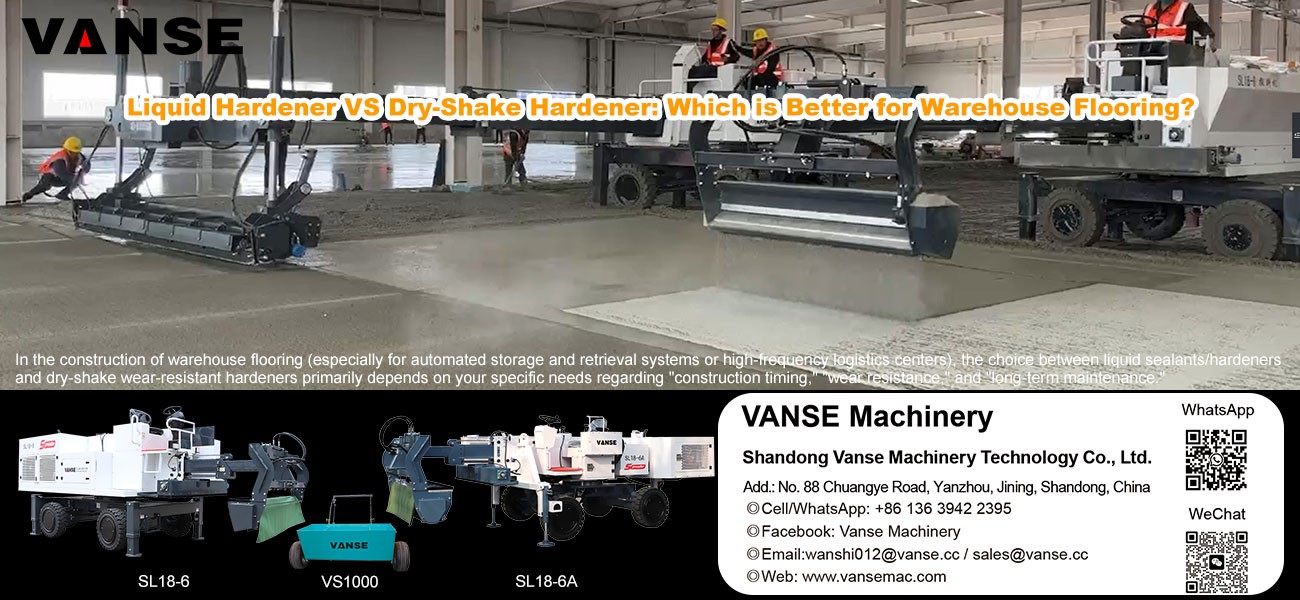
In the construction of warehouse flooring (especially for automated storage and retrieval systems or high-frequency logistics centers), the choice between liquid sealants/hardeners and dry-shake wear-resistant hardeners primarily depends on your specific needs regarding "construction timing," "wear resistance," and "long-term maintenance."
Below is an in-depth comparative analysis of the two:
1. Core Differences Comparison
| Dimensions | Dry-shake hardener (corundum/alloy) | Liquid Sealing and Hardening Agent |
| Construction timing | Applied simultaneously with concrete (during the initial setting of newly laid flooring) | Applied after concrete is formed (suitable for both new and old floors) |
| Working principle | Physical coverage: Forms a dense, wear-resistant layer of 3-5mm | Chemical reaction: Penetrates and fills capillaries, increasing hardness |
| Impact resistance | Extremely strong, suitable for heavy machinery and pallet impacts | Generally, relies on the inherent structural strength of the original concrete |
| Dustproof effect | Good, but slight dusting may occur with use | Excellent: Thoroughly seals pores, achieving a dust-free level |
| Aesthetics | Available in various colors (green, gray, red, etc.) | Retains the original cement color, becoming brighter with use over time |
2. Why choose dry-shake hardener?
If your warehouse is a new construction project and involves the installation of heavy-duty shelving or frequent forklift turning:
Physical protection: It forms an extremely hard "protective shield" on the floor surface, capable of withstanding the high-intensity shear forces exerted by forklift wheels on the ground.
Low overall cost: Construction is carried out simultaneously with concrete pouring, eliminating the need for a second mobilization, making it the most classic solution for industrial warehouses.
3. Why choose liquid hardeners?
If your warehouse requires extremely high levels of cleanliness, or if you are renovating an old floor:
Increased Mohs hardness: Through chemical reaction, the surface Mohs hardness reaches 7-8, effectively preventing cement particles from flaking off.
Nearly zero maintenance costs: No waxing or special maintenance is required; the friction from forklifts actually acts as a polishing agent, making the floor brighter with use.
Penetration power: It can penetrate 3-8mm into the concrete, solving the problem of internal looseness in the concrete.
4. Best Practices for Warehouse Flooring: A Winning Combination
Currently, high-standard warehouse flooring (such as those used in logistics parks like JD.com and Cainiao) typically employs a combined approach:
Dry-shake metallic aggregate floor hardener + Liquid concrete densifier/sealer
Step 1: Dry-shake the metallic aggregate onto the concrete during placement to establish basic wear resistance and impact resistance.
Step 2: After the curing period of the floor is complete, spray the liquid concrete densifier/sealer for penetration and sealing.
Advantages of this combination:
Completely eliminates dusting: It overcomes the drawback of dry-shake hardeners potentially producing dust in the later stages.
Impermeable and stain-resistant: Prevents forklift oil leaks or stains from penetrating the floor surface.
Extra-long lifespan: Provides a service life of over 20 years, meeting the long-term operational needs of warehouses.
Recommendations:
For elevated warehouses/precision storage facilities: A combined solution is strongly recommended.
For ordinary transfer yards/outdoor platforms: Applying a dry-shake hardener alone will suffice.
Note: The parameters provided in this document are for reference only and are not mandatory. Due to differences in technical characteristics between different brands and models of laser levelers, please consult the manufacturer for a suitable solution before actual operation. This reference document assumes no responsibility for any issues arising from failure to follow the manufacturer's instructions.
Thanks to All the Friends Who Support and Trust Shandong Vanse Machinery Technology Co., Ltd.
If you want to know more about Shandong Vanse Machinery Technology Co., Ltd. or have any questions, please feel free to contact us:
Our Factory
Shandong Vanse Machinery Technology Co., Ltd.








Share this article

About the Author: Shandong Vanse Machinery Technology Co., Ltd.
Shandong Vanse Machinery Technology Co., Ltd. is a high-tech manufacturer specializing in concrete construction machinery, including laser screeds and related equipment. The company integrates R&D, production, and global sales, with products exported to over 60 countries and widely used in infrastructure projects worldwide.
Previous Post
Next Post
Related Articles
You Might Also Like
What changes will the construction effect of the laser leveling machine have under different climatic conditions?
The effect of laser leveling machine construction under different climatic conditions may be affected to a certain extent, mainly reflected in the following aspects: 1. **Temperature changes**: – Extremely high or low temperatures may affect the performance of electronic components of laser leveling machine, such as the accuracy of laser transmitters and receivers. High temperature may cause the equipment to overheat, and low temperature may affect battery life and the response speed of electronic components. – Temperature also affects the setting time and hardening process of concrete. At high temperatures, concrete may lose moisture and solidify faster, which may shorten the operating window of the laser leveling machine, while at low temperatures, concrete solidifies more slowly and it may take longer to complete the leveling work. 2. **Humidity and rainfall**: – High humidity may affect the propagation of laser signals. Although laser leveling machines are usually designed with waterproof functions, continuous high humidity or direct rainfall may interfere with laser signals and affect leveling accuracy. – Rain will directly affect the pouring and leveling of concrete, because rain will make the concrete surface unstable, increase the difficulty of leveling, and may also cause the operation of the laser leveling machine to be suspended until the weather improves. 3. **Wind**: – Strong winds may interfere with the laser signal, especially when working outdoors. Wind may cause the laser transmitter or receiver to move slightly, affecting the accuracy of leveling. – Wind may also accelerate the evaporation of water from the concrete surface, especially in dry and hot conditions, which may affect the surface quality of the concrete and the final leveling effect. 4. **Lighting conditions**: – Strong sunlight or reflected light may interfere with the reception of laser signals, especially when there is strong light directly in the path of the laser signal. This is not a problem when working at night or on cloudy days. 5. **Dust and sand**: – Large amounts of dust and sand may block the laser signal, especially when working in a dusty environment. This may require more frequent cleaning and maintenance to ensure the normal operation of the laser leveling machine. In order to avoid the above factors affecting the construction effect of the laser leveling machine, the measures usually taken include: – Avoid construction in extreme weather conditions as much as possible, or choose the time of day when the weather conditions are most stable. – Perform regular maintenance on the laser leveling machine to ensure its optimal performance in various environments. – Take appropriate concrete pouring and maintenance measures to adapt to different climatic conditions. – Use auxiliary equipment such as protective covers or parasols to reduce the interference of external environmental factors on laser signals. In short, although the laser leveling machine is designed to take into account the influence of various environmental factors, in actual construction, it is still necessary to make corresponding adjustments according to specific climatic conditions to ensure construction quality and safety.How to deal with the ground after the construction of a concrete laser leveler?
– Polishing : When the poured and leveled concrete reaches the initial setting, the ground polishing process begins. First, use a single-disc polishing machine and a trowel disc to cross-break the slurry and trowel to ensure the flatness control of the machine operation process. Then, use a 3-meter scraper to rotate 360° to level the surface layer to achieve full control of flatness. After the first disc cross-trowel, professional technicians use a 3-meter scraper to fully level the compacted concrete surface layer. – Finishing : As the disc trowels, the machine uses a blade to smooth it. According to the speed of the strength increase, when the concrete theoretically reaches the final setting, the mechanical vertical knife method is used, combined with the machine speed and blade angle, to perform the final finishing on the surface layer. – Moisturizing maintenance: After the floor is finished, use a maintenance blanket or a special maintenance non-woven fabric to cover it and water it to keep it moist. Concrete needs to be cured 12 hours after pouring. It can be covered with plastic cloth, watered, or sprayed for maintenance. The curing should be carried out for at least 7 days. – Temperature control: Ensure that the temperature difference between the inside and outside of the concrete is less than 25℃, assign a special person to watch over it, ensure that the concrete surface is clean and watered in place. – Cover protection: If the upper construction continues on the finished floor, it is necessary to strengthen the protection of the finished product. The paper fiberboard can be used to cover the entire system to protect the concrete surface. – Protective measures: When dismantling the shelf, you can use a protective bamboo fence to cover the entire range of the dismantled shelf, and throw the dismantled steel pipes and fasteners on the bamboo fence to prevent the steel pipes and fasteners from directly hitting the "clear water concrete" floor (ground). – Anti-pollution treatment: If there are anti-pollution requirements for the finished floor (ground) surface, a special concrete sealing wax can be applied to the finished surface to form a surface wax coating to prevent pollution from damaging the floor (ground) surface. – Expansion joint cutting: After the concrete is finally set, the expansion joint is cut according to the design requirements to prevent the ground from cracking.Is there a direct relationship between the power of the trowel machine and the trowel effect?
– Trowels with higher power are usually more powerful. For example, in the concrete floor construction of large-scale construction projects, if a driving trowel with higher power (such as 5.5kW – 7.5kW) is used, its motor can provide enough torque to rotate the trowel blade at a higher speed. In this way, when facing a large area of rough ground, the unevenness of the concrete surface can be quickly smoothed, effectively improving work efficiency. – A high-power trowel has more advantages when dealing with thicker concrete surfaces or ground materials with a certain hardness. Because it can more easily overcome resistance, cut the trowel blade into the material surface to a certain depth, compact and smooth the material, and make the ground smoother. – High-power trowels may have better speed stability. Due to its sufficient power, the speed of the trowel blade can be kept relatively stable during operation, even if the local hardness of the ground changes or it is uneven. This helps to achieve a more uniform trowel effect. For example, when troweling the floor of an industrial plant, a high-power trowel can better deal with the small potholes and bumps that may exist on the ground, making the troweled ground more uniform in gloss and flatness. – The material and design of the trowel blade are crucial to the trowel effect. For example, the use of high-quality alloy steel trowel blades has better hardness and wear resistance. Driven by a trowel of the same power, this trowel blade can better smooth the ground and has a longer service life. – Different types of trowel blades are suitable for different ground materials and construction requirements. For example, for indoor floors with high precision requirements, a trowel blade with fine texture may be required. This trowel blade can achieve a delicate trowel effect at a lower power through its special texture design. – The operator's proficiency in operating the trowel will affect the trowel effect. An experienced operator can reasonably control the trowel's walking speed, trowel angle and other parameters according to the actual situation of the ground. Even if a trowel with a smaller power is used, a better trowel effect can be obtained through reasonable operation, such as multiple cross trowels. – The operator's control over the construction process is also very important. For example, the use requirements of the trowel are different in the initial setting stage and the final setting stage after concrete pouring. If the operator can accurately grasp the timing and choose the appropriate power and trowel method, the ideal trowel effect can be achieved. – The initial flatness and material quality of the ground have a great influence on the trowel effect. If the ground itself is seriously uneven, such as large cracks, potholes or local looseness caused by unreasonable concrete material ratio, then relying solely on the power of the trowel will not be able to obtain a good trowel effect. In this case, the ground foundation needs to be repaired first, and then the trowel is used for troweling.