Technical Knowledge
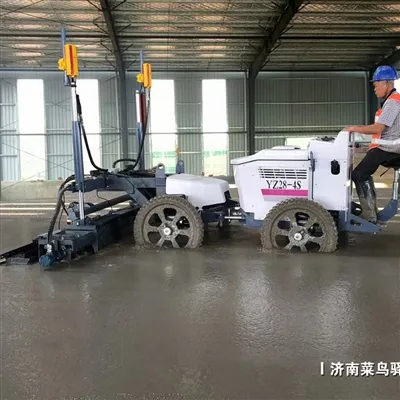
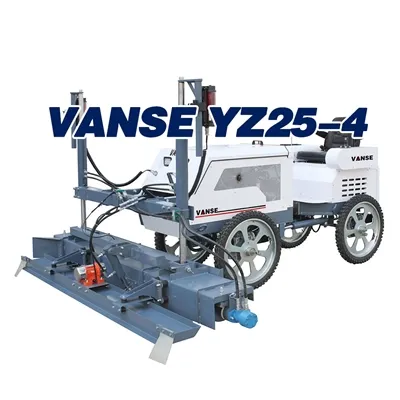
Large boom operated laser guided concrete leveling machine


Concrete laser leveling machine is used in large-area floor construction. The ground elevation is easy to control and the ground flatness error is extremely small. Due to the use of laser point-to-point, the entire floor only needs 1-2 reference points for elevation, which can reduce the error caused by multiple reference points. The laser emitter is arranged independently, and the floor elevation is always controlled by the plane formed by the rotating light beam emitted by the laser emitter. As long as the laser emitter is not disturbed, no matter where the Ruifang concrete laser leveling machine goes, it can ensure that the overall elevation of the paved ground is not affected, so that large-area one-time paving can be achieved in floor construction, and the levelness and flatness of the entire floor can be guaranteed. The concrete laser leveling machine uses a laser measurement and control system to control the elevation in real time. There is no need to pull a control line for leveling, and there is no need to support the side template in the middle to control the ground elevation, thereby avoiding the elevation error caused by the vibration of the template (channel steel) during the construction process, and also reducing the elevation error caused by traditional manual block support. Concrete laser leveling machine, used in floor construction, is very easy to achieve one-time overall paving of large-area floor. This paving technology can be divided into blocks as needed, and the whole floor can be completed continuously, making the floor more integrated, which is impossible to achieve with traditional construction technology.
When leveling concrete, the concrete laser leveling machine is always in a uniform speed construction state, with a high-frequency vibrator of 4000 times per minute, so that the vibration plate of the leveling head produces uniform high-frequency vibration, making the concrete floor more dense and uniform.
Thanks to All the Friends Who Support and Trust Shandong Vanse Machinery Technology Co., Ltd.
If you want to know more about Shandong Vanse Machinery Technology Co., Ltd. or have any questions, please feel free to contact us:
Our Factory
Shandong Vanse Machinery Technology Co., Ltd.








Share this article

About the Author: Shandong Vanse Machinery Technology Co., Ltd.
Shandong Vanse Machinery Technology Co., Ltd. is a high-tech manufacturer specializing in concrete construction machinery, including laser screeds and related equipment. The company integrates R&D, production, and global sales, with products exported to over 60 countries and widely used in infrastructure projects worldwide.
Previous Post
Next Post
Related Articles
You Might Also Like
How to perform post-inspection and treatment of concrete laser leveling machine?
Post-inspection and handling of the concrete laser leveling machine are very important to ensure the normal operation of the machine and extend its service life. Here are some suggestions: 1. Daily inspection: After the completion of daily construction, the levelinging machine should be inspected daily, including whether the fasteners are loose, whether the oil level is normal, whether there is any leakage, etc. These daily inspections can detect and solve potential problems in time, preventing small problems from accumulating into large failures. 2. Regular maintenance: According to the usage, make a regular maintenance plan, including replacing lubricating oil, cleaning the machine, checking sensors, etc. Regular maintenance can ensure that the performance indicators of the leveling machine are normal and extend the service life of the machine. 3. Professional maintenance: If you encounter problems that cannot be solved, you should seek help from professional maintenance personnel. Do not attempt to disassemble or repair the leveler yourself to avoid further damage or safety incidents. 4. Storage: When the concrete laser leveler is not in use, it should be stored in a dry and ventilated place, and the equipment should be kept clean. At the same time, the machine should be started regularly to keep it in good condition. 5. Battery maintenance: If the leveler uses battery power, attention should be paid to the charging and storage of the battery. Avoid overcharging or discharging and try to use the original charger for charging. 6. Recording and tracking: Establish detailed maintenance records to track machine usage and maintenance history. This helps to detect and deal with potential problems in time, while providing a reference for future maintenance. 7. Safe operation: Always comply with safe operating procedures and ensure that safety measures in the construction area are implemented. When using the leveler, avoid wearing loose clothing or accessories that may get caught in the rotating part. To sum up, the later inspection and processing of the concrete laser leveling machine need to be considered and implemented from the aspects of daily inspection, regular maintenance, professional repair, storage, battery maintenance, recording and tracking, and safe operation. Through the implementation of these measures, the normal operation and use effect of the concrete laser leveling can be ensured, its service life can be extended, and maintenance costs can be reduced.Can a concrete laser leveling machine handle slopes? Which settings work best?
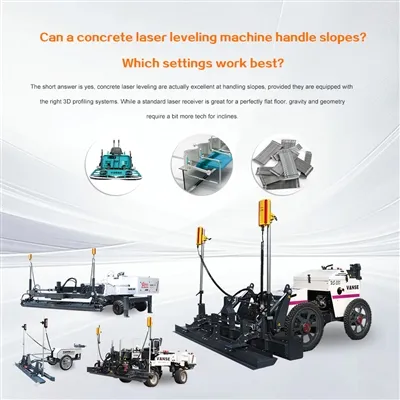
The short answer is yes, concrete laser leveling are actually excellent at handling slopes, provided they are equipped with the right 3D profiling systems. While a standard laser receiver is great for a perfectly flat floor, gravity and geometry require a bit more tech for inclines. Standard laser leveling uses a rotating laser transmitter on a tripod and receivers on the machine. This creates a flat "plane" of light. Single/Dual Slopes (2D): If you are doing a simple parking lot ramp or a consistent drainage slope, you can physically tilt the laser transmitter on its tripod to a specific percentage (e.g., a 1% grade). The machine will then follow that tilted plane.Complex Contours (3D): For complex curbs, valleys, or multi-directional slopes, the machine uses 3D Profiling Systems (often involving a Total Station or GPS). This allows the leveling to automatically adjust the head height based on its exact coordinate position on a digital map. To get the best finish on a slope, you can't just "set it and forget it." You need to account for the way wet concrete behaves under gravity. On a slope, concrete tends to "slump" or migrate downward. Setting: Keep the auger speed high enough to move excess material but not so fast that it creates a "wave" of concrete that pulls away from the high side. The vibrator is what settles the aggregate and brings the "cream" to the top. Setting: On steep slopes, lower the vibration frequency slightly. Over-vibrating on an incline can cause the concrete to fluidize too much, leading it to slide down the hill before it sets (slumping). Best Practice: Generally, you want to pull the machine up the slope or work across the fall. Pulling downhill can lead to "shingling," where the leveling head pushes too much material in front of it, resulting in an uneven thickness. If your machine has slope compensation software, ensure it is toggled on. This adjusts the hydraulic response time to ensure the leveling head reacts instantly to changes in elevation without "hunting" or bouncing, which happens more often on uneven grades. Factor Standard Flat Setting Slope Setting Laser Mode Horizontal / Level Grade / Manual Slope Vibration High / Normal Reduced (to prevent slump) Travel Speed Faster Slower & More Consistent Concrete Slump 4" – 5" 3" – 4" (Lower is better for slopes) Note: The parameters provided in this document are for reference only and are not mandatory. Due to differences in technical characteristics between different brands and models of laser levelers, please consult the manufacturer for a suitable solution before actual operation. This reference document assumes no responsibility for any issues arising from failure to follow the manufacturer's instructions.What are the methods to repair poor concrete pavement flatness?
– Applicable situations: Applicable to situations where there are small bulges or unevenness in the concrete pavement, the height of the bulge is generally within a few millimeters, and the unevenness is relatively mild. – Operation method: Use a pavement grinder to grind the uneven parts, and grind off the raised parts to make the pavement flat. When grinding, pay attention to controlling the depth and range of grinding to avoid excessive grinding causing the pavement to become thinner or new unevenness. After grinding, clean up the debris and dust on the pavement in time. – Applicable situations: Applicable to situations where there are shallow potholes or local depressions on the pavement, the depth is usually less than 2-3 cm, and the area is not large. – Operation method: First clean the potholes and remove debris, dust and loose concrete fragments. Then use cement mortar or special pavement repair materials with the same or higher strength grade as the pavement concrete to fill them. When filling, the material should be fully compacted and smoothed to ensure that the surface after filling is consistent with the surrounding road surface. In order to ensure the adhesion between the repair material and the original road surface, a layer of interface agent can be applied to the surface of the pothole before filling. – Applicable conditions: When the road surface unevenness is more obvious, the depth of the potholes or depressions is about 3-5 cm, and the area is large, the thin layer repair method can be used. – Operation method: First, cut the area to be repaired into a regular shape. The depth is determined according to the degree of unevenness, generally about 3-5 cm. Then clean up the loose concrete in the cut area and treat the base appropriately, such as compaction, cleaning, etc. Then lay a thin layer of repair material that matches the performance of the original road concrete, such as polymer-modified concrete or high-performance repair mortar. When laying, use tools such as flat vibrators or trowels to vibrate and compact the materials, smooth them, and ensure that the repair layer is tightly combined with the original road surface and the surface flatness meets the requirements. – Applicable situations: Applicable to large areas with poor road flatness, serious unevenness, multiple potholes of varying depths, wavy unevenness, etc. – Operation method: Use a road milling machine to mill off the uneven surface of the road. The milling depth is generally about 5-10 cm, and the specific depth is determined according to the actual situation of the road surface. After milling, clean up the debris and dust, inspect and treat the base layer, and repair and compact any damaged or loose parts. Then re-pave the concrete road surface according to the design requirements, including paving, vibration, troweling and other processes to ensure that the flatness of the newly laid concrete road surface meets the standard. After the concrete is poured, it should be maintained in time to prevent quality problems such as cracks. – Applicable situations: When the concrete pavement is severely broken, sunken or uneven over a large area, and the base is also severely damaged, partial plate replacement is required. – Operation method: First determine the range of the plates that need to be replaced, use a cutting machine to cut the plates neatly around, then remove the broken concrete plates, and clean up the debris and loose materials on the base. Reinforce the base, such as using compaction, replacement and other methods to ensure that the bearing capacity and stability of the base meet the requirements. Then re-pour the concrete plates according to the design requirements, including installing the formwork, tying steel bars (if required), pouring concrete, vibrating and compacting, and smoothing. After pouring, strict maintenance must be carried out, and traffic will be opened after the concrete reaches the design strength. – Applicable situations: If the overall flatness of the concrete pavement is extremely poor, and there are large-scale defects such as severe cracks, potholes, and subsidence, and after evaluation, it is believed that the repair can no longer meet the use requirements, or the repair cost is too high, overall renovation can be considered. – Operation method: First, the original pavement should be demolished, the concrete pavement should be crushed and transported away, and the base layer should be thoroughly inspected and treated. If there are weak soil layers or poor geological conditions, corresponding treatments should be carried out, such as replacement and reinforcement. Then, according to the design plan, the pavement structure should be re-laid, including the base layer, subbase layer, surface layer, etc., and the construction should be carried out in accordance with the construction specifications, and the thickness, compaction and flatness of each layer should be strictly controlled. During the construction process, quality inspection and control should be strengthened to ensure that the performance indicators of the new pavement meet the design requirements. The pavement after overall renovation needs to be maintained and debugged for a period of time. After all indicators are stable, it can be officially opened to traffic. ARMOUR JOINT CONCRETE LASER LEVELING MACHINE LIGHT TOWER STEEL FIBER TRACKED MINI DUMPER POWER TROWEL