Technical Knowledge
Is the concrete laser leveling machine efficient?

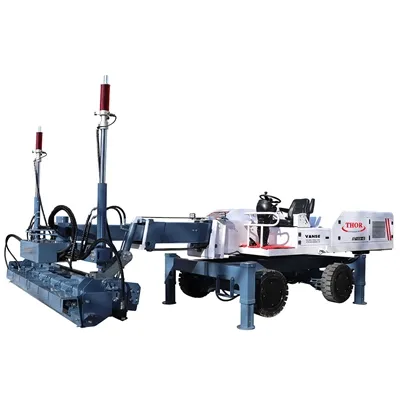
The efficiency of concrete laser leveling machines is relatively high. It uses laser measurement technology to complete large-area leveling operations in a short time and achieve high precision and flatness. Here are some factors that can affect the efficiency of a concrete laser leveling:
✈Smoothing area and working environment
The efficiency of the concrete laser leveling is closely related to the size of the levelinging area and the working environment. When the leveling area is large or the working environment is complex, the work efficiency of the leveling machine may be affected and it will take longer to complete the leveling operation.
✈Operator skills and experience
The skill and experience of the operator also plays a role in the efficiency of the concrete laser leveling. If the operator has rich experience and high skill level, can operate the leveling machine proficiently, and accurately grasps the relevant parameters and routes, then the efficiency of the leveling machine will be relatively high.
✈Automation and control system
The level of automation and control system of a concrete laser leveling also affects its efficiency. The higher the degree of automation and the more advanced the control system, the simpler and faster the leveling machine is to operate, allowing the leveling operation to be completed faster.
✈Maintenance and care
The maintenance and upkeep of a concrete laser leveling is also one of the factors that affects its efficiency. If the leveler is kept in good working condition and the time for breakdowns and repairs is reduced, the efficiency of the leveler will be relatively high.
To sum up, the efficiency of concrete laser leveling machine is relatively high, but it will also be affected by some factors. When choosing to use it, you need to consider the actual situation and choose appropriate machinery and equipment to meet the construction requirements.
Thanks to All the Friends Who Support and Trust Shandong Vanse Machinery Technology Co., Ltd.
If you want to know more about Shandong Vanse Machinery Technology Co., Ltd. or have any questions, please feel free to contact us:
Our Factory
Shandong Vanse Machinery Technology Co., Ltd.








Share this article

About the Author: Shandong Vanse Machinery Technology Co., Ltd.
Shandong Vanse Machinery Technology Co., Ltd. is a high-tech manufacturer specializing in concrete construction machinery, including laser screeds and related equipment. The company integrates R&D, production, and global sales, with products exported to over 60 countries and widely used in infrastructure projects worldwide.
Previous Post
Next Post
Related Articles
You Might Also Like
How long does it usually take for the transmission parts of a concrete power trowel to be replaced?
– Under normal working conditions: If the trowel is used in a relatively ideal working environment (clean, suitable temperature, normal load) and is regularly maintained, the drive chain can generally be used for about 1000-1500 hours. For example, the service life of the trowel chain used in a small indoor concrete prefabricated parts processing workshop may be close to this upper limit. – Under harsh working conditions: In a working environment with a lot of dust, high humidity or frequent overload shock, the wear of the chain will be aggravated. For example, at an outdoor construction site, the chain may be eroded by sand, dust and rain, and due to frequent starts and stops during construction, sudden changes in load, etc., the chain may need to be replaced in 500-800 hours. – Under normal working conditions: The service life of a good quality drive belt is about 800-1200 hours under normal use and maintenance conditions. For example, in some industrial plants, trowels are used for daily maintenance of the floor. The working environment is relatively stable, and the belt may be used for a long time. – Under harsh working conditions: When the belt is in a high temperature and high humidity environment for a long time, or is contaminated by oil or chemicals, its performance will decline rapidly. For example, in a trowel used in a factory workshop with the risk of chemical leakage, the belt may have serious problems such as slipping and aging in 400-600 hours and need to be replaced. – Under normal working conditions: For gears with high precision and good materials, they can generally be used for 2000-3000 hours under normal working conditions. For example, in a trowel used in an indoor high-precision concrete product workshop, the gear wears relatively slowly. – Under harsh working conditions: Under high load, frequent start and stop, poor lubrication or foreign matter entering the gearbox, the gear tooth surface will have serious wear and tooth root fatigue fracture. For example, in the construction of heavy-loaded port concrete dock floors, gears may need to be replaced in 1000-1500 hours. In addition to the reference working time, the actual usage conditions should also be considered when judging whether the transmission parts need to be replaced. For example, when the transmission parts are loose, slipping, severely worn (chain links are elongated by more than 3% – 5%, belts are cracked or peeled, gear tooth surfaces are worn by more than 0.5 – 1mm, etc.), or produce abnormal noise or vibration, the transmission parts should be inspected and replaced in time even if the reference working time is not reached.The reason why the laser leveling machine is efficient and fast
With the gradual improvement of the requirements of modern industrial floors, more and more floor construction equipment began to show their own power, and the laser leveling machine has been loved by the majority of users since it was launched, so it can be used in the leveling machine occupy a place in the market. Laser leveling machine manufacturers have always insisted on providing users with standardized equipment, and are committed to bringing more efficient construction to road construction. Laser leveling machine manufacturers will introduce some performance advantages of the leveling machine from the following, I hope you can understand. The laser leveling machine laser measurement and control system produced by the laser leveling machine manufacturer automatically controls the elevation. The design elevation of the top surface of the floor with the laser system imported from the United States is automatically controlled by the laser machine computer, which can ensure a very high leveling of the ground, and can directly achieve leveling on the concrete layer. The leveling of the ground is not affected by the vibration of the construction formwork, and no formwork is needed in the middle , Reduce artificial material input, reduce construction procedures, and speed up construction progress. The laser leveling machine is super flat and super economical. Since the 1990s, since the continuous promotion of "clear water concrete" (building) floor and colored wear-resistant (building) floor, after more than ten years of exploration and continuous improvement, through the upgrading of laser leveling machine equipment, the process flow The integration is perfect, so that the "three super" floors in the current "flat" product series have reached the domestic level. The laser leveling machine produced by the laser leveling machine manufacturer replaces the traditional manual leveling of concrete. The ground elevation can reach laser-level accuracy. Lasers are used to control the levelness and flatness of the ground, so as to achieve a super-flat floor in the sense. So how much is a laser leveling machine, you first understand the performance and then look at the price. The integral floor abandons the traditional method of separate construction of the concrete base and surface, thus eliminating the common quality problems of cracks and hollows caused by poor combination of the base and the surface, and is widely used in factories, warehouses, runways, docks and other projects more and more widely used. Using special leveling and polishing technology to process concrete into high-density and high-gloss floor, and naturally form a 3~5mm thick wear-resistant layer on the surface, without other chemical surface materials, meeting environmental protection requirements. The laser leveling machine is developed according to the increasing demand for ground quality such as strength, compactness, flatness, levelness, etc. of modern industrial plants, large shopping malls, warehouses and other large-area cement concrete floors. Laser leveling machine manufacturers specialize in the production of various types of leveling machines. The equipment produced is exquisite in craftsmanship, mature in technology, and stable in performance. We will provide customers with good after-sales service, allowing you to enjoy a relaxed and happy purchase process. Customers will use it later Problems encountered can be resolved in time to ensure the normal operation of the production line.Analysis of the electrical and mechanical causes of walking faults such as deviation in the direction of the power trowel machine
Faults such as deviation in direction and poor movement of the power trowel during operation are common but affect the efficiency and quality of construction. This is usually caused by both mechanical and electrical reasons, either jointly or separately. The following is a detailed analysis of the causes of the walking failure of the power trowel machine: The electrical system is mainly responsible for providing power and control to the walking motor. Its faults are usually manifested as one side of the motor not rotating, unstable speed or weak power. Internal cable breakage: The outer sheath is intact but the internal core wire (especially the neutral wire or a certain phase wire) is broken, causing single-phase motors or three-phase motors to operate with phase loss, resulting in a significant drop in motor output torque and inability to run normally. Loose/oxidized terminal blocks: The terminal blocks where the power supply is connected to the machine are loose or oxidized, resulting in excessive contact resistance and insufficient power supply voltage. Leakage protection device failure: The leakage protection device or circuit breaker of the main power supply itself malfunctions, resulting in unstable output voltage. Poor contact of the walking switch (button) : The switch controlling the walking motor has internal contacts eroded or oxidized due to frequent operation, water ingress or dust, resulting in increased contact resistance and inability to connect the full voltage. Ac contactor failure: The high-power relay (contactor) responsible for turning on and off the main circuit of the traveling motor has burned contacts and unstable coil engagement, which can cause the motor to rotate intermittently or be powered by a single phase. Speed regulator failure (frequency conversion/voltage regulation type) : For speed-adjustable polishing machines, if the internal frequency converter or voltage regulation module fails, it will cause unstable output frequency or voltage, directly resulting in abnormal motor speed and deviation. Motor winding burnout or local short circuit: The stator winding of the motor is damaged due to overload, water ingress or aging. It is manifested as severe motor heating, a burnt smell, weak operation or no rotation at all. Water ingress or moisture inside the motor: The insulation performance declines, causing inter-turn short circuits during operation and a reduction in output power. Severe wear of carbon brushes (series-excited motor) : Many power trowelers use series-excited motors, and carbon brushes are vulnerable parts. Excessive wear of carbon brushes can lead to poor contact with the commutator, increased sparks, decreased motor speed and insufficient torque. Mechanical reasons are the most common causes of deviation, mainly concentrated in the transmission system and the traveling mechanism itself. Loose or worn drive belts: This is the most common cause of deviation. The motor output is transmitted to the reducer or traveling wheels through a belt. If one side of the belt is loose, aged, stretched or worn, it will cause insufficient driving force on that side, and the machine will deviate from that side. Reducer failure Gear wear or broken teeth: This leads to a decrease in transmission efficiency or jamming. Lack or deterioration of lubricating oil: It leads to abnormal wear of gears and bearings and increases transmission resistance. Bearing damage: It causes the output shaft to rotate inflexibly and even get stuck. Chain drive failure (for a few models) : The chain is loose, worn or the sprocket teeth are sharpened, resulting in tooth skipping and unstable transmission. Uneven wear of the walking wheels: After long-term use, rubber walking wheels may experience uneven wear and deformation, causing changes in the friction force with the ground and leading to deviation. Uneven air pressure on the running wheels (pneumatic tires) : If the air pressure on both sides of the tires is inconsistent, it will cause different rolling radii and resistance, similar to a car running off course due to uneven tire pressure. Axle bearing damage: If the bearings of the traveling wheels are damaged, rusted or lack oil, it will greatly increase the rolling resistance of the wheel, and the machine will deviate severely to the side with greater resistance. The brake is not fully released (for models with brakes) : If the brake pads on one side do not fully return to their original position, they will always carry a certain braking force, causing difficulty in walking on that side. The installation height of the blades is inconsistent: The four blades (power trowels) of the power trowel machine are not installed parallel. During operation, the pressure and friction on the ground are different, which will generate a turning torque and cause the machine to not move straight. This is a very crucial but easily overlooked mechanical cause. Deformation of the machine body structure: The machine has been subjected to a violent impact, causing the chassis or bracket to deform, resulting in the two traveling wheels not being parallel and causing the "tire eating" phenomenon. It is suggested to conduct the investigation in accordance with the principle of "from simple to complex and from outside to inside" When the power is off, check whether the walking wheels on both sides rotate flexibly (by hand) and feel if the resistance is consistent. Check the tightness and wear of the belt/chain. Check if the heights of the blades are consistent (measure the distance from the blade tip to the ground with a ruler). Check if there is any obvious damage to the cable. Lift the machine off the ground to lift the traveling wheels. Start the left and right walking motors respectively and observe whether both wheels can rotate normally, smoothly and powerfully. This is the most effective way to determine whether the problem is electrical or mechanical. If one side is normal while the other does not rotate or is weak: The problem lies in the electrical system or drive system on that side. If both sides rotate normally and forcefully: The problem is likely to lie with the traveling wheel itself or the blade adjustment. For the faulty side: Use a multimeter to measure whether the voltage at the motor input terminal is normal. Measure the voltage section by section along the path from power supply → switch → contactor → motor to find the points where the voltage drops or is missing. Check the wear of the carbon brushes (if it is a series-excited motor). For the faulty side: If the motor rotates normally but the wheels do not turn or are weak, the problem lies in the transmission system. Check if the belt is slipping and if there is any abnormal noise from the reducer. Disassemble and check whether the bearings of the walking wheels are stuck. Recalibrate the heights of the four blades to ensure they are on the same plane. Fault phenomenon The electrical cause of priority suspicion The mechanical cause of priority suspicion Keep running off course to one side The carbon brushes of the motor on this side are worn out and the wiring is loose The belt on this side is loose, the bearing of the traveling wheel is damaged, and the height of the blade is uneven I walk with weakness on both sides Main power phase loss, main switch/contactor failure, motor winding problem Both sides of the belts are loose and the lubrication of the reducer is poor It starts and stops intermittently, and the operation is unstable Poor contact of the switch/contactor contacts and intermittent connection inside the cable The chain teeth are jumping and the bearing is about to get stuck For most on-site operators, first adjusting the blade height and checking the tightness of the belt can often solve more than 80% of the deviation problems. If the problem persists, conduct more complex electrical and mechanical disassembly inspections. Note: The parameters provided in this document are for reference only and are not mandatory. Due to differences in technical characteristics between different brands and models of laser levelers, please consult the manufacturer for a suitable solution before actual operation. This reference document assumes no responsibility for any issues arising from failure to follow the manufacturer's instructions.