Technical Knowledge
In a windy environment, how should the wind protection measures of the laser leveling machine be implemented?

In a windy environment, to ensure the normal operation of the laser leveler, windproof measures can be implemented from the following aspects:
Equipment stability measures
– **Weighted chassis**: Add appropriate weights to the chassis of the laser leveler. Sandbags or special metal weights can be used, evenly distributed around the chassis. For example, for a small laser leveler, a 20-30 kg sandbag can be placed at each corner of the chassis to lower the center of gravity of the equipment and enhance its wind resistance stability.
– **Install windproof anchoring device**: Set anchor points at appropriate positions on the fuselage of the leveler and use ground anchors to fix the equipment to the ground. The ground anchor can be a spiral ground anchor or a metal ground anchor with expansion bolts. Drill a hole in the solid ground at the construction site, insert and fix the ground anchor, and then connect the leveler to the ground anchor with an iron chain or high-strength rope.
Working environment adjustment
– **Set up a windproof barrier**: Set up a windproof barrier in the upwind direction of the leveler operation area. Windbreaks can be made of materials such as canvas, color steel plates or plastic woven mesh. For example, a 2-3 meter high color steel plate windbreak wall can be built and placed at a certain angle (usually 70-90 degrees) to the wind direction, which can effectively reduce the direct impact of the wind on the leveler.
– **Adjust the working time and location**: If the wind is too strong and continuous, you can consider adjusting the working time to avoid the strongest wind period. At the same time, choose a working location with natural windbreak obstacles (such as mountains, buildings, etc.) around to reduce the impact of the wind with the help of these natural barriers.
Sensor and laser system protection
– **Sensor windshield**: Install a windshield for the sensor on the laser leveler. The windshield can be made of transparent plexiglass or plastic, which can prevent wind and sand without affecting the signal reception of the sensor. For example, a hemispherical transparent plastic windshield is installed around the laser receiver, and there are small holes on the cover for ventilation to prevent internal fog from affecting signal reception.
– **Laser system reinforcement and windproof**: Reinforce the laser transmitter to ensure that it can maintain a stable emission angle in the wind. At the same time, place the laser transmitter in a windproof location, such as a temporary shed or a sheltered place, to reduce the interference of wind on the propagation of the laser beam and ensure the accuracy of the laser signal.
At the same time, we have professional customer service, online 24 hours a day, welcome to call.
Thanks to All the Friends Who Support and Trust Shandong Vanse Machinery Technology Co., Ltd.
If you want to know more about Shandong Vanse Machinery Technology Co., Ltd. or have any questions, please feel free to contact us:
Our Factory
Shandong Vanse Machinery Technology Co., Ltd.








Share this article

About the Author: Shandong Vanse Machinery Technology Co., Ltd.
Shandong Vanse Machinery Technology Co., Ltd. is a high-tech manufacturer specializing in concrete construction machinery, including laser screeds and related equipment. The company integrates R&D, production, and global sales, with products exported to over 60 countries and widely used in infrastructure projects worldwide.
Previous Post
Next Post
Related Articles
You Might Also Like
The detection methods and acceptance standards for the flatness and smoothness of the floor after the construction by the concrete laser leveling machine
The detection methods and acceptance standards for the flatness and smoothness of the floor after the construction by the concrete laser leveling machine are a very professional and important issue. Although laser levelings can achieve extremely high quality standards, the final acceptance relies on objective data. The following are the detailed testing methods and acceptance criteria: Flatness is the greatest advantage of the laser leveling machine, and its acceptance criteria are much higher than those of traditional processes. Straightedge and feeler gauge method (traditional, commonly used) Tools: 2-meter or 3-meter national standard straightedge (or electronic straightedge), feeler gauge. Method: Place the straightedge steadily on the ground and use a feeler gauge to measure the maximum gap between the bottom of the straightedge and the ground. At least 10 points should be measured in the same area (such as a slab or a room), and the measurement points should be randomly distributed and cover key parts such as the edges of walls and the bases of columns. Advantages: Simple tools, convenient operation and intuitive. Disadvantage: It reflects local "wavy" undulations and cannot accurately measure the overall flatness of a large area. Level or total station measurement method (elevation method) Tools: High-precision level, tower ruler or total station. Method: Set up measurement points on the ground in a certain grid (for example, 1m×1m or 2m×2m), measure the elevation value of each point with a level, and then calculate the height difference between any two points or the standard deviation of the entire area. Advantages: The data is precise and can generate an elevation map of the entire ground, making it the most scientific. Disadvantages: It takes a long time and requires high technical skills from the operators. F-Number System (Internationally recognized and the most scientific method) This is the method stipulated in the ASTM E1155 standard of the United States. It is currently the mainstream and highest standard for evaluating the flatness of the floor internationally, and is particularly suitable for high-standard floors constructed by laser levelings. Tools: Specialized floor profile meters (such as DipStick, DynaPulse, etc.) or continuous inertial profile measurement vehicles. Evaluation index F<sub>F</sub> value (flatness value) : It measures the undulation of the large wavelength (>600mm) of the floor, reflecting the degree of "tilt" or "wave" of the floor. The larger the F<sub>F</sub> value, the flatter the overall floor. F<sub>L</sub> value (levelness value) : It measures the undulation of the small wavelength (<600mm) of the floor surface, reflecting the degree of "roughness" or "micro-vibration" of the floor surface. The larger the F<sub>L</sub> value is, the smoother the local area of the floor will be. Method: Measurement and calculation are carried out by professionals and equipment in accordance with standard procedures. Domestic traditional standard (ruler method Ordinary industrial floor: Within a 2-meter straightedge range, the flatness deviation is ≤ 4mm. High-standard industrial floor /VNA ultra-flat floor: Within a 2-meter straightedge range, the flatness deviation is ≤ 2mm. For VNA flooring, it is usually required to be ≤ 1.5mm / 2m. International F-Number Standard (Recommended for high-standard projects) Ordinary industrial floor: F<sub>F</sub> 20 / F<sub>L</sub> 15 High-standard warehouse/logistics center: F<sub>F</sub> 35 / F<sub>L</sub> 25 VNA narrow channel library/super flat floor: F < sub > F < / sub > 50 / F < sub > L < / sub > 40 or higher (F < sub > F < / sub > 60 / F < sub > L < / sub > 50) Commercial floor (such as supermarkets) : F<sub>F</sub> 25 / F<sub>L</sub> 20 Note: The specific F value should be clearly stipulated in the project contract or design documents. Smoothness is a comprehensive concept, encompassing appearance, wear resistance, dust resistance, etc., and it is more dependent on visual inspection and functional acceptance. Visual inspection method Method: Observe the floor surface from different angles under well-lit conditions. Inspection contents Color uniformity: Whether the surface color is consistent, and whether there are obvious color differences, water marks, excessive or insufficient cement slurry. Defects: Whether there are honeycombs, pitted surfaces, holes, peeling, sanding, or exposed stones. Cracks: Check for visible plastic shrinkage cracks and dry shrinkage cracks to the naked eye. Focus on inspecting corners and areas with stress concentration. Bubbles: The quantity and size of surface bubbles. Generally, it is required that there should not be too many bubbles with a diameter greater than 2mm. Mark and gloss: Whether the surface is smooth and if there are any obvious machine marks or manual marks. Hard object scratching method Tools: Keys, coins and other hard objects. Method: Use a hard object to scratch the surface with a certain force. Judgment: If only light white scratches are left, it indicates that the surface hardness is good. If there is obvious sand grain shedding or deep grooves, it indicates that the surface strength is insufficient and sanding may occur. Rebound instrument method Tool: Concrete rebound tester. Method: Indirectly calculate the strength of the floor surface through the rebound value. This method has certain errors and needs to be corrected in accordance with the standards. Judgment: The rebound value should meet the design strength requirements. Abrasion resistance test (Laboratory) For places with high wear resistance requirements, cores can be taken on-site and sent to the laboratory for "abrasion tests" (such as ASTM C779). Visual quality Color: The surface color is uniform and consistent, without obvious color differences or contamination. Defects: The surface is dense and smooth, free from quality defects such as honeycombing, pitting, cracks, sanding, peeling, and hollowing. Seam: The cutting seam should be straight, with uniform width and depth, and no missing edges or corners. Surface hardness and anti-dusting property Scratching with a hard object should not produce sanding or loose substances. In daily use, the movement of vehicles and the movement of people should not cause dust to rise on the ground. In addition to flatness and smoothness, the following indicators also need to be paid attention to Elevation and slope Tools: Level, total station. Standard: The allowable deviation between the measured elevation and the designed elevation is usually ±10mm. In areas with drainage requirements, the slope should comply with the design requirements and there should be no water accumulation. Levelness (not flatness) Tools: Laser leveler, level. Standard: It refers to the degree of inclination of the entire floor relative to the absolute horizontal plane. For equipment foundations with strict level requirements, the allowable error is very small (such as ±3mm/10m). Inspection items Main detection tools Reference for High-standard acceptance Flatness 2-meter straightedge, feeler gauge ≤ 2mm / 2m (Recommended ≤ 1.5mm / 2m) F-Number measurement system F<sub>F</sub> 50 / F<sub>L</sub> 40 (Applicable to VNA floor) Smoothness Visual inspection, hard object scratches The color is uniform, without cracks, sanding or holes, and there is no sanding when scratched Elevation Level, total station ±10mm Slope Level, total station It meets the design requirements and there is no water accumulation Important Notice Prior agreement: All acceptance criteria (especially the methods and standards for flatness) must be clearly stipulated in the contract before construction to avoid disputes later on. Comprehensive inspection: During the acceptance process, a combination of a thorough census and key spot checks should be conducted; it is not advisable to merely focus on a few points. Environmental conditions: The inspection should be carried out after the concrete has reached a certain strength and the surface should be cleaned thoroughly. For high-standard floors constructed by laser leveling machines, it is strongly recommended to introduce the F-Number system for acceptance, as it can most scientifically and comprehensively evaluate the quality and performance of the floor, especially suitable for projects with extreme requirements for the ground such as automated warehouses and logistics centers. Note: The parameters provided in this document are for reference only and are not mandatory. Due to differences in technical characteristics between different brands and models of laser levelers, please consult the manufacturer for a suitable solution before actual operation. This reference document assumes no responsibility for any issues arising from failure to follow the manufacturer's instructions.Application Case of Ultra-flat Floors in Automated Warehousing and Logistics Centers
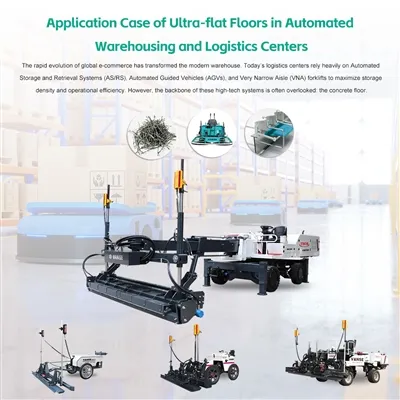
The routine inspection, fault early warning and maintenance points of the hydraulic system of the concrete laser leveling are a crucial topic, as the health condition of the hydraulic system directly determines the construction efficiency, leveling accuracy and equipment service life of the leveling. The following is a detailed and systematic guide. In a traditional warehouse, minor floor undulations might only cause slight operator discomfort. In an automated facility, they can lead to catastrophic inefficiencies. VNA Forklift Stability: VNA trucks routinely lift heavy loads to heights exceeding 15 meters (50 feet). A floor variation of just a few millimeters at ground level translates to significant mast sway at maximum height. Ultra-flat floors, measured by strict Floor Flatness (FF) and Floor Levelness (FL) metrics, eliminate this static lean, preventing collisions with racking systems. AGV and Robotics Performance: Automated Guided Vehicles use sophisticated optical and laser sensors for navigation. Uneven surfaces cause sensor misalignment, triggering automatic safety shutdowns and halting the entire supply chain. A perfectly leveled floor ensures AGVs run continuously at their designed maximum speeds. Investing in an ultra-flat floor poured and leveled with advanced concrete laser leveling provides immediate and long-term ROI for logistics operators: Maximized Operational Speed: Material Handling Equipment (MHE) can operate at 100% capacity without the need to slow down for floor defects. Reduced Equipment Maintenance: Bumps and uneven joints cause severe wear and tear on the expensive polyurethane wheels and bearings of VNA trucks and AGVs. A seamless, ultra-flat surface dramatically extends the lifespan of this machinery and reduces maintenance downtime. Optimized Storage Density: Super-flat conditions allow racks to be built higher and closer together, maximizing the cubic storage capacity of the warehouse footprint. Achieving these exacting standards requires more than traditional manual pouring. The construction of logistics center floors demands state-of-the-art concrete laser leveling machines. These machines utilize advanced laser receivers and automated hydraulic systems to continuously adjust the leveling head, guaranteeing precise elevation control and eliminating human error. Furthermore, integrating high-quality steel fibers and precision armor joints during the construction process ensures the floor remains durable under heavy dynamic loads, preventing joint spalling and shrinkage cracks. In the era of smart logistics, the concrete floor is no longer just a structural component; it is an active operational asset. By prioritizing ultra-flat floor construction, logistics centers lay the literal foundation for automation success, ensuring high-speed throughput, maximum safety, and unparalleled efficiency. Note: The parameters provided in this document are for reference only and are not mandatory. Due to differences in technical characteristics between different brands and models of laser levelers, please consult the manufacturer for a suitable solution before actual operation. This reference document assumes no responsibility for any issues arising from failure to follow the manufacturer's instructions.Concrete Laser Levelings Machine User Manual And Operating Guide
♢ • ♢ • ♢ • ☆ Equipment Overview ☆ • ♢ • ♢ • ♢ The concrete laser leveling machine is an efficient and accurate ground leveling equipment that is widely used in various construction projects. It combines modern laser technology and mechanical engineering technology, captures the signal from the laser transmitter through the laser receiver, controls the scraper height of the leveling machine, and realizes automatic leveling of newly poured concrete, greatly improving work efficiency and leveling quality. . This equipment is suitable for large-area, high-precision concrete ground construction, such as commercial complexes, parking lots, warehouses and other places. ♢ • ♢ • ♢ • ☆ Equipment composition ☆ • ♢ • ♢ • ♢ The concrete laser leveling machine mainly consists of the following parts: 1. Main machine: including core components such as engine, traveling system, leveling system, control system, etc., it is the main working mechanism of the leveling machine. 2. Laser transmitter: used to emit laser signals to provide a reference plane for the leveling machine. 3. Laser receiver: installed on the leveling machine, used to capture laser signals and convert them into mechanical control signals. 4. Water source and water spray system: Provide an appropriate amount of moisture to the concrete during the leveling process to ensure that the concrete surface is flat and smooth. 5. Accessories: including various to ols, measuring tools, etc., used to assist the use and maintenance of the leveling machine ♢ • ♢ • ♢ • ☆ Safety Instructions ☆ • ♢ • ♢ • ♢ When operating a concrete laser leveling, the following safety regulations must be strictly observed: 1. Operators must receive professional training, be familiar with the equipment structure and operating points, and must obtain operating qualifications before taking up their posts. 2. Before starting the equipment, you must check whe ther all components are intact and whether the fasteners are firm and reliable to ensure that the equipment is in good working condition. 3. During operation, overloading, overspeeding, and over-range use are strictly prohibited to avoid equipment damage due to overload. 4. At the construction site, obvious safety war ning signs must be set up to ensure that non-workers stay away from the work area. 5. When the equipment has a fault or abnormality, it should be stopped immediately for inspection and the fault can be eliminated before continued use. 6. Operators must wear complete safety protective equipment, such as hard hats, protective glasses, gloves, etc., to ensure personal safety. ♢ • ♢ • ♢ • ☆ Preparation ☆ • ♢ • ♢ • ♢ Before operating the concrete laser leveling machine, you need to make the following preparations: 1. Check whether the appearance of the equipment is intact and whether there is any obvious damage or deformation. 2. Check whether the engine oil, water tank water level, etc. are within the specified range to ensure that the equipment lubrication and cooling systems are working properly. 3. Check whether each connection part is fastened reliably to prevent the equipment from loosening or falling off during work. 4. Check whether the laser transmitter and receiver are installed correctly to ensure that the laser signal can be transmitted and received normally. 5. According to the conditions of the construction site, reasonably arrange the position of the laser transmitter to ensure that the leveler can receive stable laser signals. 6. Prepare the water source and water spray system to ensure that the concrete surface can be fully moistened during the leveling process. ♢ • ♢ • ♢ • ☆ Operational procedures ☆ • ♢ • ♢ • ♢ The operation process of the concrete laser leveling is as follows: 1. Start the engine, preheat the equipment, and check whether each system is working properly. 2. Set the parameters of the laser transmitter according to the construction drawings and site conditions to ensure that the laser signal emitted meets the leveling requirements. 3. Connect the laser receiver to the leveling machine to ensure stable and reliable signal transmission. 4. Adjust the height and angle of the scraper of the leveling machine to maintain an appropriate distance and angle from the laser signal. 5. Turn on the water spray system to provide the appropriate amount of moisture to the concrete surface. 6. Start the leveling operation. According to the construction progress and the initial setting time of the concrete, reasonably control the walking speed of the leveling machine and the lifting frequency of the scraper. 7. During the leveling process, always observe the flatness and wetness of the concrete surface, and adjust the scraper height and water spray volume in a timely manner. 8. After the leveling operation is completed, turn off the engine and water spray system, and disconnect the laser receiver from the leveling machine. 9. Clean the equipment surface and construction site to ensure that the equipment is tidy and the environment is clean. ♢ • ♢ • ♢ • ☆ Care and Maintenance ☆ • ♢ • ♢ • ♢ In order to ensure the long-term stable operation of the concrete laser leveling machine, regular maintenance and upkeep work must be performed, including: 1. Regularly replace the engine oil and clean the oil filter to ensure that the engine lubrication system is clean and effective. 2. Check whether the cooling system components such as water tanks and water pipes are leaking or blocked, and keep the cooling system unimpeded. 3. Check the wear of scrapers, running wheels and other wearing parts, and replace damaged parts in time to ensure stable equipment performance. 4. Clean dust, oil and other debris on the surface and inside of the equipment to keep the equipment clean and tidy. 5. Regularly check the working status of key components such as electrical systems, laser transmitters and receivers to ensure their normal operation. 6. In accordance with the requirements of the equipment instruction manual, conduct regular comprehensive inspections and maintenance of the equipment to ensure long-term stable operation of the equipment. ♢ • ♢ • ♢ • ☆ Troubleshooting ☆ • ♢ • ♢ • ♢ During use, the concrete laser leveling may encounter some malfunctions or abnormal situations. To solve these problems, we can take the following measures to eliminate them: 1. Difficulty starting the engine: Check whether the battery power is sufficient, whether the starter motor is working normally, whether the fuel supply is smooth, etc. If there is any problem, replace the battery, start the motor or clean the fuel system in time. 2. Poor leveling effect: Check whether the laser transmitter and receiver are installed correctly and whether the signal is stable and reliable; check whether the height and angle of the scraper are adjusted appropriately; check whether the concrete surface is even and moist. If there is any problem, adjust or replace relevant parts in time. 3. The equipment is running abnormally: check whether the running wheels are seriously worn, whether the bearings are damaged, whether the transmission chain is loose, etc. If there is any problem, replace the running wheel, bearing or adjust the transmission chain in time. 4. The laser signal is unstable: Check whether the laser transmitter and receiver are interfered, whether the reflective surface is clean, whether the lens is damaged, etc. If there is any problem, promptly eliminate the interference, clean the reflective surface or replace the lens. 5. Electrical system failure: Check whether the cables are damaged, whether the wiring is loose, whether the components are damaged, etc. If there is a problem, repair the cable, tighten the wiring or replace the components in time. When troubleshooting, operators should strictly follow the requirements of the equipment instruction manual and are strictly prohibited from dismantling or repairing the equipment at will. If you encounter a fault that cannot be solved, you should contact professional maintenance personnel in time to handle it. ♢ • ♢ • ♢ • ☆ Transportation and Storage ☆ • ♢ • ♢ • ♢ When transporting and storing the concrete laser leveling, you need to pay attention to the following points: 1. Before transportation, make sure the device is turned off and disconnect the power supply and cables to prevent accidental startup during transportation. 2. During transportation, the equipment should be fixed and protected to prevent the equipment from being collided or damaged during transportation. 3. After arriving at the destination, the equipment should be fully inspected to ensure that the equipment has not been damaged or deformed during transportation. 4. When storing equipment, you should choose a dry, ventilated, and dark place to prevent the equipment from moisture, rust, or other damage. 5. During the storage period, the equipment should be maintained and maintained regularly to ensure that the equipment can work normally the next time it is used. In short, the warm concrete laser leveling machine is an efficient and accurate ground leveling equipment, but during use it needs to strictly abide by safety regulations, make preparations, follow operating procedures, perform regular maintenance and troubleshooting, and troubleshoot in a timely manner , and take necessary protective measures during transportation and storage. Only in this way can the long-term stable operation and service life of the equipment be ensured.