Technical Knowledge
Analysis of the Causes of Unstable Laser Signals in Concrete Laser Leveling and Treatment Measures
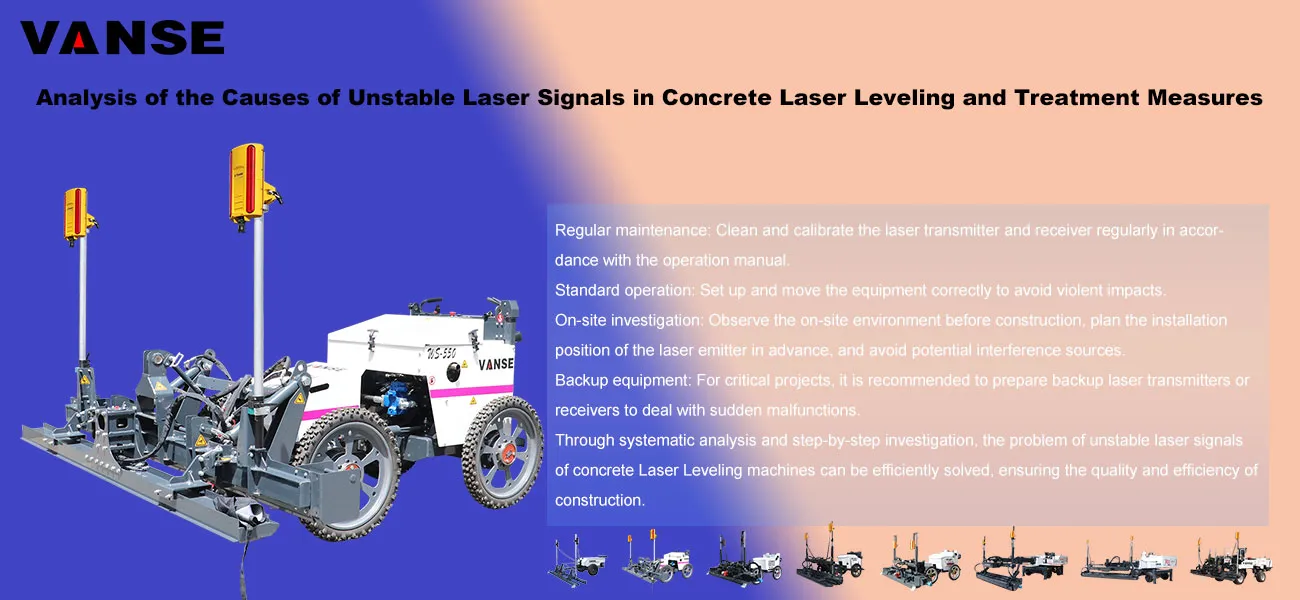
The following is a detailed answer to the analysis of the causes of unstable laser signals in Concrete Laser Leveling and the corresponding treatment measures.
Analysis of the Causes of Unstable Laser Signals in Concrete Laser Leveling and Treatment Measures
Unstable laser signals are one of the common faults in the construction of Concrete Laser Leveling, which will directly lead to a decrease in the leveling accuracy and affect the flatness and quality of the floor. It is of vital importance to quickly locate and solve problems.
I. Cause Analysis
The main causes of unstable laser signals come from four aspects: the laser emitter, the signal receiver, the external environment and the machinery itself.
1. Laser emitter system
Power supply issue: Insufficient battery power or poor contact of the power adapter leads to unstable power supply to the laser and fluctuations in output power.
Laser itself malfunction: Aging, damage of the laser module or loosening or contamination of internal optical components (such as lenses) can cause the beam to diverge or drift.
Unstable reference point: The tripod of the laser emitter is not stably set up and may slightly move or sink under the influence of wind or human touch.
Automatic calibration failure: The calibration system of the transmitter with self-leveling function (such as pendulum, magnetic damping or electronic sensor) malfunctions and cannot maintain a stable level reference.
2. Signal receiver system
Power connection issue: The connection cable between the receiver and the main body of the leveler is loose, poorly connected or damaged.
Sensor failure: The photoelectric sensor on the receiver is aged, its sensitivity has decreased, or it is covered with dirt (dust, cement slurry), making it impossible to accurately identify the laser signal.
Improper installation: The receiver is not correctly installed on the mast, or there is severe vibration at the installation position, which affects signal reception.
3. External environmental interference
Strong light interference: The intense sunlight at noon, especially its infrared spectrum, can interfere with the receiver's recognition of laser signals.
Obstruction: Temporary obstructions such as scaffolding, personnel, and equipment at the construction site block the laser beam, causing signal discontinuity.
Vibration interference: There are large equipment (such as excavators, heavy trucks) operating nearby, or the laser emitter is set up on a platform with obvious vibration, causing the reference optical path to jitter.
Atmospheric disturbance: At super-large construction sites, heat waves caused by high ground temperatures can lead to uneven air density, resulting in slight refraction and jitter of laser beams.
4. Problems with the body of the leveling machine
Mechanical vibration: If the engine of the Leveling machine operates unsmoothly or the hydraulic system vibrates excessively, the vibration will be transmitted to the receiver, introducing signal noise.
Electrical system interference: The generator, frequency converter or high-current circuit of the leveling machine itself generates electromagnetic interference, affecting the sensitive receiver circuit.
Ⅱ. Handling Measures
Follow the principle of "from simple to complex and from outside to inside" in the investigation.
Step 1: Quick inspection and basic processing
Check the power supply: Ensure that the laser emitter is fully charged and all power connections are firm and reliable.
Clean and inspect optical components: Use dedicated lens cleaning paper to clean the output lens of the laser emitter and the sensor window of the receiver.
Stable reference: Confirm that the laser emitter tripod is firmly set up on a solid floor and kept away from vibration sources. Use counterweights to stabilize the tripod when necessary.
Eliminate environmental interference
Shading: Install a sunshade on the receiver to prevent direct exposure to strong light.
Obstacle clearance: Inspect and clear all possible obstacles along the laser propagation path.
Vibration avoidance: Suspend operations that generate strong vibrations nearby or move the position of the laser emitter.
Step 2: System diagnosis and targeted maintenance
5. Restart the system: Turn off the power of the laser emitter and the leveler, wait for one minute, and then restart to reset the electronic system.
6. Calibration check
Manually rotate the transmitter to check if it can provide a stable signal throughout the entire 360-degree range.
Use professional tools to check whether the automatic leveling function of the laser emitter is normal. If necessary, send it for repair and calibration.
7. Substitution method test
Install the receiver on another confirmed normal level machine for testing. If the problem persists, it indicates that the receiver is faulty.
Replace it with a confirmed normal laser emitter. If the problem is solved, the original emitter needs to be repaired.
8. Inspect the cables and connections: Carefully check all the cables from the receiver to the main controller for any signs of compression, wear or breakage, and reinsert all the connectors.
9. Seek professional support: If none of the above steps can solve the problem, it is very likely that there is a hard fault with the electronic components inside the laser or the receiver. At this point, you should immediately contact the after-sales service department of the equipment manufacturer (such as Shandong Wansai Technology) for diagnosis and repair by professional technicians. Do not disassemble the core components by yourself.
Summary and preventive suggestions
Regular maintenance: Clean and calibrate the laser transmitter and receiver regularly in accordance with the operation manual.
Standard operation: Set up and move the equipment correctly to avoid violent impacts.
On-site investigation: Observe the on-site environment before construction, plan the installation position of the laser emitter in advance, and avoid potential interference sources.
Backup equipment: For critical projects, it is recommended to prepare backup laser transmitters or receivers to deal with sudden malfunctions.
Through systematic analysis and step-by-step investigation, the problem of unstable laser signals of concrete Laser Leveling machines can be efficiently solved, ensuring the quality and efficiency of construction.
Note: The parameters provided in this document are for reference only and are not mandatory. Due to differences in technical characteristics between different brands and models of laser levelers, please consult the manufacturer for a suitable solution before actual operation. This reference document assumes no responsibility for any issues arising from failure to follow the manufacturer's instructions.
Thanks to All the Friends Who Support and Trust Shandong Vanse Machinery Technology Co., Ltd.
If you want to know more about Shandong Vanse Machinery Technology Co., Ltd. or have any questions, please feel free to contact us:
Our Factory
Shandong Vanse Machinery Technology Co., Ltd.








Share this article

About the Author: Shandong Vanse Machinery Technology Co., Ltd.
Shandong Vanse Machinery Technology Co., Ltd. is a high-tech manufacturer specializing in concrete construction machinery, including laser screeds and related equipment. The company integrates R&D, production, and global sales, with products exported to over 60 countries and widely used in infrastructure projects worldwide.
Previous Post
Next Post
Related Articles
You Might Also Like
Does the automatic elevation adjustment function of the intelligent concrete laser leveling have a high error rate in actual construction?
The simple and straightforward answer is: The automatic elevation adjustment function of the intelligent concrete laser leveling has an extremely low error rate in actual construction, and its precision and efficiency are far beyond those of traditional manual methods. Below, I will explain in detail why its error rate is low and in what circumstances errors might occur. The high precision of the intelligent laser leveling mainly relies on the closed-loop control composed of its three major systems: Laser emitter: A fixed laser emitter is set up in the center of the construction area, which will form an absolutely horizontal laser reference plane covering the entire working surface. The precision of this laser plane is extremely high, typically reaching ±1.0mm/10m or even higher. Compared with the traditional approach: It has replaced the visual and human errors caused by relying on manual threading, rulers, etc. in the traditional way. Laser receiver: The mast on the leveling is equipped with a laser receiver to capture laser signals in real time. The controller: The receiver transmits the signal to the on-board computer (PLC), which calculates in real time the precise height difference between the current bottom of the scraper of the leveling and the laser reference surface. Compared with the traditional way: This "brain" replaces the experience and judgment of the master, eliminating human uncertainty. Hydraulic cylinder: According to the instructions of the "brain", the hydraulic system will instantly (with a response time measured in milliseconds) drive the lifting cylinders at both ends of the flattening head, keeping the scraper precisely at the height set by the laser reference. Compared with the traditional method: No matter how the foundation undulates (such as being soft or hard below), the leveling head can automatically adjust and maintain a constant elevation, while manual operation will be "deceived" by the unevenness of the foundation, resulting in an uneven ground in the end. This "eye-brain-hand" system works in coordination to form a real-time, closed-loop automatic control system, thus ensuring the ultimate accuracy of the elevation. Elevation accuracy: Under normal operation, the intelligent laser leveling can control the flatness of the floor within ±3mm/3m. For large-area integral floors, the overall elevation error can be easily controlled within ±5mm. Some high-end models can even perform better under ideal conditions. Construction efficiency: Its efficiency is 10 to 20 times that of manual labor, significantly shortening the construction period. Ground quality: As high-frequency vibration and leveling are carried out simultaneously, the density of the concrete is uniform, which can effectively avoid problems such as hollowing and peeling. Although the machine itself is of extremely high precision, the principle of "garbage in, garbage out" still applies. The errors in actual construction mainly stem from factors outside the machine rather than the failure of the machine's own automatic adjustment function. Source of error Explanation How to avoid 1. Incorrect benchmark setting The laser emitter itself was not leveled or was set up unstably and knocked over. This is the most fatal mistake, which can cause the entire working surface to tilt or go wrong. After erection, conduct a double inspection to ensure its stability and accuracy within the allowable range. 2. Improper handling at the grassroots level The flatness of the foundation (crushed stone cushion layer) is too poor, and the height fluctuation is too large. Although the leveling can adjust automatically, extreme drops may exceed its adjustment range or cause uneven concrete thickness. Strictly control the laying and compaction flatness of the base layer. 3. Concrete batching and paving Unstable slump of concrete (sometimes dry and sometimes thin), uneven particle size of aggregates, or excessive differences in initial flatness during paving will all bring difficulties to fine leveling. Ensure the stability of concrete quality. When spreading, it should be roughly uniform, and there should be no piles of materials that are too high or too low. 4. Operator skills The operator's lack of proficiency and improper planning of the walking path have led to leakage vibration or height differences at the junctions. Employ experienced operators and receive professional training. 5. Later Maintenance and load If people or equipment are placed on the concrete before it reaches sufficient strength, or if it is improperly maintained (such as losing water too quickly), causing uneven shrinkage and cracking, it will damage the already formed flatness. Strictly carry out post-maintenance and prohibit loading until the strength is reached. The automatic elevation adjustment function of the intelligent concrete laser leveling is itself very reliable with an extremely low error rate. It is a mature technology, and its features of high precision and high efficiency have been fully verified in large-scale floor construction in factories, warehouses, shopping malls, etc. both at home and abroad. The final construction accuracy does indeed depend on the combination of "advanced equipment + standardized procedures + qualified personnel". The laser leveling machine has solved the problems of "equipment" and most of the "process", automating and digitizing the most crucial and labor-dependent link of elevation control, thereby minimizing human errors and fundamentally ensuring the ultra-high flatness of floor construction. Therefore, as long as the preparatory work in the early stage and the maintenance in the later stage are in place, the error rate of construction using it can be completely controlled at an extremely low level. Note: The parameters provided in this document are for reference only and are not mandatory. Due to differences in technical characteristics between different brands and models of laser levelers, please consult the manufacturer for a suitable solution before actual operation. This reference document assumes no responsibility for any issues arising from failure to follow the manufacturer's instructions.How to deal with the possible faults and problems during the leveling process of concrete laser leveling machine?
The concrete laser leveling machine may encounter various faults and problems during the leveling process, but through reasonable prevention and response measures, these problems can be effectively dealt with to ensure the smooth progress of the construction. The following are some common faults and problems and their corresponding solutions: Trouble and problem 1: Equipment operation problems *Problem description: The operator may not be familiar with the operation of the equipment or may not be proficient in the operation, causing the equipment to fail to operate normally or produce errors. *Coping method: Conduct systematic training for operators to ensure that they are familiar with the various functions and operating procedures of the equipment. Conduct regular operational assessments to ensure operators' skills are up to standard Fault and problem 2: Sensor failure *Problem description: The sensor is a key part of the laser leveling machine. If the sensor fails, it will affect the leveling accuracy. *Countermeasures: Regularly check the operating status of the sensor, and repair or replace it in time if there is any abnormality. Use high-quality sensors and pay attention to sensor maintenance. Failure and Problem 3: Equipment Mechanical Failure *Problem description: Mechanical parts may be worn, loose or broken. *Countermeasures: Regularly inspect and maintain mechanical parts maintenance to ensure its normal operation. If there is any problem, repair or replace it in time. Trouble and problem 4: Concrete material problem *Problem description: If the ratio of concrete materials, slump and other parameters do not meet the requirements, the smoothing effect will be affected. *Countermeasures: Strictly control the proportion and quality of concrete materials to ensure that they meet construction requirements. Test the various properties of the concrete, and promptly adjust the faults and problems if there are any problems 5: Impact of environmental factors *Problem description: Environmental factors at the construction site, such as temperature, humidity, dust, etc., may affect the normal operation and smoothing effect of the equipment. *Countermeasures: Try to choose an appropriate construction time and avoid construction under extreme temperature and humidity conditions. Keep the construction site clean and tidy to reduce the impact of dust. When dealing with possible faults and problems that may occur during the leveling process of the laser leveling machine, multiple factors such as personnel, equipment, materials, and the environment need to be comprehensively considered. Developing an effective set of preventive and response measures can greatly reduce the occurrence of failures and problems and improve construction efficiency and quality.What is the future development of concrete laser leveling machines?
Concrete laser leveling machine is an advanced construction technology that uses laser beams to scan and measure the ground and automatically control the lifting and lowering of the mixer truck to achieve automatic leveling and leveling of concrete. This technology has the advantages of high efficiency, high quality, and low cost, and is widely used in the construction of concrete structures such as buildings, bridges, and tunnels. In the future, concrete laser leveling machines will develop in a more efficient, intelligent, and multifunctional direction. First, concrete laser levelings will be more efficient. With the acceleration of urbanization, construction period requirements for construction are becoming more and more stringent. The concrete laser leveling machine can realize automated construction, greatly improving construction efficiency and shortening the construction period. In the future, there will be more efficient and intelligent concrete laser leveling machines that can achieve fast and precise construction and further improve construction efficiency. Secondly, concrete laser levelings will be more intelligent. With the development of artificial intelligence, Internet of Things and other technologies, concrete laser leveling machines will have more intelligent functions. For example, by combining with BIM technology, real-time monitoring and data management of the construction process can be achieved to improve construction quality and efficiency; by combining with drones, robots and other technologies, more intelligent and automatic construction can be achieved, reducing manual intervention and reducing construction costs. . Third, concrete laser levelings will have more functions. At present, concrete laser leveling machines are mainly used for leveling and leveling concrete, and will have more functions in the future. For example, it can realize automatic distribution, lightening, compaction and other operations of concrete to realize one-stop concrete construction; it can realize quality inspection such as strength detection and crack detection of concrete, providing a more comprehensive guarantee for construction quality. Finally, the application range of concrete laser levelings will be wider. At present, concrete laser leveling machines are mainly used in the construction of concrete structures such as buildings, bridges, and tunnels, and will be expanded to more fields in the future. For example, in road construction, operations such as automatic leveling and compaction of road surfaces can be realized; in the agricultural field, operations such as leveling and compaction of farmland can be realized to improve agricultural production efficiency and quality. In short, in the future, concrete laser leveling machines will develop in a more efficient, intelligent, and multi-functional direction, providing more high-quality, efficient, and intelligent solutions for building construction. With the continuous advancement of technology and the expansion of application scope, concrete laser leveling machines will play an important role in more fields.